THE ADVENTURE COLLECTIVE® · Independent discovery and booking for outdoor travel

Walk downtown Mesa’s sculpture-lined streets, visit the reflecting pools of the Mesa Temple, explore free galleries at the Mesa Arts Center, and sample fry bread, empanadas and award-winning local ice cream on a 3-hour accessible tasting tour.
Walk downtown Mesa’s sculpture-lined streets, visit the reflecting pools of the Mesa Temple, explore free galleries at the Mesa Arts Center, and sample fry bread, empanadas and award-winning local ice cream on a 3-hour accessible tasting tour.
On a bright morning on Main Street in downtown Mesa, the sculptures and low-slung storefronts set a measured pace: metal forms catching light, hummingbirds darting around the urban garden, and the scent of frying dough drifting from a corner stand.
Verified experiences and guided adventures in the surrounding area.
Operated by Arizona "ING" Tours · Mesa, Arizona
On a bright morning on Main Street in downtown Mesa, the sculptures and low-slung storefronts set a measured pace: metal forms catching light, hummingbirds darting around the urban garden, and the scent of frying dough drifting from a corner stand.
The walk threads together the city's public art, religious architecture and civic galleries. You’ll see a reproduction of Bertel Thorvaldsen’s 1833 Christus, step around reflecting pools at the Mesa Temple (dedicated in 1927), and pass the modern geometry of the Mesa Arts Center—its plazas designed to showcase rotating public sculpture and free galleries. The route also pauses at the community-run Mesa Urban Garden, where seasonal vegetables and pollinators demonstrate Arizona’s small-scale agricultural traditions.
Geologically the Salt River Valley is a flat basin edged by low desert and distant ranges; here the cityscape gives way to Sonoran Desert plants that tolerate sun and scarcity. Culturally the tour touches on Native and Hispanic influences visible in food—fry bread, empanadas—and in public art that references local histories.
Practical guidance: the loop is about three hours, mostly flat and on paved sidewalks with curb cuts; the operator lists it as wheelchair-accessible. Morning departures beat afternoon heat—carry water and sunscreen even when clouds appear. Expect multiple food stops with small tastings; bring a small bill for extra bites or tips. Comfortable walking shoes, a light sun layer, and a camera round out what you need to enjoy an easy, sensory city stroll that balances art, gardens and local flavor.
easy.
3 hours.
Suitable for most fitness levels; requires standing and walking for up to three hours with short pauses.
Yes—paths, gardens and main stops are reported as wheelchair accessible; contact the operator ahead if you require specific accommodations.
The itinerary includes four to five small cultural bites and sweet treats; additional purchases are available at vendor discretion.
Yes—stroller access is noted and the route includes family-friendly stops like the visible dinosaur at the Natural History Museum.
Tours may be canceled for bad weather; in hot conditions choose morning slots and follow guide recommendations for water and shade.
Mesa grew as an agricultural center in the Salt River Valley; the Mesa Temple (1927) and public art reflect layers of settlement and civic investment.
The urban garden models water-wise planting and community stewardship; visitors are asked to stay on paths and avoid disturbing pollinator beds.
Arizona "ING" Tours operates guided outdoor trips and adventures with an emphasis on safety, stewardship, and memorable experiences.
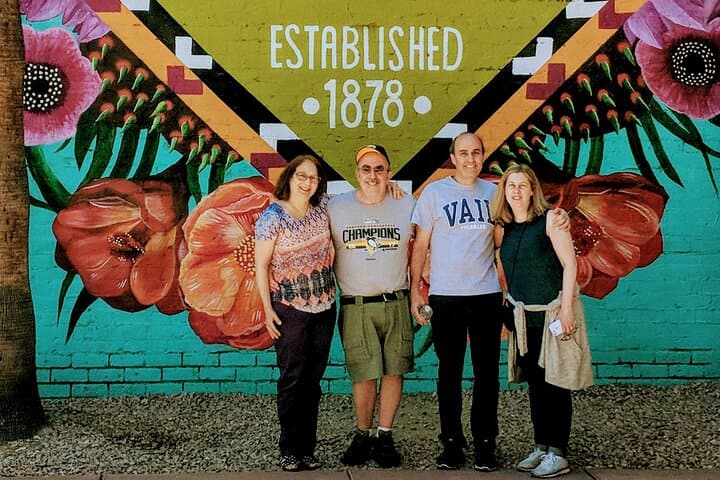
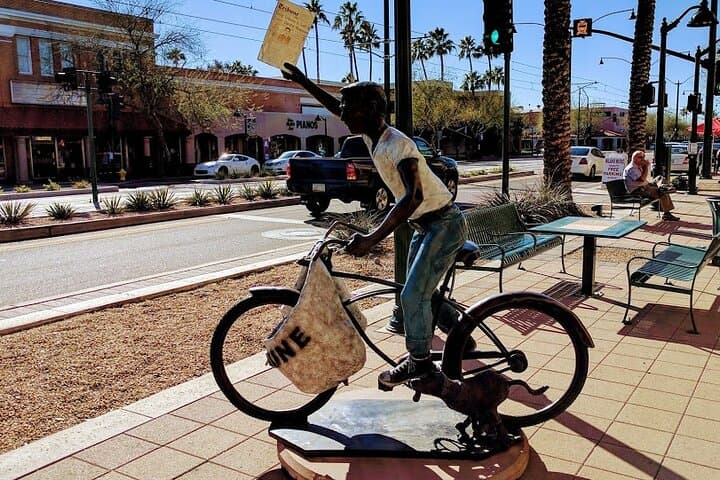
On a bright morning on Main Street in downtown Mesa, the sculptures and low-slung storefronts set a measured pace: metal forms catching light, hummingbirds darting around the urban garden, and the scent of frying dough drifting from a corner stand.
On a bright morning on Main Street in downtown Mesa, the sculptures and low-slung storefronts set a measured pace: metal forms catching light, hummingbirds darting around the urban garden, and the scent of frying dough drifting from a corner stand.
The walk threads together the city's public art, religious architecture and civic galleries. You’ll see a reproduction of Bertel Thorvaldsen’s 1833 Christus, step around reflecting pools at the Mesa Temple (dedicated in 1927), and pass the modern geometry of the Mesa Arts Center—its plazas designed to showcase rotating public sculpture and free galleries. The route also pauses at the community-run Mesa Urban Garden, where seasonal vegetables and pollinators demonstrate Arizona’s small-scale agricultural traditions.
Geologically the Salt River Valley is a flat basin edged by low desert and distant ranges; here the cityscape gives way to Sonoran Desert plants that tolerate sun and scarcity. Culturally the tour touches on Native and Hispanic influences visible in food—fry bread, empanadas—and in public art that references local histories.
Practical guidance: the loop is about three hours, mostly flat and on paved sidewalks with curb cuts; the operator lists it as wheelchair-accessible. Morning departures beat afternoon heat—carry water and sunscreen even when clouds appear. Expect multiple food stops with small tastings; bring a small bill for extra bites or tips. Comfortable walking shoes, a light sun layer, and a camera round out what you need to enjoy an easy, sensory city stroll that balances art, gardens and local flavor.