THE ADVENTURE COLLECTIVE® · Independent discovery and booking for outdoor travel

Walk Trento’s living history on your own schedule with an audio guide that links Roman remains, the Cathedral of San Vigilio, and Buonconsiglio Castle. This self-guided tour packs centuries of European history into one walkable Alpine city center.
Walk Trento’s living history on your own schedule with an audio guide that links Roman remains, the Cathedral of San Vigilio, and Buonconsiglio Castle. This self-guided tour packs centuries of European history into one walkable Alpine city center.
You step off the bus and the air tastes faintly of espresso and alpine freshness; the Adige moves through Trento with steady purpose, cutting a cool line between pastel palaces and stone towers. Cobblestones click underfoot as a recorded voice begins to place the city’s layers—Roman foundations beneath Gothic arches, medieval ramparts watching over Renaissance squares.
Verified experiences and guided adventures in the surrounding area.
Operated by VoiceMap Audio Tours · Trento, Trentino-Alto Adige
You step off the bus and the air tastes faintly of espresso and alpine freshness; the Adige moves through Trento with steady purpose, cutting a cool line between pastel palaces and stone towers. Cobblestones click underfoot as a recorded voice begins to place the city’s layers—Roman foundations beneath Gothic arches, medieval ramparts watching over Renaissance squares.
Trento’s story is compact and visible: Roman remains at street level, the Cathedral of San Vigilio where the Council of Trent reshaped Catholic Europe, and Buonconsiglio Castle rising above with its fortified walls and ornate frescoed rooms. The surrounding Dolomitic foothills are limestone—sharp ridges and terraces that directed trade routes and military lines for centuries—so the city grew where the valley flattened and the river could be forded.
Culturally, Trento still lives between Italian and Alpine rhythms; local markets offer speck, cheeses, and polenta while shop windows display practical outdoor gear next to tailored fashion. The audio tour frames those contrasts, pointing out quiet gardens, bell towers, and the best café stops for a cucina trentina bite.
Practical guidance: allow 45–75 minutes depending on stops, wear sturdy shoes for uneven cobbles, and download the app for offline maps. Start mid-morning for good light on frescoes and fewer crowds in the cathedral square. Bring a small water bottle, a charged phone and comfortable layers—the weather can shift rapidly in alpine valleys. With this basic preparation the self-guided route reads like a lived map of empire, art, and alpine trade—compact, walkable, and rich with texture.
easy.
45–75 minutes.
Suitable for most fitness levels; requires standing and walking up to an hour on uneven pavement.
No—this is a self-guided audio tour with lifetime access; start whenever suits your schedule within site opening hours.
Many central streets are flat and stroller-accessible, but there are some cobbled areas and steps; check the route ahead for exact accessibility details.
The version described provides English audio; check the app for additional language options before download.
No—this tour provides audio context and geodata; separate entrance fees apply for museums and castle interiors.
Trento rose as a prince-bishopric and hosted the 16th-century Council of Trent, a pivotal event in Catholic history; the city’s architecture reflects layers of Roman, medieval, and Renaissance rule.
Historic preservation is active here—stay on marked paths, avoid touching frescoes, and support small local businesses to keep tourism sustainable.
VoiceMap Audio Tours operates guided outdoor trips and adventures with an emphasis on safety, stewardship, and memorable experiences.
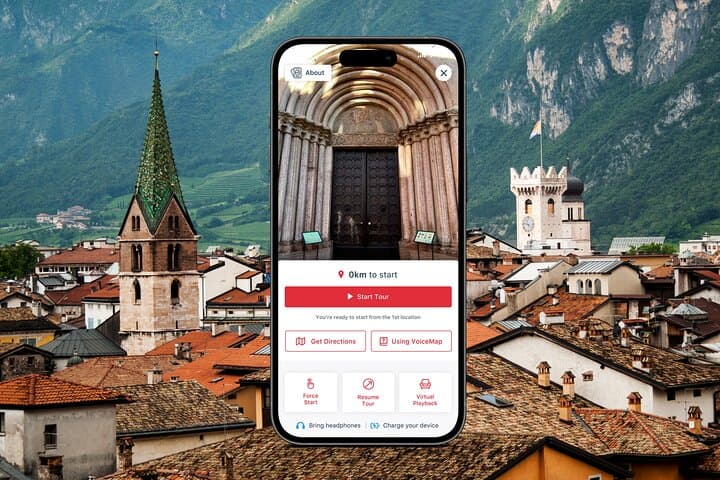


You step off the bus and the air tastes faintly of espresso and alpine freshness; the Adige moves through Trento with steady purpose, cutting a cool line between pastel palaces and stone towers. Cobblestones click underfoot as a recorded voice begins to place the city’s layers—Roman foundations beneath Gothic arches, medieval ramparts watching over Renaissance squares.
You step off the bus and the air tastes faintly of espresso and alpine freshness; the Adige moves through Trento with steady purpose, cutting a cool line between pastel palaces and stone towers. Cobblestones click underfoot as a recorded voice begins to place the city’s layers—Roman foundations beneath Gothic arches, medieval ramparts watching over Renaissance squares.
Trento’s story is compact and visible: Roman remains at street level, the Cathedral of San Vigilio where the Council of Trent reshaped Catholic Europe, and Buonconsiglio Castle rising above with its fortified walls and ornate frescoed rooms. The surrounding Dolomitic foothills are limestone—sharp ridges and terraces that directed trade routes and military lines for centuries—so the city grew where the valley flattened and the river could be forded.
Culturally, Trento still lives between Italian and Alpine rhythms; local markets offer speck, cheeses, and polenta while shop windows display practical outdoor gear next to tailored fashion. The audio tour frames those contrasts, pointing out quiet gardens, bell towers, and the best café stops for a cucina trentina bite.
Practical guidance: allow 45–75 minutes depending on stops, wear sturdy shoes for uneven cobbles, and download the app for offline maps. Start mid-morning for good light on frescoes and fewer crowds in the cathedral square. Bring a small water bottle, a charged phone and comfortable layers—the weather can shift rapidly in alpine valleys. With this basic preparation the self-guided route reads like a lived map of empire, art, and alpine trade—compact, walkable, and rich with texture.