THE ADVENTURE COLLECTIVE® · Independent discovery and booking for outdoor travel

Explore Nswatugi Cave and White Rhino Shelter on a focused half-day tour of Matobo Hills. Small-group guiding, ancient San paintings, and dramatic granite viewpoints combine geology and culture into an accessible outdoor experience.
Explore Nswatugi Cave and White Rhino Shelter on a focused half-day tour of Matobo Hills. Small-group guiding, ancient San paintings, and dramatic granite viewpoints combine geology and culture into an accessible outdoor experience.
You step off the vehicle onto warm granite; the sun lays bright fingers across rounded kopjes while wind threads through narrow rock corridors that smell faintly of dust and bush.
Verified experiences and guided adventures in the surrounding area.
Operated by Matobo Hills Lodge Tours · Bulawayo, Matabeleland South
You step off the vehicle onto warm granite; the sun lays bright fingers across rounded kopjes while wind threads through narrow rock corridors that smell faintly of dust and bush.
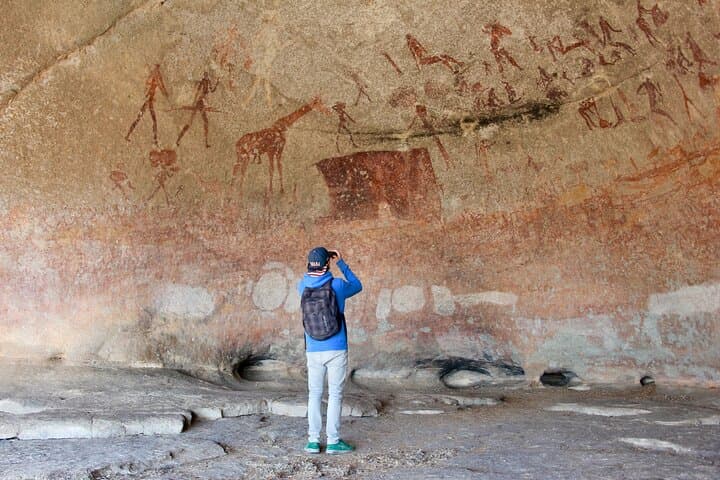
This half-day tour moves deliberately — Nswatugi Cave first, then White Rhino Shelter — where ochre and charcoal figures stare out from sheltered overhangs. The paintings belong to the San people and span millennia, showing hunting scenes, animals and ritual figures that anchor human life to this stony terrain.
Geologically, Matobo’s rounded domes and balancing rocks are born of ancient granite that cracked and weathered into domelike kopjes; those bulging forms now channel light and shadow across the rock art panels. Culturally, guides relay both San cosmology and more recent Ndebele associations, framing images as living stories rather than museum pieces.
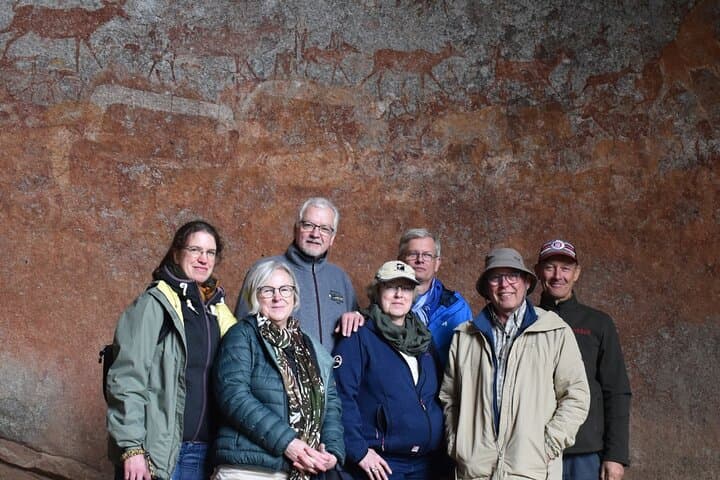
Expect slow, purposeful walking over uneven rock, short low-ceiling passages, and photo stops at a private granite viewpoint where snacks and beverages are served. The group size is small (about eight), which keeps the experience intimate and reduces footprint on fragile sites.
Practical tips: wear sturdy shoes with grip, bring a sun hat, and carry at least one liter of water — bottled water is provided but the day can be hot. Respect the panels: no touching, no flash on delicate pigments, and follow your guide’s route. The tour includes a conservation contribution; stick to paths to protect lichens and microhabitats.
If you want depth with minimal exertion, this expedition pairs cultural richness with dramatic geological scenery — an accessible half-day that rewards attention and patience.
moderate.
4–5 hours.
Moderate fitness; comfortable with short uphill sections, uneven ground and low cave passages.
The itinerary runs about 4–5 hours, including guided visits to Nswatugi Cave and White Rhino Shelter, viewpoint stops, and transportation.
Yes — the paintings are fragile; guides enforce no-touch policies, limited group sizes and designated viewing distances to minimize impact.
Families can join, but infants must sit on laps and the route includes uneven terrain and low overhangs that require supervision.
Basic facilities may be available at the visitor area or vehicle stops, but expect limited options on the rocks; plan accordingly before walks.
Matobo Hills carry layers of human occupation; San rock art here dates back thousands of years and reflects hunting, ritual and cosmological scenes important to southern Africa’s earliest peoples.
Visiting with small groups and contributing to conservation fees helps protect pigments and fragile microhabitats; stay on paths and follow guide instructions to limit erosion.
Matobo Hills Lodge Tours operates guided outdoor trips and adventures with an emphasis on safety, stewardship, and memorable experiences.

You step off the vehicle onto warm granite; the sun lays bright fingers across rounded kopjes while wind threads through narrow rock corridors that smell faintly of dust and bush.
You step off the vehicle onto warm granite; the sun lays bright fingers across rounded kopjes while wind threads through narrow rock corridors that smell faintly of dust and bush.
This half-day tour moves deliberately — Nswatugi Cave first, then White Rhino Shelter — where ochre and charcoal figures stare out from sheltered overhangs. The paintings belong to the San people and span millennia, showing hunting scenes, animals and ritual figures that anchor human life to this stony terrain.
Geologically, Matobo’s rounded domes and balancing rocks are born of ancient granite that cracked and weathered into domelike kopjes; those bulging forms now channel light and shadow across the rock art panels. Culturally, guides relay both San cosmology and more recent Ndebele associations, framing images as living stories rather than museum pieces.
Expect slow, purposeful walking over uneven rock, short low-ceiling passages, and photo stops at a private granite viewpoint where snacks and beverages are served. The group size is small (about eight), which keeps the experience intimate and reduces footprint on fragile sites.
Practical tips: wear sturdy shoes with grip, bring a sun hat, and carry at least one liter of water — bottled water is provided but the day can be hot. Respect the panels: no touching, no flash on delicate pigments, and follow your guide’s route. The tour includes a conservation contribution; stick to paths to protect lichens and microhabitats.
If you want depth with minimal exertion, this expedition pairs cultural richness with dramatic geological scenery — an accessible half-day that rewards attention and patience.