THE ADVENTURE COLLECTIVE® · Independent discovery and booking for outdoor travel

A compact two-day loop from Marrakech to Zagora that pairs High Atlas passes and Ait Ben Haddou’s ksar with a short camel trek and an overnight in a Berber desert camp. Expect long drives, clean desert light and a star-filled night.
A compact two-day loop from Marrakech to Zagora that pairs High Atlas passes and Ait Ben Haddou’s ksar with a short camel trek and an overnight in a Berber desert camp. Expect long drives, clean desert light and a star-filled night.
Dust on the road, the High Atlas rising like a folded map, and the driver pointing toward a pass: the first day of this two-day loop moves fast from Marrakech into a landscape that changes from cedar-streaked slopes to ochre plains.
Verified experiences and guided adventures in the surrounding area.
Operated by Morocco Tours · Zagora, Drâa-Tafilalet
Dust on the road, the High Atlas rising like a folded map, and the driver pointing toward a pass: the first day of this two-day loop moves fast from Marrakech into a landscape that changes from cedar-streaked slopes to ochre plains.
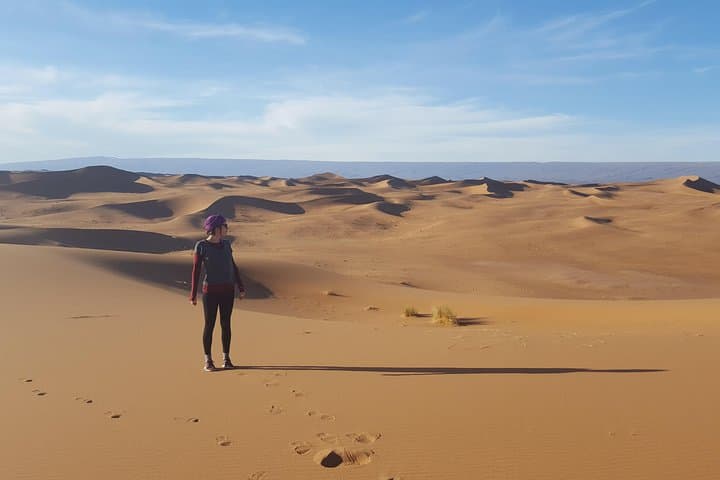
You’ll cross the High Atlas at roughly 2,260 m, stop at an argan cooperative to see oil pressed by hand, then walk the narrow streets of Ait Ben Haddou — a UNESCO ksar whose rammed-earth walls trace old caravan routes and modern film sets. The route through Anti-Atlas foothills softens into the Draa Valley’s palm-lined riverbeds before the small dunes near Zagora appear: camel saddles creak, the sand accepts each footstep, and the sun pulls the horizon into a clean, long shadow.
Cultural notes: local Berber guides host a simple desert camp with shared tents, tagine dinners and live music; mint tea is both welcome and ritual. Geology here is straightforward—folded Paleozoic ranges giving way to wind-sculpted dunes and gravel plains—so expect compact sand rather than the massive Erg Chebbi dunes farther east.
Practical guidance: pack sun protection, bring at least 2–3 liters of water for daytime stretches, and use closed-toe shoes for the camel approach and rocky viewpoints. Nights in the camp are cool; layer accordingly. Cameras will thank you for an early start—sunrise over low dunes is decisive. Respect private oases, carry cash for small purchases and tipping, and confirm pickup times in Marrakech to keep the schedule tight.
moderate.
2 days.
Suitable for travelers with basic fitness—able to handle several hours of riding and short walks; long vehicle transfers require endurance.
Most departures begin and end in Marrakech with hotel pickup; confirm your pickup point when booking.
The camel ride is short to moderate—no technical skill required; camp tents are basic but staffed, suitable for travelers of most fitness levels.
Dinner and breakfast at the camp are included; bring additional drinking water for daytime stretches between towns.
Autumn and spring offer the most temperate conditions; summer can be very hot during daytime, while winter nights can be chilly.
Ait Ben Haddou is an historic ksar on former trans-Saharan caravan routes and became a UNESCO site in 1987; the Draa Valley has supported settlements with date palms for centuries.
Water is scarce—minimize consumption and support local cooperatives to ensure tourism benefits communities; avoid trampling dunes and leave no trace at campsites.
Morocco Tours operates guided outdoor trips and adventures with an emphasis on safety, stewardship, and memorable experiences.


Dust on the road, the High Atlas rising like a folded map, and the driver pointing toward a pass: the first day of this two-day loop moves fast from Marrakech into a landscape that changes from cedar-streaked slopes to ochre plains.
Dust on the road, the High Atlas rising like a folded map, and the driver pointing toward a pass: the first day of this two-day loop moves fast from Marrakech into a landscape that changes from cedar-streaked slopes to ochre plains.
You’ll cross the High Atlas at roughly 2,260 m, stop at an argan cooperative to see oil pressed by hand, then walk the narrow streets of Ait Ben Haddou — a UNESCO ksar whose rammed-earth walls trace old caravan routes and modern film sets. The route through Anti-Atlas foothills softens into the Draa Valley’s palm-lined riverbeds before the small dunes near Zagora appear: camel saddles creak, the sand accepts each footstep, and the sun pulls the horizon into a clean, long shadow.
Cultural notes: local Berber guides host a simple desert camp with shared tents, tagine dinners and live music; mint tea is both welcome and ritual. Geology here is straightforward—folded Paleozoic ranges giving way to wind-sculpted dunes and gravel plains—so expect compact sand rather than the massive Erg Chebbi dunes farther east.
Practical guidance: pack sun protection, bring at least 2–3 liters of water for daytime stretches, and use closed-toe shoes for the camel approach and rocky viewpoints. Nights in the camp are cool; layer accordingly. Cameras will thank you for an early start—sunrise over low dunes is decisive. Respect private oases, carry cash for small purchases and tipping, and confirm pickup times in Marrakech to keep the schedule tight.