THE ADVENTURE COLLECTIVE® · Independent discovery and booking for outdoor travel

Seven days that begin in the frenetic alleys of Marrakech and end beneath the star-sliced sky of Erg Chebbi. Expect mountain passes, kasbahs, river gorges and two nights in a desert bivouac—packed with culture and long, cinematic drives.
Seven days that begin in the frenetic alleys of Marrakech and end beneath the star-sliced sky of Erg Chebbi. Expect mountain passes, kasbahs, river gorges and two nights in a desert bivouac—packed with culture and long, cinematic drives.
The city exhales heat and color as you step from the riad courtyard into Jemaa el-Fna—spice smoke, citrus sellers, and the clack of cart wheels. For a week this pulse is your starting point: narrow medina alleys, rooftop cafés watching the sunset over minarets, and then a long ribbon of asphalt that climbs the High Atlas and drops you into sand that keeps time by wind.
Verified experiences and guided adventures in the surrounding area.
Operated by Abdelkrim Aiteddaiz · Marrakech, Marrakech-Safi
The city exhales heat and color as you step from the riad courtyard into Jemaa el-Fna—spice smoke, citrus sellers, and the clack of cart wheels. For a week this pulse is your starting point: narrow medina alleys, rooftop cafés watching the sunset over minarets, and then a long ribbon of asphalt that climbs the High Atlas and drops you into sand that keeps time by wind.
This seven-day loop pairs Marrakech’s layered history with the large, quiet geometry of Erg Chebbi. The itinerary threads through Tizi n’Tichka — the High Atlas pass sitting around 2,260 meters — where cedar forests and Berber villages suddenly give way to ochre kasbahs. Ait Ben Haddou, a UNESCO mud-brick ksar, holds its cinematic face against the light; scenes from Gladiator and Lawrence of Arabia still echo along its battered alleys. Eastward, the Dades and Todra valleys cut deep, folded canyons and river palm oases that supported caravan routes for centuries.
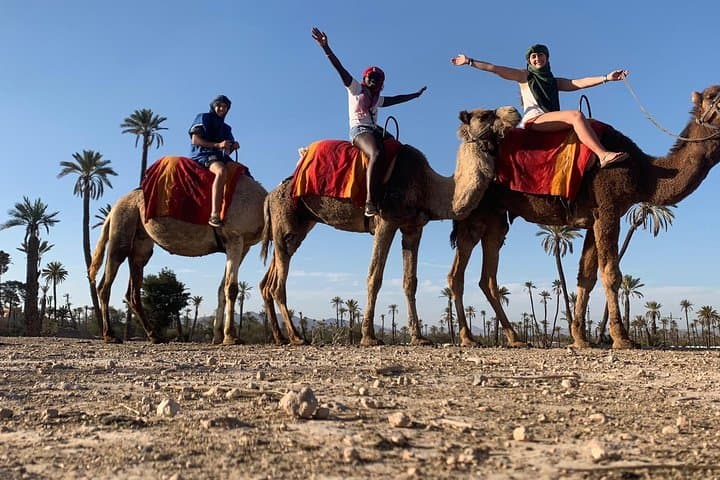
Merzouga’s dunes are the trip’s slow center: Erg Chebbi stretches for kilometers, some dunes cresting 150 meters high. Camel caravans move in the evening like ink strokes across a parchment sky; sunrise climbs the dunes with quick, clean light that sharpens every ripple. Nights here are spare and star-bright—local nomads play drums and sing, and the cold desert air makes the campfire necessary and exact.
Culturally, the trip is a primer in Morocco’s contrasts: French-influenced Guéliz and botanical pockets like Majorelle sit a short taxi ride from the centuries-old Medina; saffron and rosewater artisans work in the Dades and Kalaat M'Gouna; Merzouga’s communities keep camel husbandry and date-market traditions alive. Geologically you move from folded Atlas ranges to alluvial plains and finally to wind-built dune fields, a quick course in how climate and rock shape human routes.
Practical edge: bring layers, sun protection, and a daypack for short hikes. Expect long driving days — Marrakech to Merzouga is roughly 560 km when routed through the pass and stops — but travel is broken into comfortable stages with hotels, riads, and two nights under canvas. Road surfaces vary; an air-conditioned minivan is standard. Hydration and sunscreen aren’t optional in the low desert; sandals won’t cut it on the dunes—sturdy shoes and gaiters help. Carry local dirhams for market purchases and small tips; practice a few Arabic or Tamazight phrases and accept mint tea as an essential social currency.
This trip suits travelers who want a mix of urban wandering, cultural immersion, and simple backcountry nights. It’s dense but well-paced: city evenings, a three-day desert circuit, and a choice of excursions—to Ourika Valley waterfalls, Essaouira’s Atlantic calm, or the Ouzoud waterfalls—make this a compact cross-section of southern Morocco.
moderate.
7 days.
Moderate fitness for long drive days and easy-to-moderate walks—able to manage dune walks and short canyon hikes.
Roughly 560 km when following the Tizi n’Tichka route with stops; expect 8–10 hours of driving broken into stages over the three-day desert circuit.
Camps are traditional bivouacs with mattress-equipped tents, communal dining and shared ablution facilities; some operators add showers at the lodge before/after camping.
Yes, but summers are very hot in the desert; spring and fall offer the most comfortable temperatures while winter nights can be very cold.
The operator notes the trip is easy physically; children tolerate the drives and camel rides, but plan for sun, dust and long seat time.
Recommended—cover for medical evacuation and trip cancellation is wise given remote stretches and long driving days.
Guides commonly speak French, English and Arabic; Tamazight-speaking local guides are available in mountain and valley areas.
Ait Ben Haddou is a fortified ksar on caravan routes and is UNESCO-listed; the region reflects centuries of trans-Saharan trade and Berber settlement.
Water scarcity and off-road vehicle traffic stress desert ecosystems—stick to marked tracks, minimize single-use plastics, and support local guides and small businesses.
Abdelkrim Aiteddaiz operates guided outdoor trips and adventures with an emphasis on safety, stewardship, and memorable experiences.
The city exhales heat and color as you step from the riad courtyard into Jemaa el-Fna—spice smoke, citrus sellers, and the clack of cart wheels. For a week this pulse is your starting point: narrow medina alleys, rooftop cafés watching the sunset over minarets, and then a long ribbon of asphalt that climbs the High Atlas and drops you into sand that keeps time by wind.
The city exhales heat and color as you step from the riad courtyard into Jemaa el-Fna—spice smoke, citrus sellers, and the clack of cart wheels. For a week this pulse is your starting point: narrow medina alleys, rooftop cafés watching the sunset over minarets, and then a long ribbon of asphalt that climbs the High Atlas and drops you into sand that keeps time by wind.
This seven-day loop pairs Marrakech’s layered history with the large, quiet geometry of Erg Chebbi. The itinerary threads through Tizi n’Tichka — the High Atlas pass sitting around 2,260 meters — where cedar forests and Berber villages suddenly give way to ochre kasbahs. Ait Ben Haddou, a UNESCO mud-brick ksar, holds its cinematic face against the light; scenes from Gladiator and Lawrence of Arabia still echo along its battered alleys. Eastward, the Dades and Todra valleys cut deep, folded canyons and river palm oases that supported caravan routes for centuries.
Merzouga’s dunes are the trip’s slow center: Erg Chebbi stretches for kilometers, some dunes cresting 150 meters high. Camel caravans move in the evening like ink strokes across a parchment sky; sunrise climbs the dunes with quick, clean light that sharpens every ripple. Nights here are spare and star-bright—local nomads play drums and sing, and the cold desert air makes the campfire necessary and exact.
Culturally, the trip is a primer in Morocco’s contrasts: French-influenced Guéliz and botanical pockets like Majorelle sit a short taxi ride from the centuries-old Medina; saffron and rosewater artisans work in the Dades and Kalaat M'Gouna; Merzouga’s communities keep camel husbandry and date-market traditions alive. Geologically you move from folded Atlas ranges to alluvial plains and finally to wind-built dune fields, a quick course in how climate and rock shape human routes.
Practical edge: bring layers, sun protection, and a daypack for short hikes. Expect long driving days — Marrakech to Merzouga is roughly 560 km when routed through the pass and stops — but travel is broken into comfortable stages with hotels, riads, and two nights under canvas. Road surfaces vary; an air-conditioned minivan is standard. Hydration and sunscreen aren’t optional in the low desert; sandals won’t cut it on the dunes—sturdy shoes and gaiters help. Carry local dirhams for market purchases and small tips; practice a few Arabic or Tamazight phrases and accept mint tea as an essential social currency.
This trip suits travelers who want a mix of urban wandering, cultural immersion, and simple backcountry nights. It’s dense but well-paced: city evenings, a three-day desert circuit, and a choice of excursions—to Ourika Valley waterfalls, Essaouira’s Atlantic calm, or the Ouzoud waterfalls—make this a compact cross-section of southern Morocco.