THE ADVENTURE COLLECTIVE® · Independent discovery and booking for outdoor travel

Cross the High Atlas, explore kasbahs and canyon walls, then ride camels into Erg Chebbi for a night under the stars. This compact 3-day loop balances long drives with unforgettable desert moments.
Cross the High Atlas, explore kasbahs and canyon walls, then ride camels into Erg Chebbi for a night under the stars. This compact 3-day loop balances long drives with unforgettable desert moments.
You climb into the minivan before dawn as Marrakech stirs — the city’s ochre walls recede and the road threads upward through the High Atlas. By late morning the air thins at the Tizi n’Tichka pass (≈2,260 m), and villages of sun-baked clay slip by like still life paintings. The landscape shifts from terraced farming to rocky gorges and finally to the soft, wind-sculpted curves of Erg Chebbi.
Verified experiences and guided adventures in the surrounding area.
Operated by Morocco Sahara Trip · Merzouga, Drâa-Tafilalet
You climb into the minivan before dawn as Marrakech stirs — the city’s ochre walls recede and the road threads upward through the High Atlas. By late morning the air thins at the Tizi n’Tichka pass (≈2,260 m), and villages of sun-baked clay slip by like still life paintings. The landscape shifts from terraced farming to rocky gorges and finally to the soft, wind-sculpted curves of Erg Chebbi.
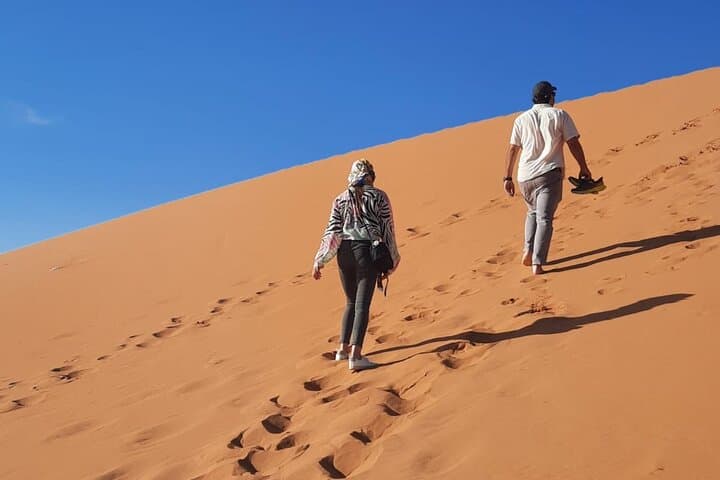
This route follows old caravan corridors. Ait Ben Haddou’s earthen towers recall the kasbahs that once sheltered traders; Todra and Dades Gorges expose layered sandstone carved by seasonal rivers. The dunes of Merzouga are relatively young geologically — mobile sand forming ridges up to 130–150 m — and they still move with every wind, daring you to climb them at sunrise.
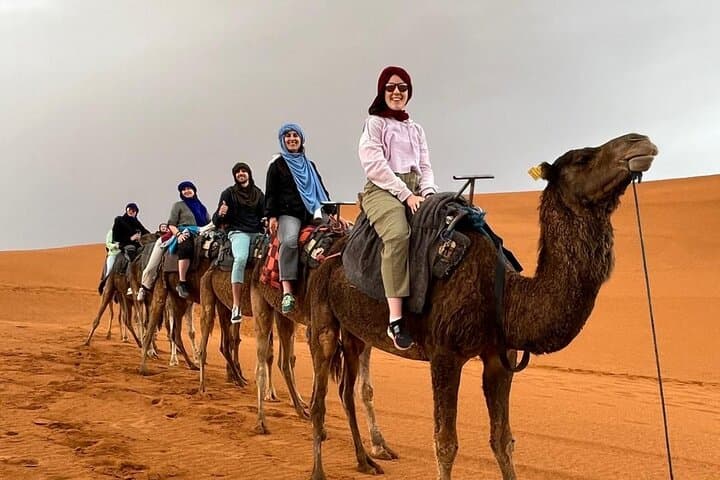
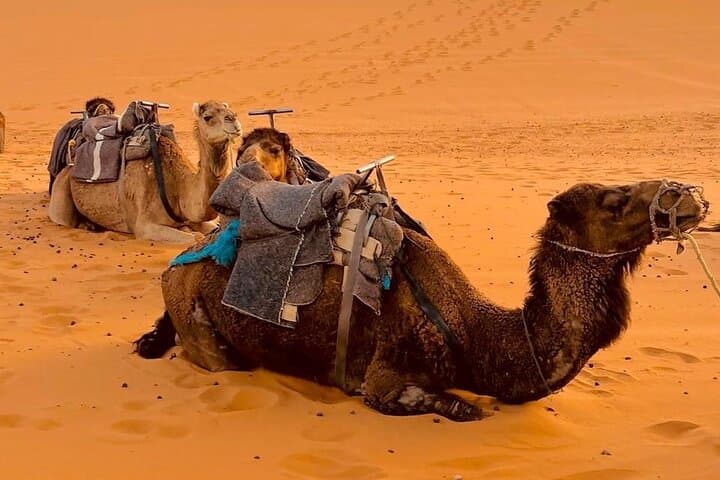
Culture here is hands-on: Berber hospitality, mint tea rituals, drum circles beneath an open sky. The tour blends long driving stretches (expect multiple 6–8 hour travel segments across two days) with active stops — short hikes in the gorges, a camel trek at sunset, and an overnight in a private desert tent under starlight.
Practical edge: pack layered clothing (desert days can be hot, nights cold), closed-toe shoes for dune walks and rockscapes, and at least 2–3 liters of water per day. Plan for dusty conditions, limited cell service in parts, and early starts to catch golden light. If you prefer less driving, choose small-group departures and confirm vehicle type; a 4x4 handles rougher sections and gives more flexibility on photo stops.
moderate.
3 days.
Suitable for travelers in average physical condition; involves short hikes, dune climbs and camel rides but no technical exertion.
One-way driving with stops typically takes 8–10 hours depending on traffic and photo breaks; the itinerary spreads this over two travel days.
Most people can ride camels for short treks; inform the operator about age or mobility concerns so they can arrange pace and assistance.
No technical fitness required — expect short walks, dune climbs, and getting on/off camels; average mobility is sufficient.
Warm layers, a hat, toiletries, any necessary medication, and a small daypack; camps provide bedding but nights can be cold.
The route traces historic caravan paths linking Marrakech with Saharan trade hubs; kasbahs like Ait Ben Haddou grew as fortified waystations for merchants.
Dune ecosystems are fragile — stick to established camps and tracks, reduce single-use plastic, and support local guides to benefit communities conserving water and landscapes.
Morocco Sahara Trip operates guided outdoor trips and adventures with an emphasis on safety, stewardship, and memorable experiences.

You climb into the minivan before dawn as Marrakech stirs — the city’s ochre walls recede and the road threads upward through the High Atlas. By late morning the air thins at the Tizi n’Tichka pass (≈2,260 m), and villages of sun-baked clay slip by like still life paintings. The landscape shifts from terraced farming to rocky gorges and finally to the soft, wind-sculpted curves of Erg Chebbi.
You climb into the minivan before dawn as Marrakech stirs — the city’s ochre walls recede and the road threads upward through the High Atlas. By late morning the air thins at the Tizi n’Tichka pass (≈2,260 m), and villages of sun-baked clay slip by like still life paintings. The landscape shifts from terraced farming to rocky gorges and finally to the soft, wind-sculpted curves of Erg Chebbi.
This route follows old caravan corridors. Ait Ben Haddou’s earthen towers recall the kasbahs that once sheltered traders; Todra and Dades Gorges expose layered sandstone carved by seasonal rivers. The dunes of Merzouga are relatively young geologically — mobile sand forming ridges up to 130–150 m — and they still move with every wind, daring you to climb them at sunrise.
Culture here is hands-on: Berber hospitality, mint tea rituals, drum circles beneath an open sky. The tour blends long driving stretches (expect multiple 6–8 hour travel segments across two days) with active stops — short hikes in the gorges, a camel trek at sunset, and an overnight in a private desert tent under starlight.
Practical edge: pack layered clothing (desert days can be hot, nights cold), closed-toe shoes for dune walks and rockscapes, and at least 2–3 liters of water per day. Plan for dusty conditions, limited cell service in parts, and early starts to catch golden light. If you prefer less driving, choose small-group departures and confirm vehicle type; a 4x4 handles rougher sections and gives more flexibility on photo stops.