THE ADVENTURE COLLECTIVE® · Independent discovery and booking for outdoor travel

Drive the High Atlas, explore Ait Ben Haddou, then cross dune fields to Erg Chebbi for a camel-led sunset and an overnight desert camp. This compact two-day route balances scenic drives with a true Sahara experience.
Drive the High Atlas, explore Ait Ben Haddou, then cross dune fields to Erg Chebbi for a camel-led sunset and an overnight desert camp. This compact two-day route balances scenic drives with a true Sahara experience.
A low-slung bus eases out of Marrakech before dawn, Atlas peaks cutting a serrated horizon as the road climbs. Sunlight sketches mud-brick kasbahs and terraced fields, then softens into the ochre dunes of Erg Chebbi — the desert that pushes you to slow down. By evening, a single line of camels marks the skyline and the camp’s lanterns blink like a small, human constellation.
Verified experiences and guided adventures in the surrounding area.
Operated by Ouattou Morocco Tours · Merzouga, Drâa-Tafilalet
A low-slung bus eases out of Marrakech before dawn, Atlas peaks cutting a serrated horizon as the road climbs. Sunlight sketches mud-brick kasbahs and terraced fields, then softens into the ochre dunes of Erg Chebbi — the desert that pushes you to slow down. By evening, a single line of camels marks the skyline and the camp’s lanterns blink like a small, human constellation.
This two-day route threads High Atlas passes, the fortified ksar of Ait Ben Haddou and the palm-lined Draa Valley en route to Merzouga. Geologically, Erg Chebbi is a north–south dune sea created by wind-driven sand trapped by the Saharan margin; its tallest dunes shift seasonally and reveal fossilized riverbeds beneath. Culturally, the area sits on old trans-Saharan corridors and is home to Berber and nomadic communities — you’ll pass ksars, kasbahs and the occasional Gnawa music village whose rhythms echo a trading past.
Expect long but scenic vehicle transfers punctuated by short walks, a sunset camel ride into camp, a night under canvas with dinner and tea, and a sunrise over rippling sand. Camps range from basic tents to staffed desert bivouacs; facilities are simple — drinking water, shared latrines and communal dining.
Practical tips: wear closed-toe shoes for sand and walks, layer for cold desert nights, carry sun protection and at least 2 liters of water per person. Plan for early starts and flexible schedules; road times vary with traffic and weather. This trip pairs immersive scenery with straightforward logistics — rewarding for travelers who accept long transfers for singular desert time.
moderate.
48 hours (2 days).
Suitable for travelers in average fitness; able to handle short hikes in sand and a camel ride and tolerate long vehicle transfers.
Expect roughly 8–10 hours each way depending on stops and road conditions; the itinerary includes scenic breaks at Ait Ben Haddou and other viewpoints.
The camel rides are short (usually 45–90 minutes) and gentle; anyone comfortable mounting a camel can usually take part — inform the operator if you have mobility issues.
Most overnight camps offer individual or shared tents, basic sleeping pads or mattresses, communal dining, potable water and simple toilets; luxury options add private tents and showers.
Spring and fall offer the most comfortable daytime temperatures; winter has cold nights and summer can be very hot during the day.
This route follows portions of old trans-Saharan trade corridors; Ait Ben Haddou is a nearby UNESCO ksar that illustrates earthen architecture and caravan history.
Erg Chebbi’s dune systems are fragile: avoid driving on active dunes, minimize campfire impacts, pack out trash and respect nomadic lands to reduce erosion and cultural disturbance.
Ouattou Morocco Tours operates guided outdoor trips and adventures with an emphasis on safety, stewardship, and memorable experiences.

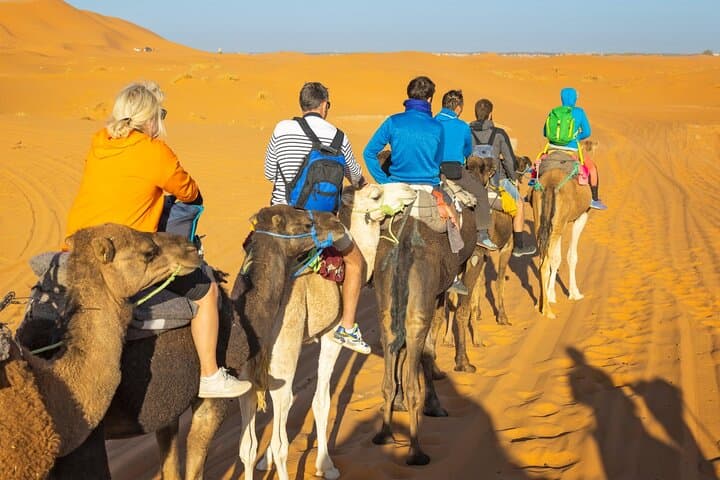


A low-slung bus eases out of Marrakech before dawn, Atlas peaks cutting a serrated horizon as the road climbs. Sunlight sketches mud-brick kasbahs and terraced fields, then softens into the ochre dunes of Erg Chebbi — the desert that pushes you to slow down. By evening, a single line of camels marks the skyline and the camp’s lanterns blink like a small, human constellation.
A low-slung bus eases out of Marrakech before dawn, Atlas peaks cutting a serrated horizon as the road climbs. Sunlight sketches mud-brick kasbahs and terraced fields, then softens into the ochre dunes of Erg Chebbi — the desert that pushes you to slow down. By evening, a single line of camels marks the skyline and the camp’s lanterns blink like a small, human constellation.
This two-day route threads High Atlas passes, the fortified ksar of Ait Ben Haddou and the palm-lined Draa Valley en route to Merzouga. Geologically, Erg Chebbi is a north–south dune sea created by wind-driven sand trapped by the Saharan margin; its tallest dunes shift seasonally and reveal fossilized riverbeds beneath. Culturally, the area sits on old trans-Saharan corridors and is home to Berber and nomadic communities — you’ll pass ksars, kasbahs and the occasional Gnawa music village whose rhythms echo a trading past.
Expect long but scenic vehicle transfers punctuated by short walks, a sunset camel ride into camp, a night under canvas with dinner and tea, and a sunrise over rippling sand. Camps range from basic tents to staffed desert bivouacs; facilities are simple — drinking water, shared latrines and communal dining.
Practical tips: wear closed-toe shoes for sand and walks, layer for cold desert nights, carry sun protection and at least 2 liters of water per person. Plan for early starts and flexible schedules; road times vary with traffic and weather. This trip pairs immersive scenery with straightforward logistics — rewarding for travelers who accept long transfers for singular desert time.