THE ADVENTURE COLLECTIVE® · Independent discovery and booking for outdoor travel

Approach Maraya and the desert folds into the mirror — a sudden visual vanishing act in Al Ula’s Ashar Valley. This short visit combines contemporary architecture with a landscape shaped over millions of years.
Approach Maraya and the desert folds into the mirror — a sudden visual vanishing act in Al Ula’s Ashar Valley. This short visit combines contemporary architecture with a landscape shaped over millions of years.
A low sun slides across ochre cliffs as you pull into Ashar Valley, and for a moment the horizon vanishes — only to reappear mapped across an impossible sheet of glass. Maraya stands as a geometric interruption in desert rock: an auditorium-sized mirror that throws back the sandstone, sky, and the small caravan of visitors moving around its base.
Verified experiences and guided adventures in the surrounding area.
A low sun slides across ochre cliffs as you pull into Ashar Valley, and for a moment the horizon vanishes — only to reappear mapped across an impossible sheet of glass. Maraya stands as a geometric interruption in desert rock: an auditorium-sized mirror that throws back the sandstone, sky, and the small caravan of visitors moving around its base.
The structure — named for the Arabic word for "mirror" — is a recent addition to Al Ula's long story. It sits amid millennia of geological work: layered sandstone carved by wind and seasonal flood into ribs and ridges that give the valley its raw, tactile character. Culturally, Maraya is modern Saudi Arabia's statement in a landscape defined by Nabataean tombs, ancient trade routes, and the nearby UNESCO site of Hegra (Madain Saleh).
Expect a brief, visually rich visit rather than a long hike: the venue hosts concerts, exhibitions, and events, and visitors typically spend 60–120 minutes on-site. Paths are paved and low-grade; the real exertion is squinting at reflected light and hunting the best composition. Practicalities matter here — sun, heat, and cultural norms shape the day. Early morning or late afternoon delivers softer light and cooler temperatures.
Bring sun protection, a refillable water bottle, and comfortable shoes; modest dress is respectful and often required. Parking and short walks connect you to the entrance, and volunteers or staff can guide accessibility needs. Leave no trace: the desert’s fragile surfaces bruise easily under too many footsteps. In return, Maraya offers one of the most modern, uncanny perspectives on a landscape that has been watching travelers for thousands of years.
easy.
1–2 hours.
Minimal physical fitness required; mostly short walks on paved surfaces
Maraya hosts both ticketed events and periods open to general visitors; check the venue’s schedule and book in advance for concerts or exhibitions.
Most visitors spend 60–120 minutes exploring the exterior, taking photos, and visiting any on-site exhibitions.
Paths around the main entrance are paved and the venue provides accessibility options, but contact the venue ahead for specific assistance requirements.
Basic visitor facilities are usually available during open hours; plan for limited food options nearby and carry snacks if you need them.
Maraya is a contemporary landmark inserted into a region defined by ancient Nabataean trade routes and the monumental tombs of Hegra; it reflects Al Ula’s push to connect past and present.
Al Ula’s desert is ecologically sensitive; stick to paths, avoid climbing fragile rock faces, and follow guidance from site staff to minimize impact.
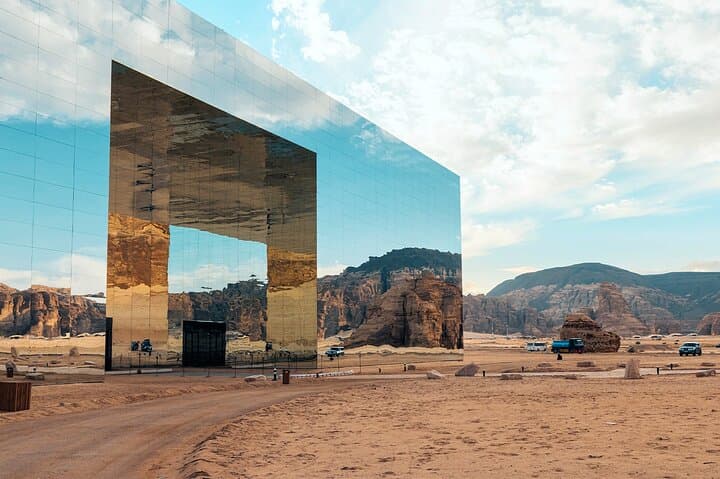
A low sun slides across ochre cliffs as you pull into Ashar Valley, and for a moment the horizon vanishes — only to reappear mapped across an impossible sheet of glass. Maraya stands as a geometric interruption in desert rock: an auditorium-sized mirror that throws back the sandstone, sky, and the small caravan of visitors moving around its base.
A low sun slides across ochre cliffs as you pull into Ashar Valley, and for a moment the horizon vanishes — only to reappear mapped across an impossible sheet of glass. Maraya stands as a geometric interruption in desert rock: an auditorium-sized mirror that throws back the sandstone, sky, and the small caravan of visitors moving around its base.
The structure — named for the Arabic word for "mirror" — is a recent addition to Al Ula's long story. It sits amid millennia of geological work: layered sandstone carved by wind and seasonal flood into ribs and ridges that give the valley its raw, tactile character. Culturally, Maraya is modern Saudi Arabia's statement in a landscape defined by Nabataean tombs, ancient trade routes, and the nearby UNESCO site of Hegra (Madain Saleh).
Expect a brief, visually rich visit rather than a long hike: the venue hosts concerts, exhibitions, and events, and visitors typically spend 60–120 minutes on-site. Paths are paved and low-grade; the real exertion is squinting at reflected light and hunting the best composition. Practicalities matter here — sun, heat, and cultural norms shape the day. Early morning or late afternoon delivers softer light and cooler temperatures.
Bring sun protection, a refillable water bottle, and comfortable shoes; modest dress is respectful and often required. Parking and short walks connect you to the entrance, and volunteers or staff can guide accessibility needs. Leave no trace: the desert’s fragile surfaces bruise easily under too many footsteps. In return, Maraya offers one of the most modern, uncanny perspectives on a landscape that has been watching travelers for thousands of years.