THE ADVENTURE COLLECTIVE® · Independent discovery and booking for outdoor travel

Glide through Madrid's historic core in a private electric tuk‑tuk—two hours of palaces, fountains, and Prado‑adjacent boulevards that give you orientation and local context without the crowds. Perfect for first‑time visitors wanting a quick, low‑impact overview.
Glide through Madrid's historic core in a private electric tuk‑tuk—two hours of palaces, fountains, and Prado‑adjacent boulevards that give you orientation and local context without the crowds. Perfect for first‑time visitors wanting a quick, low‑impact overview.
You step into a low-slung electric tuk‑tuk at Plaza de Oriente, the Royal Palace looming to your right while lamplight and tramlines unfold the city's pulse. The vehicle hums, and narrow streets—lined with chestnut trees and cafés—slide past: fountains staring back from plazas, a basilica's dome catching sun, a market's shadowed awning hinting at early-morning life.
Verified experiences and guided adventures in the surrounding area.
Operated by Eco Tuk Tuk - Spain · Madrid, Madrid
You step into a low-slung electric tuk‑tuk at Plaza de Oriente, the Royal Palace looming to your right while lamplight and tramlines unfold the city's pulse. The vehicle hums, and narrow streets—lined with chestnut trees and cafés—slide past: fountains staring back from plazas, a basilica's dome catching sun, a market's shadowed awning hinting at early-morning life.
Madrid's center grew from a medieval fortress to a Bourbon capital; its broad boulevards and neoclassical façades reflect 18th–19th century planning layered over Roman and medieval bones. The route crosses cultural veins—Paseo del Prado with its museum corridor, the stately Puerta de Alcalá, and small-scale markets that keep neighborhood rhythms alive. The tuk‑tuk's electric drive lets you approach monuments without the bulk of a coach, preserving sightlines and allowing quick turns into historic squares.
Expect short, curated stops for photos at prearranged viewpoints rather than long visits. Drivers are guides by trade—practical storytellers who manage access and timing in busy traffic. The tour suits travelers who want orientation and context before deeper exploration: sketching a map of where to return on foot or by metro.
Practical guidance: book morning or golden‑hour slots to avoid peak traffic and heat, keep a compact bag (tuk‑tuks have no trunks), and check weather protections in winter. Arrive at the Plaza de Oriente underground bus station 10–15 minutes early; the company provides infant seats and assistance for mobility issues. With a modest physical requirement and a private vehicle, this is an efficient, low‑impact way to see Madrid's civic core and decide where to linger next.
easy.
2 hours (approx. 120 minutes).
Minimal; suitable for most mobility levels though boarding involves a low step.
Yes—tuk‑tuks are reserved privately; up to 4 passengers per vehicle, and the route is tailored to the group's size.
At the Plaza de Oriente underground bus station next to the Royal Palace—search for ‘Calle Bailén 4’ or ‘Puerta del Príncipe’ on maps and follow EcoTukTuk signage to the stairs.
Children two years and older are permitted; infant seats are available but babies under two are not allowed per operator policy.
Yes—routes may vary due to closed streets, demonstrations, or traffic; the operator will adjust and prioritize scheduled viewpoints.
Madrid evolved from a medieval stronghold to Spain’s capital under the Habsburgs and Bourbons; many neoclassical façades date to 18th–19th century urban reforms.
The electric tuk‑tuks are a low‑emission option aligned with Madrid’s low‑emission zone policies; stay on public roads and respect pedestrian zones to minimize impacts.
Eco Tuk Tuk - Spain operates guided outdoor trips and adventures with an emphasis on safety, stewardship, and memorable experiences.
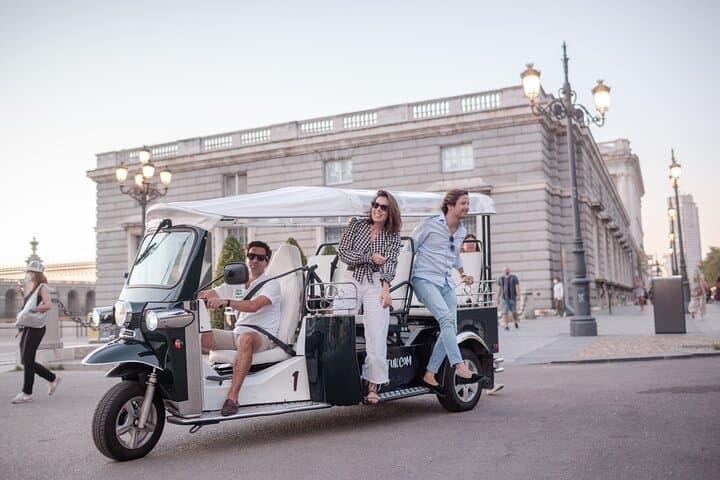
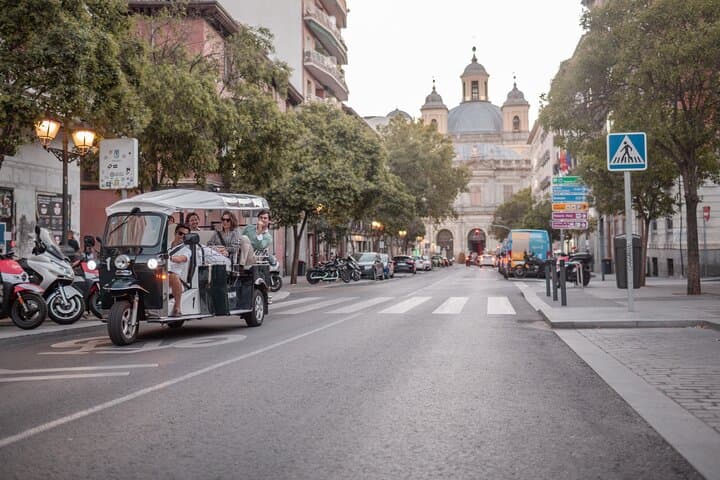
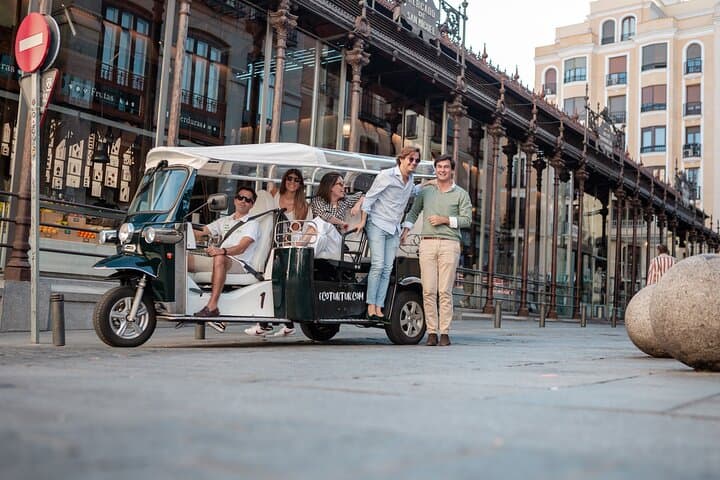
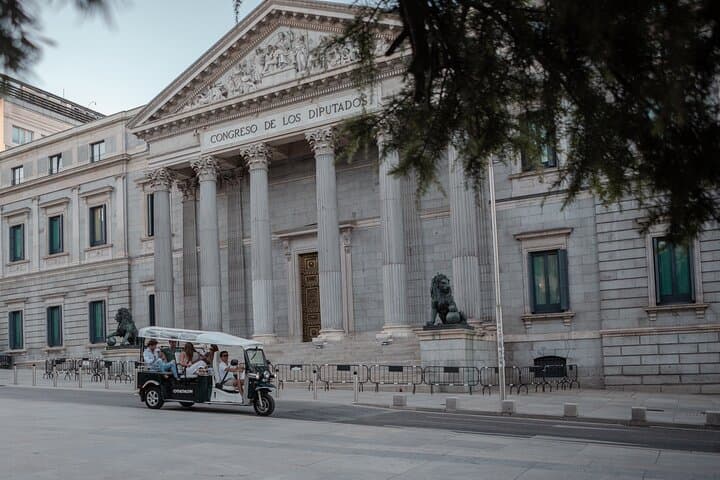
You step into a low-slung electric tuk‑tuk at Plaza de Oriente, the Royal Palace looming to your right while lamplight and tramlines unfold the city's pulse. The vehicle hums, and narrow streets—lined with chestnut trees and cafés—slide past: fountains staring back from plazas, a basilica's dome catching sun, a market's shadowed awning hinting at early-morning life.
You step into a low-slung electric tuk‑tuk at Plaza de Oriente, the Royal Palace looming to your right while lamplight and tramlines unfold the city's pulse. The vehicle hums, and narrow streets—lined with chestnut trees and cafés—slide past: fountains staring back from plazas, a basilica's dome catching sun, a market's shadowed awning hinting at early-morning life.
Madrid's center grew from a medieval fortress to a Bourbon capital; its broad boulevards and neoclassical façades reflect 18th–19th century planning layered over Roman and medieval bones. The route crosses cultural veins—Paseo del Prado with its museum corridor, the stately Puerta de Alcalá, and small-scale markets that keep neighborhood rhythms alive. The tuk‑tuk's electric drive lets you approach monuments without the bulk of a coach, preserving sightlines and allowing quick turns into historic squares.
Expect short, curated stops for photos at prearranged viewpoints rather than long visits. Drivers are guides by trade—practical storytellers who manage access and timing in busy traffic. The tour suits travelers who want orientation and context before deeper exploration: sketching a map of where to return on foot or by metro.
Practical guidance: book morning or golden‑hour slots to avoid peak traffic and heat, keep a compact bag (tuk‑tuks have no trunks), and check weather protections in winter. Arrive at the Plaza de Oriente underground bus station 10–15 minutes early; the company provides infant seats and assistance for mobility issues. With a modest physical requirement and a private vehicle, this is an efficient, low‑impact way to see Madrid's civic core and decide where to linger next.