THE ADVENTURE COLLECTIVE® · Independent discovery and booking for outdoor travel

A full-day shared tour from Cusco that pairs round-trip train travel with a guided visit to Machu Picchu. Expect 12–14 hours, uneven Inca steps, shifting weather and a tight but unforgettable window to explore the citadel.
A full-day shared tour from Cusco that pairs round-trip train travel with a guided visit to Machu Picchu. Expect 12–14 hours, uneven Inca steps, shifting weather and a tight but unforgettable window to explore the citadel.
Dawn breaks over the high Andean ridges as a shared bus leaves Cusco, the city’s colonial stone giving way to terraced fields and jagged peaks.
The train to Aguas Calientes threads a river valley, and a short bus climb through cloud forest delivers you to the stone thresholds of Machu Picchu—where mist and stone trade places like characters in a long-running play.
Verified experiences and guided adventures in the surrounding area.
Operated by FIND MY JOURNEY · Aguas Calientes, Cusco
Dawn breaks over the high Andean ridges as a shared bus leaves Cusco, the city’s colonial stone giving way to terraced fields and jagged peaks.
The train to Aguas Calientes threads a river valley, and a short bus climb through cloud forest delivers you to the stone thresholds of Machu Picchu—where mist and stone trade places like characters in a long-running play.
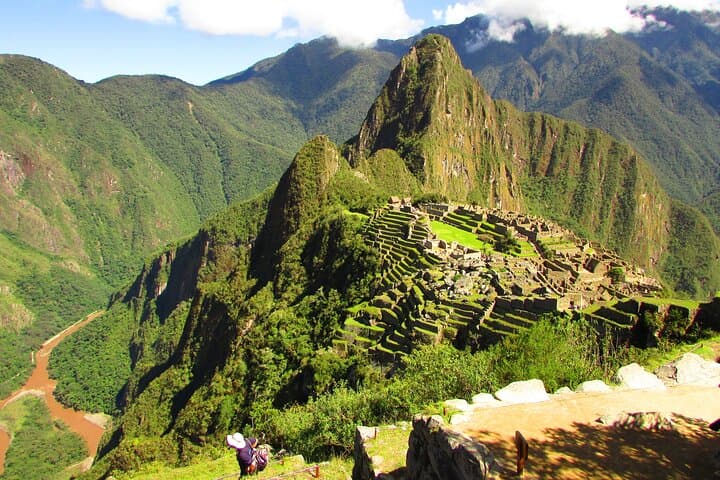
Built in the 15th century under the Inca ruler Pachacuti and largely abandoned after the Spanish conquest, Machu Picchu sits on a granite spine above the Urubamba River. Its terraces and finely cut stones are set against steep, fern-slick slopes carved by tectonic uplift and relentless erosion; the site’s weather shifts rapidly because it sits at the meeting point of Andean highlands and tropical cloud forest.
Culturally, the day trip threads living Quechua communities—Ollantaytambo’s narrow streets and Aguas Calientes’ market stalls—into the narrative, and local guides translate both archaeological detail and present-day village life.
Practical guidance: expect a long (12–14 hour) day, substantial walking on uneven Inca steps, and sharp microclimate changes—pack a rain shell, layers, good shoes, water and your passport (required for ticket verification). The shared itinerary typically includes round-trip train, tourist bus to the citadel, and a guided ~2.5-hour tour; optional climbs such as Huayna Picchu require separate permits and early reservations. Move on marked trails, keep waste with you, and plan for limited free time in Aguas Calientes before the return train to Ollantaytambo and transfer back to Cusco.
moderate.
12–14 hours.
Moderate fitness helpful—tour involves prolonged standing, walking on uneven stone steps and some steep paths.
Yes—it's marketed as suitable for all fitness levels, but you should be prepared for several hours of walking, uneven stone steps and some steep paths; it's not recommended for people with serious cardiovascular issues or pregnancy.
Yes—the shared service typically includes round-trip tourist train tickets, the bus from Aguas Calientes to the citadel, a professional guide and entrance to Machu Picchu.
Not usually—those climbs require separate permits with limited daily slots and often an earlier start; check availability and book in advance if you want to add them.
Yes—bring small local currency for meals, tips, souvenirs and the hot springs; some places accept cards but connectivity can be limited.
Machu Picchu was constructed in the 1400s under Inca ruler Pachacuti and largely abandoned after the Spanish conquest; Hiram Bingham brought it to international attention in 1911.
Visitor limits, route controls and local tourism fees help protect fragile structures and cloud-forest habitat—stay on marked paths and pack out waste.
FIND MY JOURNEY operates guided outdoor trips and adventures with an emphasis on safety, stewardship, and memorable experiences.
Dawn breaks over the high Andean ridges as a shared bus leaves Cusco, the city’s colonial stone giving way to terraced fields and jagged peaks.
The train to Aguas Calientes threads a river valley, and a short bus climb through cloud forest delivers you to the stone thresholds of Machu Picchu—where mist and stone trade places like characters in a long-running play.
Dawn breaks over the high Andean ridges as a shared bus leaves Cusco, the city’s colonial stone giving way to terraced fields and jagged peaks.
The train to Aguas Calientes threads a river valley, and a short bus climb through cloud forest delivers you to the stone thresholds of Machu Picchu—where mist and stone trade places like characters in a long-running play.
Built in the 15th century under the Inca ruler Pachacuti and largely abandoned after the Spanish conquest, Machu Picchu sits on a granite spine above the Urubamba River. Its terraces and finely cut stones are set against steep, fern-slick slopes carved by tectonic uplift and relentless erosion; the site’s weather shifts rapidly because it sits at the meeting point of Andean highlands and tropical cloud forest.
Culturally, the day trip threads living Quechua communities—Ollantaytambo’s narrow streets and Aguas Calientes’ market stalls—into the narrative, and local guides translate both archaeological detail and present-day village life.
Practical guidance: expect a long (12–14 hour) day, substantial walking on uneven Inca steps, and sharp microclimate changes—pack a rain shell, layers, good shoes, water and your passport (required for ticket verification). The shared itinerary typically includes round-trip train, tourist bus to the citadel, and a guided ~2.5-hour tour; optional climbs such as Huayna Picchu require separate permits and early reservations. Move on marked trails, keep waste with you, and plan for limited free time in Aguas Calientes before the return train to Ollantaytambo and transfer back to Cusco.