THE ADVENTURE COLLECTIVE® · Independent discovery and booking for outdoor travel

Spend a day exploring Ninh Binh’s dramatic karst rivers and village lanes by private transfer. This luxury day trip pairs a sampan ride through Trang An’s caves with a stair-climb to Mua Cave’s panoramic ridge and a cultural stop at Bich Dong Pagoda.
Spend a day exploring Ninh Binh’s dramatic karst rivers and village lanes by private transfer. This luxury day trip pairs a sampan ride through Trang An’s caves with a stair-climb to Mua Cave’s panoramic ridge and a cultural stop at Bich Dong Pagoda.
You arrive before dawn by private transfer, the road south from Hanoi flattening into rice plains while limestone towers begin to puncture the horizon. The river at Trang An welcomes you with slow, green water that seems to nudge the sampan forward as a local rower slips through a sequence of caves and tunnel mouths.
Verified experiences and guided adventures in the surrounding area.
Operated by Asia Green Travel · Ninh Binh, Ninh Binh Province
You arrive before dawn by private transfer, the road south from Hanoi flattening into rice plains while limestone towers begin to puncture the horizon. The river at Trang An welcomes you with slow, green water that seems to nudge the sampan forward as a local rower slips through a sequence of caves and tunnel mouths.
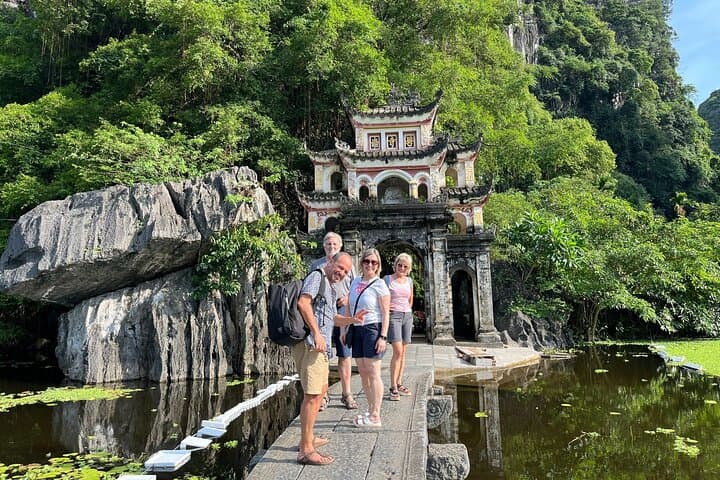
This circuit stitches together karst geology, imperial history and living village culture. Trang An — a UNESCO World Heritage site since 2014 — exposes a drowned limestone landscape carved over millennia; boat passages thread through caves with names tied to local legends. Bich Dong Pagoda perches on a low cliff and reflects layered Vietnamese Buddhist architecture dating to the late medieval period, while nearby Hoa Lu was the 10th-century capital that shaped the region’s identity.
The hike at Mua Cave (Hang Múa) demands attention: almost 500 stone steps climb a steep ridge to a ridgeline viewpoint that frames Tam Coc’s rice-carved river loops. Cycling around quiet lanes gives a different cadence — flat, farm-track riding past water buffalo and small homestays.
Practical edge: expect a full 11-hour day with about 2.5 hours of driving each way from Hanoi (≈120 km). Terrain varies — smooth village roads, slick mud in the wet season, and steep, uneven stairs at the summit. Wear grippy shoes, carry rain protection and at least 1–1.5 L of water, and budget time for photos and boat waits. The trip balances easy cultural access with short bursts of physical effort — ideal for travelers who want curated comfort but still want to move through the landscape.
moderate.
11 hours.
Suitable for reasonably active travelers who can handle a long day, short hikes and about an hour of casual cycling.
The tour typically takes about 11 hours round-trip with roughly 2.5 hours driving each way (around 120 km).
Yes — entrance fees, a buffet lunch at a local restaurant, and mineral water are included in the package.
The sampan ride is calm and suitable for most people, but it requires getting into a low boat and remaining seated; the rowers operate in shallow tunnels and caves.
Children can join; infants must sit on an adult’s lap. The operator notes the tour is suitable for all fitness levels, though the Mua steps may be tiring for very young children.
Ninh Binh’s landscape held the capital of an early Vietnamese kingdom (Hoa Lu) in the 10th century; Bich Dong Pagoda reflects centuries of local Buddhist practice.
Tourism concentrates on fragile karst and wetland systems—stick to paths, avoid littering and support local guides to help fund conservation and community livelihoods.
Asia Green Travel operates guided outdoor trips and adventures with an emphasis on safety, stewardship, and memorable experiences.
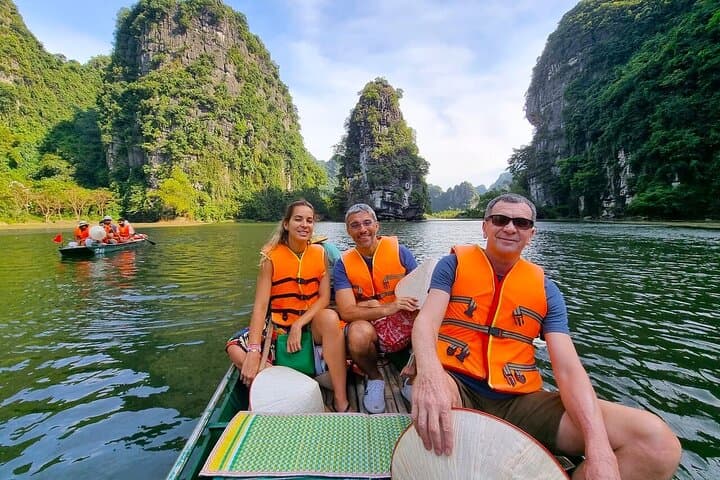


You arrive before dawn by private transfer, the road south from Hanoi flattening into rice plains while limestone towers begin to puncture the horizon. The river at Trang An welcomes you with slow, green water that seems to nudge the sampan forward as a local rower slips through a sequence of caves and tunnel mouths.
You arrive before dawn by private transfer, the road south from Hanoi flattening into rice plains while limestone towers begin to puncture the horizon. The river at Trang An welcomes you with slow, green water that seems to nudge the sampan forward as a local rower slips through a sequence of caves and tunnel mouths.
This circuit stitches together karst geology, imperial history and living village culture. Trang An — a UNESCO World Heritage site since 2014 — exposes a drowned limestone landscape carved over millennia; boat passages thread through caves with names tied to local legends. Bich Dong Pagoda perches on a low cliff and reflects layered Vietnamese Buddhist architecture dating to the late medieval period, while nearby Hoa Lu was the 10th-century capital that shaped the region’s identity.
The hike at Mua Cave (Hang Múa) demands attention: almost 500 stone steps climb a steep ridge to a ridgeline viewpoint that frames Tam Coc’s rice-carved river loops. Cycling around quiet lanes gives a different cadence — flat, farm-track riding past water buffalo and small homestays.
Practical edge: expect a full 11-hour day with about 2.5 hours of driving each way from Hanoi (≈120 km). Terrain varies — smooth village roads, slick mud in the wet season, and steep, uneven stairs at the summit. Wear grippy shoes, carry rain protection and at least 1–1.5 L of water, and budget time for photos and boat waits. The trip balances easy cultural access with short bursts of physical effort — ideal for travelers who want curated comfort but still want to move through the landscape.