THE ADVENTURE COLLECTIVE® · Independent discovery and booking for outdoor travel

A compact two-day pilgrimage from Luxor to Abu Simbel that packs Edfu, Kom Ombo, Philae, and Aswan’s High Dam into a schedule built for ancient monuments and big Nile views. Prepare for early starts, long drives, and unforgettable temple façades.
A compact two-day pilgrimage from Luxor to Abu Simbel that packs Edfu, Kom Ombo, Philae, and Aswan’s High Dam into a schedule built for ancient monuments and big Nile views. Prepare for early starts, long drives, and unforgettable temple façades.
Dawn on the desert road feels deliberate — headlights slice the predawn air as the van pushes south toward Abu Simbel, the Nile a slow, glittering line at the edge of the highway. By midmorning you trade the hum of the road for stone floors and carved colossi: Horus’ falcon gaze at Edfu, Kom Ombo’s double sanctuaries, Philae’s island temple drifting just off Aswan’s shore, and finally the colossal faces of Ramesses II at Abu Simbel.
Verified experiences and guided adventures in the surrounding area.
Operated by LuxorPrivateTour · Aswan, Aswan Governorate
Dawn on the desert road feels deliberate — headlights slice the predawn air as the van pushes south toward Abu Simbel, the Nile a slow, glittering line at the edge of the highway. By midmorning you trade the hum of the road for stone floors and carved colossi: Horus’ falcon gaze at Edfu, Kom Ombo’s double sanctuaries, Philae’s island temple drifting just off Aswan’s shore, and finally the colossal faces of Ramesses II at Abu Simbel.
This route threads millennia: Pharaonic temples hewn from sandstone and granite, monuments repositioned in the 1960s to escape the High Dam’s waters, and Nubian settlements whose culture has shaped the southern Nile for generations. Geology is plain here — hard rock and alluvial plain, cliffs of Nubian sandstone giving way to riverine palms.
Expect paved courtyards, stepped ramps, and short, guided walks of 1–2 km at each site; most temple approaches are flat but include uneven stone and steps. The Abu Simbel transfer is an early start (often before 5:00 AM) with 3–4 hours round driving from Aswan; Luxor to Aswan is roughly 3–4 hours by road if your schedule begins there.
Practical edge: bring sun protection, a lightweight layer for early-morning wind, comfortable shoes, and local cash for small purchases. Respect site rules — no touching carved reliefs — and allow time for immigration-style checks at Abu Simbel. With short walks and long drives, this tour balances cultural payoff and logistical pace: big monuments, sparse terrain, and an itinerary built for impact.
moderate.
2 days (approx. 48 hours).
Suitable for travelers in average fitness; able to handle several short walks, stairs, and early-morning transfers.
Admission to the main sites listed in the itinerary (Edfu, Kom Ombo, Philae, Abu Simbel) is typically included; confirm final ticket details with the operator at booking.
The one-way drive is roughly 3 hours (about 280 km) on well-maintained desert roads; expect an early pre-dawn departure and a full morning at the site.
The tour is family-friendly, but Abu Simbel and some temple areas have steps and uneven surfaces; visitors with mobility issues should check for available assistance and inform the operator in advance.
The tour includes one night’s hotel accommodation in Aswan on bed-and-breakfast and breakfast on the second day, with lunch typically provided en route or at local restaurants as noted in the itinerary.
Abu Simbel’s twin temples were carved during Ramesses II’s reign and were relocated piece-by-piece in the 1960s to save them from the rising waters of the Aswan High Dam.
Site preservation is active here — avoid touching reliefs, follow marked paths, and use water and waste resources sparingly in a region with limited freshwater supply.
LuxorPrivateTour operates guided outdoor trips and adventures with an emphasis on safety, stewardship, and memorable experiences.

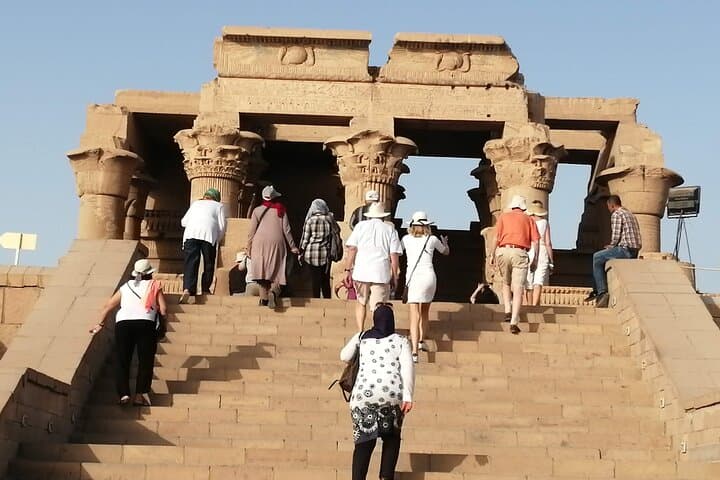


Dawn on the desert road feels deliberate — headlights slice the predawn air as the van pushes south toward Abu Simbel, the Nile a slow, glittering line at the edge of the highway. By midmorning you trade the hum of the road for stone floors and carved colossi: Horus’ falcon gaze at Edfu, Kom Ombo’s double sanctuaries, Philae’s island temple drifting just off Aswan’s shore, and finally the colossal faces of Ramesses II at Abu Simbel.
Dawn on the desert road feels deliberate — headlights slice the predawn air as the van pushes south toward Abu Simbel, the Nile a slow, glittering line at the edge of the highway. By midmorning you trade the hum of the road for stone floors and carved colossi: Horus’ falcon gaze at Edfu, Kom Ombo’s double sanctuaries, Philae’s island temple drifting just off Aswan’s shore, and finally the colossal faces of Ramesses II at Abu Simbel.
This route threads millennia: Pharaonic temples hewn from sandstone and granite, monuments repositioned in the 1960s to escape the High Dam’s waters, and Nubian settlements whose culture has shaped the southern Nile for generations. Geology is plain here — hard rock and alluvial plain, cliffs of Nubian sandstone giving way to riverine palms.
Expect paved courtyards, stepped ramps, and short, guided walks of 1–2 km at each site; most temple approaches are flat but include uneven stone and steps. The Abu Simbel transfer is an early start (often before 5:00 AM) with 3–4 hours round driving from Aswan; Luxor to Aswan is roughly 3–4 hours by road if your schedule begins there.
Practical edge: bring sun protection, a lightweight layer for early-morning wind, comfortable shoes, and local cash for small purchases. Respect site rules — no touching carved reliefs — and allow time for immigration-style checks at Abu Simbel. With short walks and long drives, this tour balances cultural payoff and logistical pace: big monuments, sparse terrain, and an itinerary built for impact.