THE ADVENTURE COLLECTIVE® · Independent discovery and booking for outdoor travel

Fly from Cairo for a focused, private day in Luxor visiting the Valley of the Kings, Hatshepsut’s temple, the Colossi of Memnon and Karnak. This full-day itinerary blends efficient logistics with deep historical context — ideal for travelers short on time who want maximum archaeological payoff.
Fly from Cairo for a focused, private day in Luxor visiting the Valley of the Kings, Hatshepsut’s temple, the Colossi of Memnon and Karnak. This full-day itinerary blends efficient logistics with deep historical context — ideal for travelers short on time who want maximum archaeological payoff.
The plane touches down and the Nile unfurls below like a ribbon of time — palm groves and pale mud bricks giving way to colossal stone columns that have watched the desert for three millennia. You step from the airport and the air pushes at you, warm and dry, while the West Bank escarpment throws a blue shadow across the valley. This is Luxor: an open-air museum where funerary cliffs and temple courtyards still carry the echoes of pharaohs.
Verified experiences and guided adventures in the surrounding area.
Operated by Eyes of Egypt · Luxor, Luxor Governorate
The plane touches down and the Nile unfurls below like a ribbon of time — palm groves and pale mud bricks giving way to colossal stone columns that have watched the desert for three millennia. You step from the airport and the air pushes at you, warm and dry, while the West Bank escarpment throws a blue shadow across the valley. This is Luxor: an open-air museum where funerary cliffs and temple courtyards still carry the echoes of pharaohs.
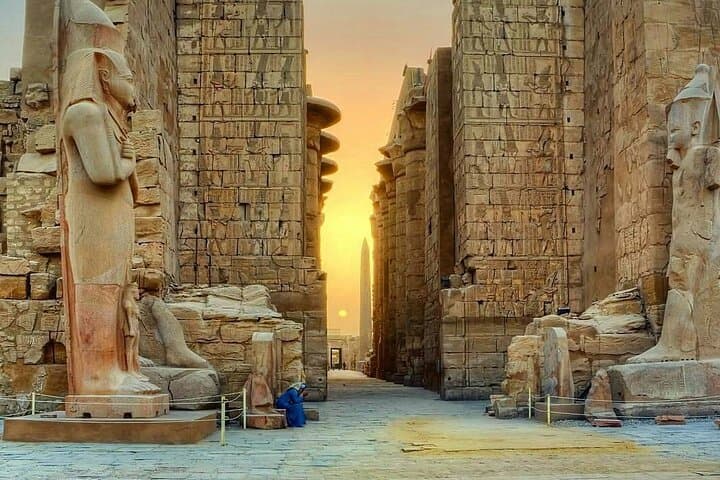
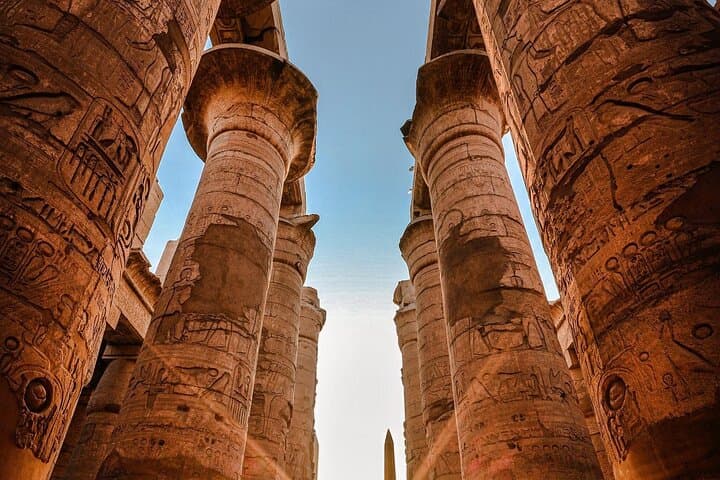
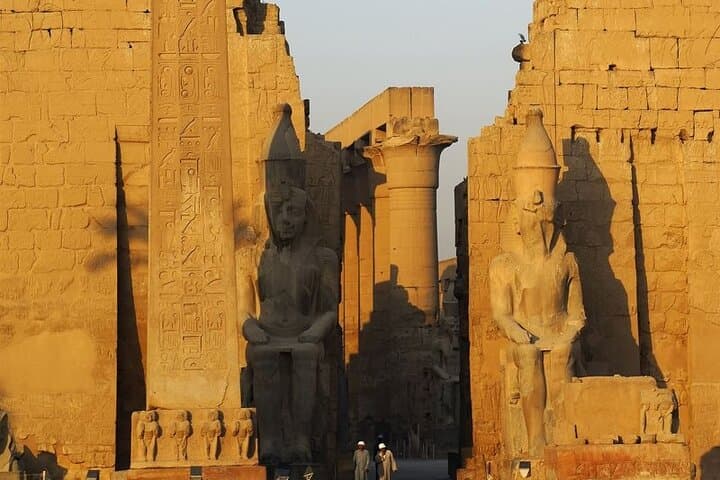
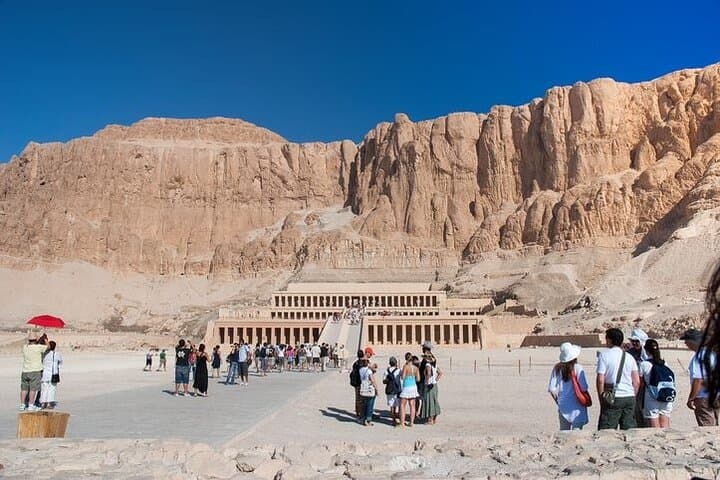
On a well-paced private day tour you move from the Tombs of the Valley of the Kings — carved into the limestone with painted chapels that survived millennia — to Hatshepsut’s terraced mortuary temple, an architectural pivot in New Kingdom design. The Colossi of Memnon cut a solitary silhouette on the floodplain; Karnak’s hypostyle hall delivers the scale and engineering of a civilization centered on Amon-Ra.
Geologically the sites sit where the Nile’s alluvial plain meets Eocene limestone; expect packed paths, stepped tomb entrances and exposed desert surfaces. Culturally the rhythm is modern Egyptian — market sellers, mosque calls, and guides translating layers of ritual and kingship.
Practically: plan for a 12–13 hour day that includes flights between Cairo and Luxor (not included in base price), multiple short walks (several kilometers total), and exposed sun; bring hydration, sturdy shoes, and time for security and ticket lines if you choose the Silver or Golden options. Diamond packages commonly include entrance fees and a licensed Egyptologist, which makes the archaeology richer and the logistics smoother. Pace yourself, respect temple signage, and leave room in your camera roll — these are places that stay with you.
moderate.
12–12.5 hours.
Suitable for travelers who can handle several short walks over uneven ground and a long travel day; minimal endurance required but expect lots of standing.
No; round-trip flights are not included in the base price — you can book flights separately to match the tour timing.
It depends on the package: Diamond usually includes entrance tickets, Golden may include guide-only, and Silver typically covers transport only — confirm at booking.
The tour lists wheelchair-accessible options, but many tombs and some temple areas have steps or uneven ground; contact the operator ahead to plan accessible routing.
Expect several short walks adding to a few kilometers overall, with some stair descents into tombs and long temple courtyards to traverse.
Luxor sits on the site of ancient Thebes, the political and religious heart of the New Kingdom (c. 1550–1070 BCE), with monuments built across successive pharaonic reigns.
Visitor pressure threatens painted surfaces and fragile tomb microclimates; follow site rules, avoid touching reliefs, and use licensed guides who promote low-impact visitation.
Eyes of Egypt operates guided outdoor trips and adventures with an emphasis on safety, stewardship, and memorable experiences.
The plane touches down and the Nile unfurls below like a ribbon of time — palm groves and pale mud bricks giving way to colossal stone columns that have watched the desert for three millennia. You step from the airport and the air pushes at you, warm and dry, while the West Bank escarpment throws a blue shadow across the valley. This is Luxor: an open-air museum where funerary cliffs and temple courtyards still carry the echoes of pharaohs.
The plane touches down and the Nile unfurls below like a ribbon of time — palm groves and pale mud bricks giving way to colossal stone columns that have watched the desert for three millennia. You step from the airport and the air pushes at you, warm and dry, while the West Bank escarpment throws a blue shadow across the valley. This is Luxor: an open-air museum where funerary cliffs and temple courtyards still carry the echoes of pharaohs.
On a well-paced private day tour you move from the Tombs of the Valley of the Kings — carved into the limestone with painted chapels that survived millennia — to Hatshepsut’s terraced mortuary temple, an architectural pivot in New Kingdom design. The Colossi of Memnon cut a solitary silhouette on the floodplain; Karnak’s hypostyle hall delivers the scale and engineering of a civilization centered on Amon-Ra.
Geologically the sites sit where the Nile’s alluvial plain meets Eocene limestone; expect packed paths, stepped tomb entrances and exposed desert surfaces. Culturally the rhythm is modern Egyptian — market sellers, mosque calls, and guides translating layers of ritual and kingship.
Practically: plan for a 12–13 hour day that includes flights between Cairo and Luxor (not included in base price), multiple short walks (several kilometers total), and exposed sun; bring hydration, sturdy shoes, and time for security and ticket lines if you choose the Silver or Golden options. Diamond packages commonly include entrance fees and a licensed Egyptologist, which makes the archaeology richer and the logistics smoother. Pace yourself, respect temple signage, and leave room in your camera roll — these are places that stay with you.