THE ADVENTURE COLLECTIVE® · Independent discovery and booking for outdoor travel

Spend a half-day in the stony Agafay Desert, dining in a luxury Berber tent with views of the Atlas. This accessible day trip pairs cultural hospitality, short walks or camel rides, and a lakeside stop at Takerkoust.
Spend a half-day in the stony Agafay Desert, dining in a luxury Berber tent with views of the Atlas. This accessible day trip pairs cultural hospitality, short walks or camel rides, and a lakeside stop at Takerkoust.
You arrive to a horizon of stone and short scrub where the Atlas Mountains stand like a distant wall, and the Agafay Desert greets you with wind that rearranges light as if tuning a lens. The air is dry, the ground a mosaic of pebble and limestone, and a cluster of white Berber tents sits open to the sky—an unlikely oasis of shade and simmering tagine.
Verified experiences and guided adventures in the surrounding area.
Operated by Morocco Authentic journey · Marrakech, Marrakech-Safi
You arrive to a horizon of stone and short scrub where the Atlas Mountains stand like a distant wall, and the Agafay Desert greets you with wind that rearranges light as if tuning a lens. The air is dry, the ground a mosaic of pebble and limestone, and a cluster of white Berber tents sits open to the sky—an unlikely oasis of shade and simmering tagine.
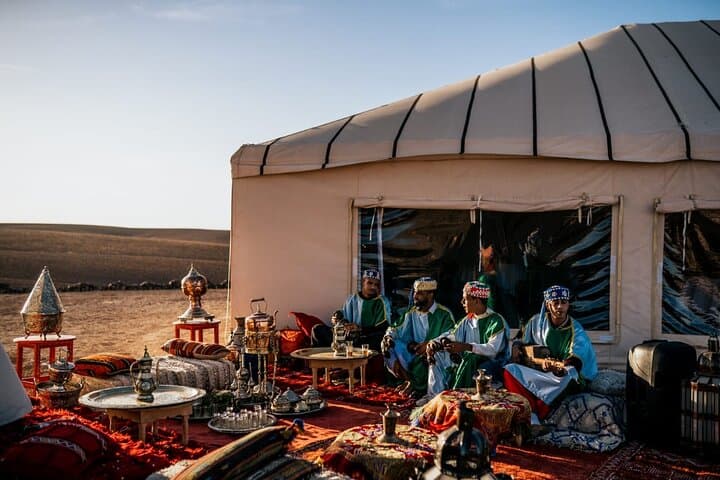
Geology here is immediate: worn bedrock and fossil-bearing outcrops carved by millennia of rain and wind, not the classic Sahara dunes but a stony desert that reveals the foothills’ history. Culturally, the visit ties to contemporary Berber hospitality—tea poured with ceremony, lamb and couscous served family-style—and a short walk can lead to a local house where life follows seasonal rhythms tied to the land.
The itinerary commonly pairs a 45-minute drive from Marrakech with stops at Lake Takerkoust and viewpoints of the Atlas; expect opportunities for short walks, camel or mule rides, and photography. Weather shifts quickly—morning chill can give way to sharp sun by midday—so plan accordingly.
Practical guidance: arrive with sun protection and sturdy shoes for uneven tracks, keep water handy, and allow time for digestion if you’ll walk after the meal. Respect formal dress requests inside the camp, ask before photographing private spaces, and leave no trace: the soft, stony ground shows footprints and litter for a long time.
This is a one-day taste of desert life—gentle on logistics but rich in visual contrast and simple, deliberate hospitality.
moderate.
4–6 hours.
Suitable for travelers with moderate fitness—includes short walks on uneven terrain and minimal climbing
Pickup and drive to Agafay typically take about 45 minutes, making this a convenient half-day excursion.
Most camps offer vegetarian and simpler options if requested in advance—note any allergies when booking.
Yes—short rides are offered as an optional activity, but check availability and safety briefings on arrival.
Some camps and vehicles advertise accessibility, but terrain around the tents is uneven—confirm specific accessibility needs when booking.
Agafay is a rocky, erosion-formed landscape on the southern edge of the Atlas foothills—used historically for seasonal grazing and trade routes rather than dune travel.
Water is scarce and the area is sensitive to litter and off-track driving—use established tracks, avoid single-use plastics, and follow camp waste rules.
Morocco Authentic journey operates guided outdoor trips and adventures with an emphasis on safety, stewardship, and memorable experiences.
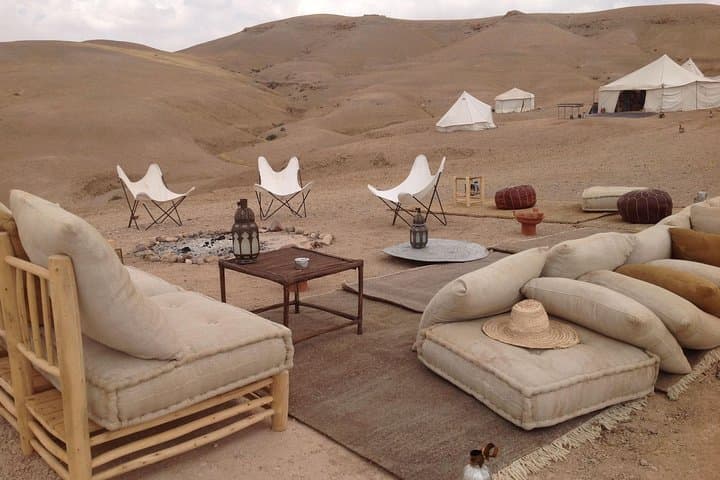
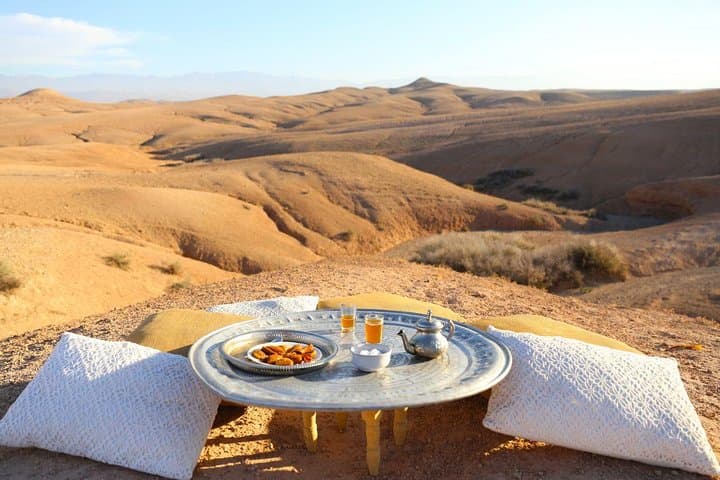
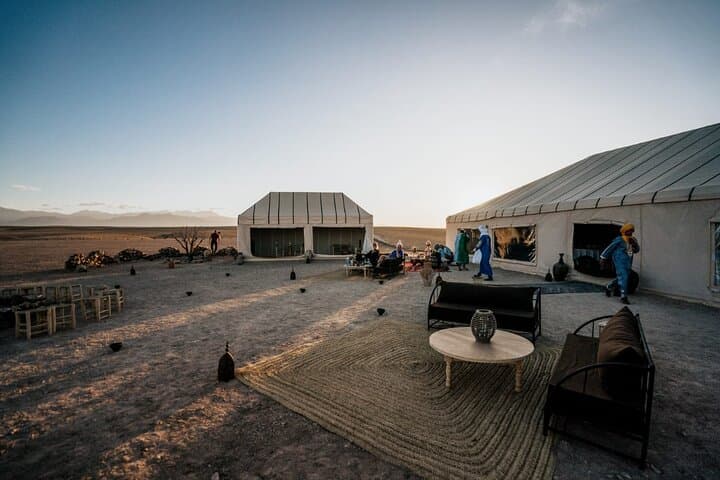
You arrive to a horizon of stone and short scrub where the Atlas Mountains stand like a distant wall, and the Agafay Desert greets you with wind that rearranges light as if tuning a lens. The air is dry, the ground a mosaic of pebble and limestone, and a cluster of white Berber tents sits open to the sky—an unlikely oasis of shade and simmering tagine.
You arrive to a horizon of stone and short scrub where the Atlas Mountains stand like a distant wall, and the Agafay Desert greets you with wind that rearranges light as if tuning a lens. The air is dry, the ground a mosaic of pebble and limestone, and a cluster of white Berber tents sits open to the sky—an unlikely oasis of shade and simmering tagine.
Geology here is immediate: worn bedrock and fossil-bearing outcrops carved by millennia of rain and wind, not the classic Sahara dunes but a stony desert that reveals the foothills’ history. Culturally, the visit ties to contemporary Berber hospitality—tea poured with ceremony, lamb and couscous served family-style—and a short walk can lead to a local house where life follows seasonal rhythms tied to the land.
The itinerary commonly pairs a 45-minute drive from Marrakech with stops at Lake Takerkoust and viewpoints of the Atlas; expect opportunities for short walks, camel or mule rides, and photography. Weather shifts quickly—morning chill can give way to sharp sun by midday—so plan accordingly.
Practical guidance: arrive with sun protection and sturdy shoes for uneven tracks, keep water handy, and allow time for digestion if you’ll walk after the meal. Respect formal dress requests inside the camp, ask before photographing private spaces, and leave no trace: the soft, stony ground shows footprints and litter for a long time.
This is a one-day taste of desert life—gentle on logistics but rich in visual contrast and simple, deliberate hospitality.