THE ADVENTURE COLLECTIVE® · Independent discovery and booking for outdoor travel

Walk terraces that slope to the sea with local rice farmers as guides, taking in reflections in flooded paddies and sweeping views of the Kujuku Islands. This one-hour tour combines hands-on agricultural history with coastal scenery.
Walk terraces that slope to the sea with local rice farmers as guides, taking in reflections in flooded paddies and sweeping views of the Kujuku Islands. This one-hour tour combines hands-on agricultural history with coastal scenery.
Morning fog lifts over a slope of glassy water; terraces reflect the sky and the Kujuku Islands spill across the bay like a scattered chart. The walk begins on a narrow dirt ridge where local rice farmers lead small groups along contour paths, the paddies on one side and coastal views on the other. The rhythm is slow — feet on packed soil, wind through young rice shoots that seem to tug the air toward the sea.
Verified experiences and guided adventures in the surrounding area.
Operated by 株式会社VISIT九州 · Sasebo, Nagasaki
Morning fog lifts over a slope of glassy water; terraces reflect the sky and the Kujuku Islands spill across the bay like a scattered chart. The walk begins on a narrow dirt ridge where local rice farmers lead small groups along contour paths, the paddies on one side and coastal views on the other. The rhythm is slow — feet on packed soil, wind through young rice shoots that seem to tug the air toward the sea.
These terraces are human geology: slopes reshaped over generations to hold water and soil, part of Japan’s satoyama — the worked landscape between mountain and sea. Farmers on the walk explain planting cycles, traditional tools and how tidal bays and modest plateaus shaped field placement here. Cultural notes touch on harvest festivals and community irrigation customs that still dictate the year's pace.
Expect low-impact hiking: gentle grades, muddy sections after rain, and footpaths wide enough for small groups. The sensory highlights are quiet — frogs, the distant call of gulls, and the view of Kujuku (Ninety-Nine) Islands punctuating the horizon.
Practical guidance: schedule the tour in morning light for reflections and cooler temperatures; wear grippy shoes and bring a small bottle of water. The one-hour experience is interpretive and suitable for most fitness levels, with English- and Japanese-speaking guides using local knowledge and translation apps. Be prepared to follow farm biosecurity requests (no dirty footwear on crop edges) and respect private agricultural land. This is a compact, culturally rich walk that connects coastal vistas with living rice-country traditions.
easy.
1 hour.
Suitable for most fitness levels; requires steady balance on uneven farm paths
The guided experience lasts about one hour and covers a short circuit of terraced fields with stops for explanation and views.
Yes — the tour is rated easy and designed for most ages, but participants should be steady on uneven ground; the provider notes it isn’t recommended for those with serious spinal, heart, or pregnancy-related concerns.
Facilities may be limited near field sites; use restrooms in nearby towns like Sasebo before arriving and ask the guide about on-route options.
Guides communicate in Japanese and English; translation apps may be used to support interpretation.
These terraces reflect centuries of incremental earthworks and community-managed irrigation central to Japan’s satoyama farming systems.
Tours promote low-impact behavior to protect seedlings and soil; visitors are asked to avoid trampling crop edges and to minimize litter in the watershed.
株式会社VISIT九州 operates guided outdoor trips and adventures with an emphasis on safety, stewardship, and memorable experiences.

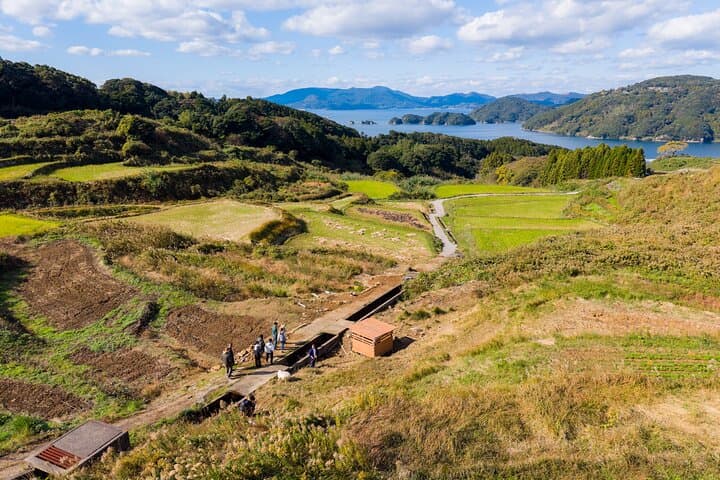


Morning fog lifts over a slope of glassy water; terraces reflect the sky and the Kujuku Islands spill across the bay like a scattered chart. The walk begins on a narrow dirt ridge where local rice farmers lead small groups along contour paths, the paddies on one side and coastal views on the other. The rhythm is slow — feet on packed soil, wind through young rice shoots that seem to tug the air toward the sea.
Morning fog lifts over a slope of glassy water; terraces reflect the sky and the Kujuku Islands spill across the bay like a scattered chart. The walk begins on a narrow dirt ridge where local rice farmers lead small groups along contour paths, the paddies on one side and coastal views on the other. The rhythm is slow — feet on packed soil, wind through young rice shoots that seem to tug the air toward the sea.
These terraces are human geology: slopes reshaped over generations to hold water and soil, part of Japan’s satoyama — the worked landscape between mountain and sea. Farmers on the walk explain planting cycles, traditional tools and how tidal bays and modest plateaus shaped field placement here. Cultural notes touch on harvest festivals and community irrigation customs that still dictate the year's pace.
Expect low-impact hiking: gentle grades, muddy sections after rain, and footpaths wide enough for small groups. The sensory highlights are quiet — frogs, the distant call of gulls, and the view of Kujuku (Ninety-Nine) Islands punctuating the horizon.
Practical guidance: schedule the tour in morning light for reflections and cooler temperatures; wear grippy shoes and bring a small bottle of water. The one-hour experience is interpretive and suitable for most fitness levels, with English- and Japanese-speaking guides using local knowledge and translation apps. Be prepared to follow farm biosecurity requests (no dirty footwear on crop edges) and respect private agricultural land. This is a compact, culturally rich walk that connects coastal vistas with living rice-country traditions.