THE ADVENTURE COLLECTIVE® · Independent discovery and booking for outdoor travel

A compact, private shore tour that threads Montenegro’s best coastal stops into a 5–6 hour loop—Perast, Our Lady of the Rock, Sv. Stefan, Budva, and Kotor’s Old Town. Ideal for cruise passengers who want a focused, local-led introduction to the Bay of Kotor.
A compact, private shore tour that threads Montenegro’s best coastal stops into a 5–6 hour loop—Perast, Our Lady of the Rock, Sv. Stefan, Budva, and Kotor’s Old Town. Ideal for cruise passengers who want a focused, local-led introduction to the Bay of Kotor.
You step off the ship into a wind that tastes faintly of salt and pine. The Bay of Kotor opens like a folded map: steep karst walls pressing in, a narrow ribbon of water threading small towns, islands, and promontories. Your guide—waiting at the port gate—waves you toward a cool minivan and, within minutes, the rhythm of the Adriatic replaces the ship’s engine-room hum.
Verified experiences and guided adventures in the surrounding area.
Operated by Celsus Travel · Kotor, Kotor Municipality
You step off the ship into a wind that tastes faintly of salt and pine. The Bay of Kotor opens like a folded map: steep karst walls pressing in, a narrow ribbon of water threading small towns, islands, and promontories. Your guide—waiting at the port gate—waves you toward a cool minivan and, within minutes, the rhythm of the Adriatic replaces the ship’s engine-room hum.
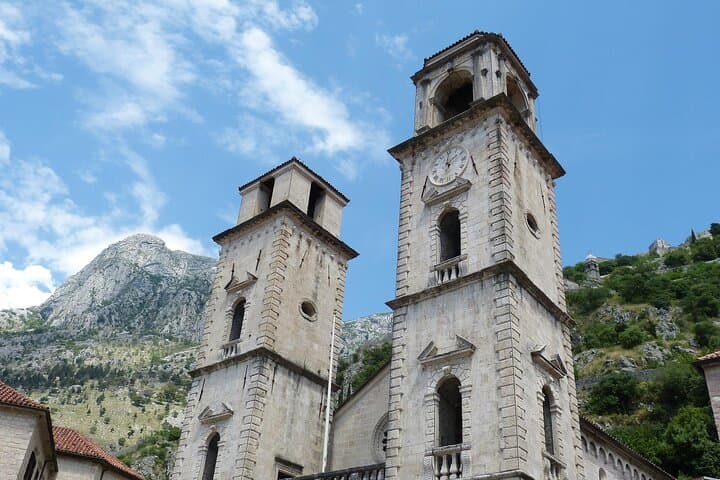
This five- to six-hour shore excursion stitches together Montenegro’s coastal highlights: Budva’s layered ramparts and coffee corners, the manicured baroque lines of Perast, the tiny artificial island crowned by the Church of Our Lady of the Rock, a panoramic pause above Jaz Beach, and a 45-minute walk through Kotor’s medieval Old Town—where St. Tryphon’s 12th-century façade still cuts a formal silhouette.
Geologically the bay is a drowned river canyon—often mistaken for a fjord—its limestone cliffs carved by water and time. That geology shaped local lives: harbors tucked into coves, villages clinging where slopes permit, and a seafaring culture that built Montenegro’s long maritime history. Over centuries Venetian palaces appeared alongside Orthodox churches; Austro-Hungarian influences left a civic clarity in Perast’s façades. The Church of Our Lady of the Rock itself is a human-made island, stones laid by generations of sailors as offerings for safe crossings.
Culturally this route is compact but rich. Perast’s quiet quay and small museums tell of merchant fleets; Budva’s old town hums with cafés and centuries-old lanes. Sv. Stefan is a headland that reads like a postcard—private now, but its viewpoint rewards a quick stop. Local gastronomy pivots on seafood, smoked prosciutto from Njeguši inland, and a simple black risotto grilled by the sea.
Practical guidance: the tour runs 5–6 hours with port pickup and drop-off; wear comfortable walking shoes for cobbled streets and a short walk in Kotor. Bring your passport (required for cruise passengers), a light jacket for abrupt coastal breezes, and cash in euros for small purchases and tips. Time in each stop is limited—Perast and Kotor get the most attention—so prioritize what you want to see. If you can, request an early pickup to catch calmer light on the water and fewer crowds in Perast.
Sustainability note: the bay bears heavy tourist pressure—travel with local operators, avoid single-use plastics, and keep to marked streets and viewpoints. With a little planning this shore excursion delivers a concentrated, tactile introduction to Montenegro: dramatic geology, layered history, and a coastline that still insists on surprising you.
easy.
5–6 hours.
Suitable for most fitness levels; involves short walks and standing periods
The excursion lasts approximately 5–6 hours (300–360 minutes) with port pickup and drop-off included.
The itinerary lists admission as included for the church visit, but confirm specifics with the supplier at booking.
The tour is rated easy but includes cobbled streets and short climbs; it’s not recommended for travelers with serious back problems or pregnant guests.
Yes—there’s typically a 45-minute guided walk through Kotor’s Old Town, enough to see main highlights and take photos.
Montenegro uses the euro; carry small bills for snacks, restrooms, or tips where cards aren’t accepted.
Yes—this is offered as a private tour with transportation by air-conditioned minivan and a professional guide.
Kotor Bay has layered influences—Venetian maritime power shaped its palaces and ports, reflected in the baroque architecture of Perast and Kotor.
The bay faces heavy cruise tourism; choose local guides, avoid single-use plastics, and stick to designated paths to reduce impact.
Celsus Travel operates guided outdoor trips and adventures with an emphasis on safety, stewardship, and memorable experiences.



You step off the ship into a wind that tastes faintly of salt and pine. The Bay of Kotor opens like a folded map: steep karst walls pressing in, a narrow ribbon of water threading small towns, islands, and promontories. Your guide—waiting at the port gate—waves you toward a cool minivan and, within minutes, the rhythm of the Adriatic replaces the ship’s engine-room hum.
You step off the ship into a wind that tastes faintly of salt and pine. The Bay of Kotor opens like a folded map: steep karst walls pressing in, a narrow ribbon of water threading small towns, islands, and promontories. Your guide—waiting at the port gate—waves you toward a cool minivan and, within minutes, the rhythm of the Adriatic replaces the ship’s engine-room hum.
This five- to six-hour shore excursion stitches together Montenegro’s coastal highlights: Budva’s layered ramparts and coffee corners, the manicured baroque lines of Perast, the tiny artificial island crowned by the Church of Our Lady of the Rock, a panoramic pause above Jaz Beach, and a 45-minute walk through Kotor’s medieval Old Town—where St. Tryphon’s 12th-century façade still cuts a formal silhouette.
Geologically the bay is a drowned river canyon—often mistaken for a fjord—its limestone cliffs carved by water and time. That geology shaped local lives: harbors tucked into coves, villages clinging where slopes permit, and a seafaring culture that built Montenegro’s long maritime history. Over centuries Venetian palaces appeared alongside Orthodox churches; Austro-Hungarian influences left a civic clarity in Perast’s façades. The Church of Our Lady of the Rock itself is a human-made island, stones laid by generations of sailors as offerings for safe crossings.
Culturally this route is compact but rich. Perast’s quiet quay and small museums tell of merchant fleets; Budva’s old town hums with cafés and centuries-old lanes. Sv. Stefan is a headland that reads like a postcard—private now, but its viewpoint rewards a quick stop. Local gastronomy pivots on seafood, smoked prosciutto from Njeguši inland, and a simple black risotto grilled by the sea.
Practical guidance: the tour runs 5–6 hours with port pickup and drop-off; wear comfortable walking shoes for cobbled streets and a short walk in Kotor. Bring your passport (required for cruise passengers), a light jacket for abrupt coastal breezes, and cash in euros for small purchases and tips. Time in each stop is limited—Perast and Kotor get the most attention—so prioritize what you want to see. If you can, request an early pickup to catch calmer light on the water and fewer crowds in Perast.
Sustainability note: the bay bears heavy tourist pressure—travel with local operators, avoid single-use plastics, and keep to marked streets and viewpoints. With a little planning this shore excursion delivers a concentrated, tactile introduction to Montenegro: dramatic geology, layered history, and a coastline that still insists on surprising you.