THE ADVENTURE COLLECTIVE® · Independent discovery and booking for outdoor travel

Glide through Kompong Phluk’s stilted streets and paddle a flooded forest on this private Tonle Sap tour from Siem Reap. Learn village crafts, sample Khmer snacks, and watch the lake’s seasonal drama up close.
Glide through Kompong Phluk’s stilted streets and paddle a flooded forest on this private Tonle Sap tour from Siem Reap. Learn village crafts, sample Khmer snacks, and watch the lake’s seasonal drama up close.
Morning light slips across a low horizon and the water answers, lapping wooden stilts and the ribbed sides of longboats as the village wakes. On the Kompong Phluk tour, travelers move slowly through a water-world: houses on towering stilts, children threading narrow walkways, and a flooded forest where trunks rise like columns from the lake.
Verified experiences and guided adventures in the surrounding area.
Operated by The Tonle Sap Experience · Siem Reap, Siem Reap Province
Morning light slips across a low horizon and the water answers, lapping wooden stilts and the ribbed sides of longboats as the village wakes. On the Kompong Phluk tour, travelers move slowly through a water-world: houses on towering stilts, children threading narrow walkways, and a flooded forest where trunks rise like columns from the lake.
The Tonle Sap is Cambodia’s ecological heartbeat — a seasonal lake whose pulse changes with the monsoon, expanding to flood forests and fields. Kompong Phluk and nearby Kompong Khleang grew around that rhythm; generations adapted by building on stilts and harvesting fish and freshwater resources. The landscape tells geological and cultural stories: sediment-rich flows from the Mekong, floating fish sanctuaries, and pagodas that anchor communities when waters surge.
Guides from the village bring lived knowledge—how incense was once rolled at home, how local snacks fit the daily rhythm, and which channels hold the best sightlines at low and high water. Canoes weave into the flooded mangrove where light filters through tangled roots and birds—kingfishers, egrets—react like small alarms to passing boats.
Practically, expect 4–5 hours total including hotel pickup. Wear quick-dry layers and non-slip shoes; bring sunscreen, insect repellent, and a camera with a waterproof case. Morning departures include an incense workshop and market stops; afternoon runs offer a sunset over Tonle Sap. Boats and life jackets are provided, but mobility to step in and out of boats is required. The tour is adaptable—tell your guide if you want a shorter day, more photography time, or a stop at a pagoda. It’s an intimate, low-impact way to see how water shapes lives in Cambodia, best approached with curiosity and basic water-safety sense.
easy.
4–5 hours.
Suitable for most fitness levels; participants should be able to step into boats and handle short guided walks
Tours run about 4–5 hours; common departure times are 8:00 AM and 2:00 PM, with flexibility on request.
Children are welcome but must be accompanied by an adult; participants should be able to step into boats—those with limited mobility should advise the operator ahead of time.
Expect waterbirds like kingfishers and egrets, and occasional sightings of freshwater fish near the surface; mammals are rare in boated sections.
Life jackets are included; the tour operates year-round but conditions and water levels change with the monsoon—operators adjust routes accordingly.
Tonle Sap’s seasonal floodplain has supported Khmer settlement and rice-fish systems for centuries; villages like Kompong Phluk adapted architecture and livelihoods to the lake’s annual expansion.
Tonle Sap is a UNESCO biosphere with conservation efforts focused on sustainable fishing and protecting flooded forests; visitors are encouraged to minimize plastic and avoid disturbing wildlife.
The Tonle Sap Experience operates guided outdoor trips and adventures with an emphasis on safety, stewardship, and memorable experiences.
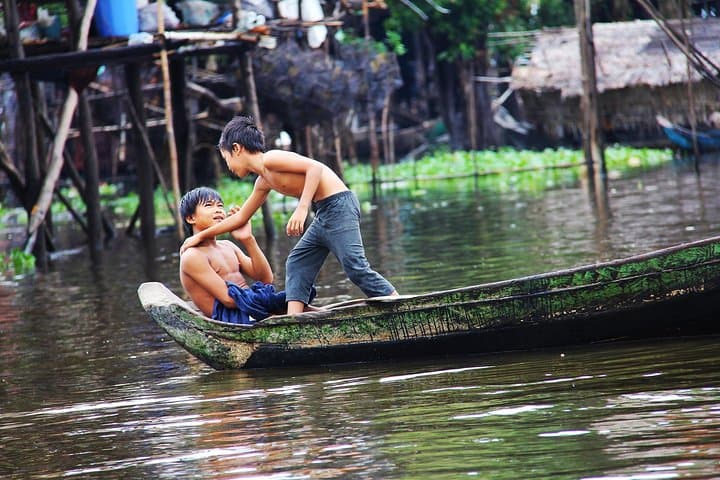
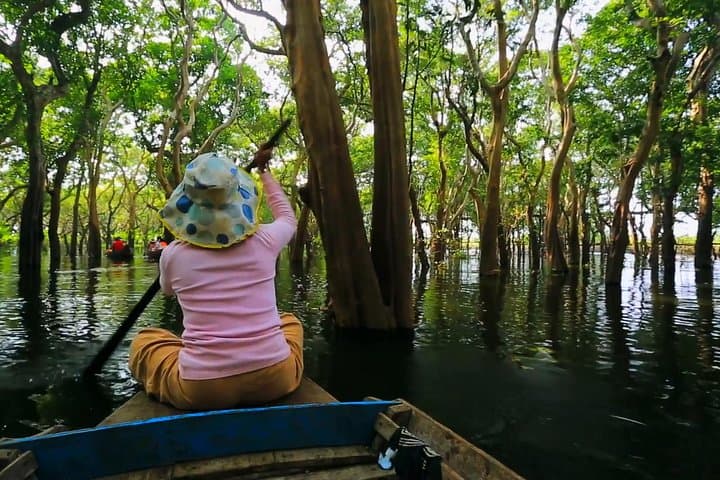
Morning light slips across a low horizon and the water answers, lapping wooden stilts and the ribbed sides of longboats as the village wakes. On the Kompong Phluk tour, travelers move slowly through a water-world: houses on towering stilts, children threading narrow walkways, and a flooded forest where trunks rise like columns from the lake.
Morning light slips across a low horizon and the water answers, lapping wooden stilts and the ribbed sides of longboats as the village wakes. On the Kompong Phluk tour, travelers move slowly through a water-world: houses on towering stilts, children threading narrow walkways, and a flooded forest where trunks rise like columns from the lake.
The Tonle Sap is Cambodia’s ecological heartbeat — a seasonal lake whose pulse changes with the monsoon, expanding to flood forests and fields. Kompong Phluk and nearby Kompong Khleang grew around that rhythm; generations adapted by building on stilts and harvesting fish and freshwater resources. The landscape tells geological and cultural stories: sediment-rich flows from the Mekong, floating fish sanctuaries, and pagodas that anchor communities when waters surge.
Guides from the village bring lived knowledge—how incense was once rolled at home, how local snacks fit the daily rhythm, and which channels hold the best sightlines at low and high water. Canoes weave into the flooded mangrove where light filters through tangled roots and birds—kingfishers, egrets—react like small alarms to passing boats.
Practically, expect 4–5 hours total including hotel pickup. Wear quick-dry layers and non-slip shoes; bring sunscreen, insect repellent, and a camera with a waterproof case. Morning departures include an incense workshop and market stops; afternoon runs offer a sunset over Tonle Sap. Boats and life jackets are provided, but mobility to step in and out of boats is required. The tour is adaptable—tell your guide if you want a shorter day, more photography time, or a stop at a pagoda. It’s an intimate, low-impact way to see how water shapes lives in Cambodia, best approached with curiosity and basic water-safety sense.