THE ADVENTURE COLLECTIVE® · Independent discovery and booking for outdoor travel

Cover Koh Samui’s essential sights in a focused half-day: Big Buddha, Plai Laem’s Chinese shrine, the Hin Ta Hin Yai formations, a bronze Guan Yu, and the swim-ready Na Muang waterfall. This practical loop blends culture, geology and easy walking.
Cover Koh Samui’s essential sights in a focused half-day: Big Buddha, Plai Laem’s Chinese shrine, the Hin Ta Hin Yai formations, a bronze Guan Yu, and the swim-ready Na Muang waterfall. This practical loop blends culture, geology and easy walking.
Stepping off an air-conditioned minivan onto Koh Samui’s coastal road, salt-slick air and the distant crash of surf set the pace. The tour threads a compact loop — temple courtyards, a cliff-top viewpoint over Chaweng, the odd-shaped Hin Ta Hin Yai rocks, a towering Guan Yu statue and the plunging Na Muang waterfall — each stop close enough that the island feels intimate rather than vast.
Verified experiences and guided adventures in the surrounding area.
Operated by Go Samui Cook · Chaweng, Surat Thani Province
Stepping off an air-conditioned minivan onto Koh Samui’s coastal road, salt-slick air and the distant crash of surf set the pace. The tour threads a compact loop — temple courtyards, a cliff-top viewpoint over Chaweng, the odd-shaped Hin Ta Hin Yai rocks, a towering Guan Yu statue and the plunging Na Muang waterfall — each stop close enough that the island feels intimate rather than vast.
This route traces the island’s mixed heritage: Chinese shrines reflecting Hainanese migration, Buddhist hilltop stupas built to be seen from sea, and the volcanic-and-sand geology that shaped Lamai’s rounded rocks and Na Muang’s natural plunge pools. Local vendors selling kalamae candy and incense add small, human chapters to the landscape.
Expect short walks rather than long hikes: steps up to the Big Buddha platform, flat stone paths through Plai Laem, and an easy scramble to viewpoints. Cultural etiquette matters — cover shoulders and knees at temples, speak softly in shrine areas, and accept that some sites are more sacred than scenic.
Practically, the half-day format is efficient: hotel pickup, a guide who handles logistics, one bottled drink and a refresh towel provided, and a final hotel drop-off. Bring swimwear and a towel for Na Muang, sun protection for open viewpoints, and modest clothing for temple visits. Morning departures avoid midday heat and give clearer water at the falls.
This is a well-paced introduction to Koh Samui for travelers who want varied scenery, cultural context and a short, active morning of exploration without strenuous effort.
easy.
5 hours.
Suitable for most travelers in everyday fitness; short flights of steps and brief walks are required.
The tour lasts about 5 hours, including hotel pickup and drop-off, a local guide, one bottled drink and a refresh towel; entrance fees are generally not required for the listed stops.
Yes — Na Muang has a natural pool suitable for swimming; bring water shoes and a towel, and follow any posted safety signs and staff guidance.
Temples like Big Buddha have steps to elevated platforms and may not be fully wheelchair accessible; contact the operator ahead to discuss specific accessibility needs.
The operator lists the tour as suitable for general fitness levels but not recommended for pregnant travelers or those with serious spinal or cardiovascular conditions.
Koh Samui’s coastal route reflects waves of migration and trade: Chinese communities left visible marks in Guanyin and Guan Yu shrines, while Buddhist monuments grew where hilltops offered visibility to seafarers.
Na Muang is a freshwater feature sensitive to litter and sunscreen runoff; stick to marked paths, avoid single-use plastics when possible, and respect temple donation and waste practices.
Go Samui Cook operates guided outdoor trips and adventures with an emphasis on safety, stewardship, and memorable experiences.
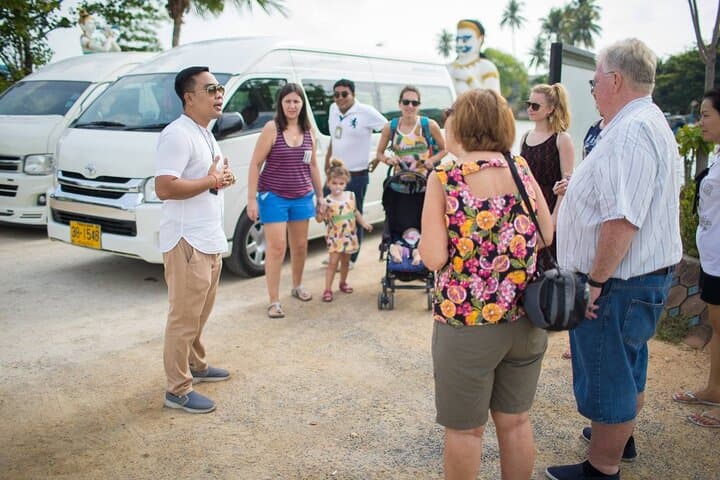


Stepping off an air-conditioned minivan onto Koh Samui’s coastal road, salt-slick air and the distant crash of surf set the pace. The tour threads a compact loop — temple courtyards, a cliff-top viewpoint over Chaweng, the odd-shaped Hin Ta Hin Yai rocks, a towering Guan Yu statue and the plunging Na Muang waterfall — each stop close enough that the island feels intimate rather than vast.
Stepping off an air-conditioned minivan onto Koh Samui’s coastal road, salt-slick air and the distant crash of surf set the pace. The tour threads a compact loop — temple courtyards, a cliff-top viewpoint over Chaweng, the odd-shaped Hin Ta Hin Yai rocks, a towering Guan Yu statue and the plunging Na Muang waterfall — each stop close enough that the island feels intimate rather than vast.
This route traces the island’s mixed heritage: Chinese shrines reflecting Hainanese migration, Buddhist hilltop stupas built to be seen from sea, and the volcanic-and-sand geology that shaped Lamai’s rounded rocks and Na Muang’s natural plunge pools. Local vendors selling kalamae candy and incense add small, human chapters to the landscape.
Expect short walks rather than long hikes: steps up to the Big Buddha platform, flat stone paths through Plai Laem, and an easy scramble to viewpoints. Cultural etiquette matters — cover shoulders and knees at temples, speak softly in shrine areas, and accept that some sites are more sacred than scenic.
Practically, the half-day format is efficient: hotel pickup, a guide who handles logistics, one bottled drink and a refresh towel provided, and a final hotel drop-off. Bring swimwear and a towel for Na Muang, sun protection for open viewpoints, and modest clothing for temple visits. Morning departures avoid midday heat and give clearer water at the falls.
This is a well-paced introduction to Koh Samui for travelers who want varied scenery, cultural context and a short, active morning of exploration without strenuous effort.