THE ADVENTURE COLLECTIVE® · Independent discovery and booking for outdoor travel

Watch the rare Przewalski’s horse on a compact two-day excursion from Ulaanbaatar. This overnight tour pairs wildlife viewing in Khustai with a stop at the Moltsog sand dunes and a night in a traditional yurt camp.
Watch the rare Przewalski’s horse on a compact two-day excursion from Ulaanbaatar. This overnight tour pairs wildlife viewing in Khustai with a stop at the Moltsog sand dunes and a night in a traditional yurt camp.
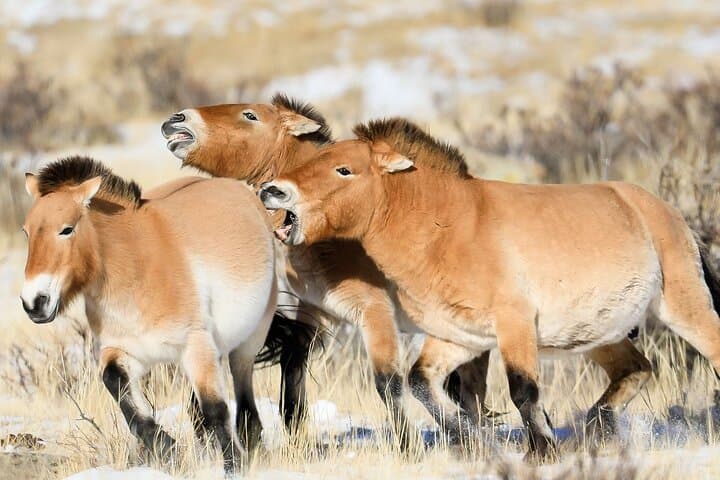
You step out of Ulaanbaatar before dawn and the city recedes into rolling steppe. Wind pushes against the 4WD as pines thin into grassland; in the distance low dunes rise like islands in a sea of grasses. By midafternoon the first herd appears—short-backed Przewalski’s horses grazing with a cautious, ancient patience.
Verified experiences and guided adventures in the surrounding area.
Operated by Augi's Travel · Ulaanbaatar, Töv Province
You step out of Ulaanbaatar before dawn and the city recedes into rolling steppe. Wind pushes against the 4WD as pines thin into grassland; in the distance low dunes rise like islands in a sea of grasses. By midafternoon the first herd appears—short-backed Przewalski’s horses grazing with a cautious, ancient patience.
Khustai National Park is the site of one of the most successful reintroductions in conservation history: the Takhi (Przewalski’s horse) was extinct in the wild until captive-breeding programs released animals here in the 1990s. Geologically the area sits on forest-steppe where glacial and fluvial action over millennia left sandy pockets—the Moltsog dunes—surprising in their contrast to wind-scoured grass.
Culturally the route crosses traditional herding country; overnight stays at a yurt camp offer simple hospitality and meals built around mutton and dairy, where stories about the land are as direct as the people who live on it.
Practical guidance: expect bumpy 4x4 driving, short interpretive walks to observation points, and basic overnight yurt accommodation. Pack layers for wide diurnal swings, binoculars for long-distance spotting, and closed shoes for uneven ground. Wildlife viewing is best in the cooler morning and late afternoon; guides know seasonal concentrations near watering holes.
Plan for two full days—you’ll trade city traffic for the deliberate pace of the steppe, where the landscape tests your attention and rewards it with close encounters, quiet dunes, and the rare sight of a wild horse at eye level.
easy.
2 days.
Suitable for most fitness levels; requires short, easy walks and the ability to board a 4x4 vehicle.
Sightings are common in Khustai National Park, especially near watering areas at dawn and dusk, but wildlife is never guaranteed.
The tour includes an overnight at a yurt camp with basic sleeping facilities and communal meals—comfortable but rustic.
Yes, the tour includes pickup and return by 4WD SUV; confirm your pickup location when you book.
Late spring through early autumn offers the most active wildlife viewing, with cooler mornings and evenings concentrating animals near water.
Khustai was established in 1993 to reintroduce the Przewalski’s horse; careful monitoring and protected habitat enabled wild populations to reestablish.
The park is a model for species reintroduction and emphasizes low-impact tourism—visitors should follow guide instructions to minimize disturbance.
Augi's Travel operates guided outdoor trips and adventures with an emphasis on safety, stewardship, and memorable experiences.
You step out of Ulaanbaatar before dawn and the city recedes into rolling steppe. Wind pushes against the 4WD as pines thin into grassland; in the distance low dunes rise like islands in a sea of grasses. By midafternoon the first herd appears—short-backed Przewalski’s horses grazing with a cautious, ancient patience.
You step out of Ulaanbaatar before dawn and the city recedes into rolling steppe. Wind pushes against the 4WD as pines thin into grassland; in the distance low dunes rise like islands in a sea of grasses. By midafternoon the first herd appears—short-backed Przewalski’s horses grazing with a cautious, ancient patience.
Khustai National Park is the site of one of the most successful reintroductions in conservation history: the Takhi (Przewalski’s horse) was extinct in the wild until captive-breeding programs released animals here in the 1990s. Geologically the area sits on forest-steppe where glacial and fluvial action over millennia left sandy pockets—the Moltsog dunes—surprising in their contrast to wind-scoured grass.
Culturally the route crosses traditional herding country; overnight stays at a yurt camp offer simple hospitality and meals built around mutton and dairy, where stories about the land are as direct as the people who live on it.
Practical guidance: expect bumpy 4x4 driving, short interpretive walks to observation points, and basic overnight yurt accommodation. Pack layers for wide diurnal swings, binoculars for long-distance spotting, and closed shoes for uneven ground. Wildlife viewing is best in the cooler morning and late afternoon; guides know seasonal concentrations near watering holes.
Plan for two full days—you’ll trade city traffic for the deliberate pace of the steppe, where the landscape tests your attention and rewards it with close encounters, quiet dunes, and the rare sight of a wild horse at eye level.