THE ADVENTURE COLLECTIVE® · Independent discovery and booking for outdoor travel

A full‑day private tour along the UAE’s east coast that combines mountain viewpoints, a man‑made waterfall, heritage forts and the rare Madha–Nahwa enclave. Expect scenic drives, short walks, and photographic vistas across the Hajar Mountains and Gulf of Oman.
A full‑day private tour along the UAE’s east coast that combines mountain viewpoints, a man‑made waterfall, heritage forts and the rare Madha–Nahwa enclave. Expect scenic drives, short walks, and photographic vistas across the Hajar Mountains and Gulf of Oman.
Walk into a coast that leans against a mountain range — the Gulf of Oman on one side, the Hajar Mountains rising raw and fluted on the other. The day begins with windows down on a mountain road, salt air pushing through the car as jagged ridgelines shadow a series of small villages and perched rest houses. You’ll feel the landscape press in: rock ledges daring you toward a viewpoint, wadis cooling the valley floor like a hidden breath.
Verified experiences and guided adventures in the surrounding area.
Operated by Dubai Abu Dhabi City Tours & Safaris · Khorfakkan, Sharjah
Walk into a coast that leans against a mountain range — the Gulf of Oman on one side, the Hajar Mountains rising raw and fluted on the other. The day begins with windows down on a mountain road, salt air pushing through the car as jagged ridgelines shadow a series of small villages and perched rest houses. You’ll feel the landscape press in: rock ledges daring you toward a viewpoint, wadis cooling the valley floor like a hidden breath.
This route stitches together modern attractions and deep history. The Khorfakkan waterfall and Al Rafisah dam are recent interventions that sit beside ancient forts and the 15th‑century mosque, reminders of coastal trade, fishing, and inland clans who shaped the east coast. Geologically, the Hajar are ophiolite complexes — uplifted oceanic crust — which explains the steep, fractured rock and narrow wadi channels that funnel seasonal floods.
Culturally the area is a crossroads: local souqs trade woven goods and spices; small museums catalogue pottery and arrowheads from sites such as Al Badiyah. The oddest stop is the Madha–Nahwa enclave complex, a geopolitical curiosity where national borders fold into one another.
Practically, expect a full day (6–7 hours) of scenic driving with short walks and one moderate 3‑hour hiking option at Al Rafisah/Al Suhub. Bring sun protection and at least 1.5–2L of water, comfortable closed shoes for uneven paths, and a lightweight layer for breezy hilltops. Photography windows are frequent — aim for morning or late afternoon light to avoid midday heat and to catch sharper contrast on the cliffs.
easy.
6–7 hours.
Light activity: suitable for most fitness levels; able to walk 1–3 miles on uneven terrain and climb short stair sections
The tour runs about 6–7 hours and includes private transport, admission fees where noted, bottled water, and a guided itinerary of coastal and mountain highlights.
Yes — the tour views the enclave complex from designated stops; access is controlled and visits follow local regulations included in the itinerary.
Most stops are short walks or viewpoints; there’s an optional 3‑hour hiking section at Al Rafisah/Al Suhub that is moderate with some elevation gain.
Yes. The operator lists stroller and wheelchair accessibility for many sites and notes the tour is suitable for all fitness levels; check specific pickup and mobility needs when booking.
The region preserves coastal forts dating to the 16th century and a small 15th‑century mosque, reflecting centuries of maritime trade and local clan settlement.
Recent restoration projects have improved wadis and promenades; visitors are asked to stay on trails to protect fragile mountain vegetation and conserve scarce water resources.
Dubai Abu Dhabi City Tours & Safaris operates guided outdoor trips and adventures with an emphasis on safety, stewardship, and memorable experiences.


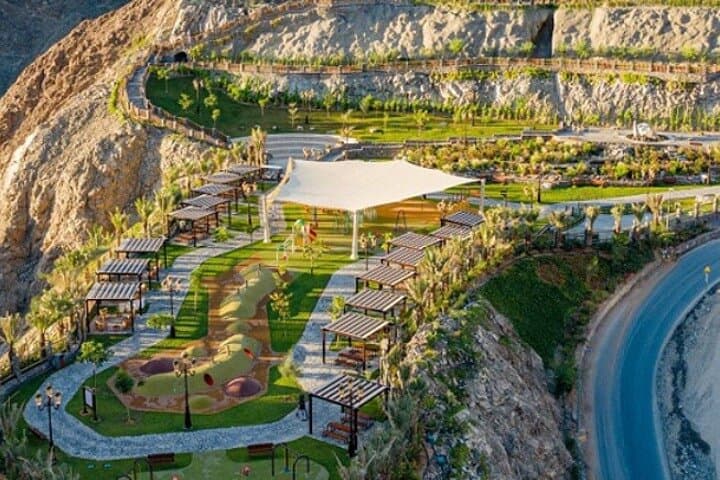
Walk into a coast that leans against a mountain range — the Gulf of Oman on one side, the Hajar Mountains rising raw and fluted on the other. The day begins with windows down on a mountain road, salt air pushing through the car as jagged ridgelines shadow a series of small villages and perched rest houses. You’ll feel the landscape press in: rock ledges daring you toward a viewpoint, wadis cooling the valley floor like a hidden breath.
Walk into a coast that leans against a mountain range — the Gulf of Oman on one side, the Hajar Mountains rising raw and fluted on the other. The day begins with windows down on a mountain road, salt air pushing through the car as jagged ridgelines shadow a series of small villages and perched rest houses. You’ll feel the landscape press in: rock ledges daring you toward a viewpoint, wadis cooling the valley floor like a hidden breath.
This route stitches together modern attractions and deep history. The Khorfakkan waterfall and Al Rafisah dam are recent interventions that sit beside ancient forts and the 15th‑century mosque, reminders of coastal trade, fishing, and inland clans who shaped the east coast. Geologically, the Hajar are ophiolite complexes — uplifted oceanic crust — which explains the steep, fractured rock and narrow wadi channels that funnel seasonal floods.
Culturally the area is a crossroads: local souqs trade woven goods and spices; small museums catalogue pottery and arrowheads from sites such as Al Badiyah. The oddest stop is the Madha–Nahwa enclave complex, a geopolitical curiosity where national borders fold into one another.
Practically, expect a full day (6–7 hours) of scenic driving with short walks and one moderate 3‑hour hiking option at Al Rafisah/Al Suhub. Bring sun protection and at least 1.5–2L of water, comfortable closed shoes for uneven paths, and a lightweight layer for breezy hilltops. Photography windows are frequent — aim for morning or late afternoon light to avoid midday heat and to catch sharper contrast on the cliffs.