THE ADVENTURE COLLECTIVE® · Independent discovery and booking for outdoor travel

Early-morning trail runs in Karura Forest pair runnable singletrack with rivers, a small waterfall and pockets of steep climbing. This private 90-minute experience is ideal for runners wanting a nature-focused workout inside Nairobi.
Early-morning trail runs in Karura Forest pair runnable singletrack with rivers, a small waterfall and pockets of steep climbing. This private 90-minute experience is ideal for runners wanting a nature-focused workout inside Nairobi.
Dawn in Karura Forest arrives soft and active — birds call from the canopy, a thin mist clings to the trail, and the river dares you to follow its course. A guided trail run here threads through tall indigenous trees, skirting streams and a compact waterfall, with short, punchy climbs that wake the legs and caves that punctuate the route.
Verified experiences and guided adventures in the surrounding area.
Operated by Davis Munene · Nairobi, Nairobi County
Dawn in Karura Forest arrives soft and active — birds call from the canopy, a thin mist clings to the trail, and the river dares you to follow its course. A guided trail run here threads through tall indigenous trees, skirting streams and a compact waterfall, with short, punchy climbs that wake the legs and caves that punctuate the route.
Karura is a remnant of Nairobi’s indigenous forest and became a flashpoint in Kenya’s conservation history during the 1990s when public campaigns helped secure it as a protected urban sanctuary. Geologically the area sits on Nairobi’s plateau of volcanic soils and soft rock, producing well-draining earth that becomes slippery after rain. Culturally, runs here pair clean air with a strong local running tradition — Kenya’s daily life and elite sport intersect in the city’s parks.
Expect 5–15 km (3–10 miles) routes on dirt and compacted forest trails, with cumulative elevation gains of roughly 30–90 m (100–300 ft) depending on your line. Early mornings bring the best birdlife and cooler temperatures; mid-day runs can be exposed and hotter.
Practical guidance: wear trail shoes with grip, carry 500–1000 ml water or a light hydration pack, and plan for sticky mud after rains. Stick to marked paths, keep noise low around wildlife, and use a guided run if you’re unfamiliar with trail navigation. Runs are private and typically 90 minutes, offering a practical, athletic way to experience Nairobi’s green heart without leaving the city.
moderate.
1–2 hours.
Moderate cardiovascular fitness; comfortable running on uneven terrain for up to 10 miles if you choose the longer options.
Typical guided runs are 90 minutes and routes can be tailored from about 5 km (3 miles) up to 15 km (10 miles) depending on fitness and pace.
The forest is popular and generally safe during daylight, but if you’re unfamiliar with the trails choose a guided or group run for navigation and local knowledge.
Routes include short, steep hills and uneven terrain; nothing requires technical climbing, but good balance and ankle stability help.
Expect birdlife, colobus and vervet monkeys, and occasionally bushbuck; maintain distance and avoid feeding animals.
Karura became a high-profile conservation success in the 1990s when public activism helped secure it as a protected urban forest, preserving a colonial-era forest reserve within Nairobi.
Visitors are asked to stay on marked trails, avoid littering and keep dogs on leads; local groups and Nairobi County manage trail upkeep and reforestation efforts.
Davis Munene operates guided outdoor trips and adventures with an emphasis on safety, stewardship, and memorable experiences.



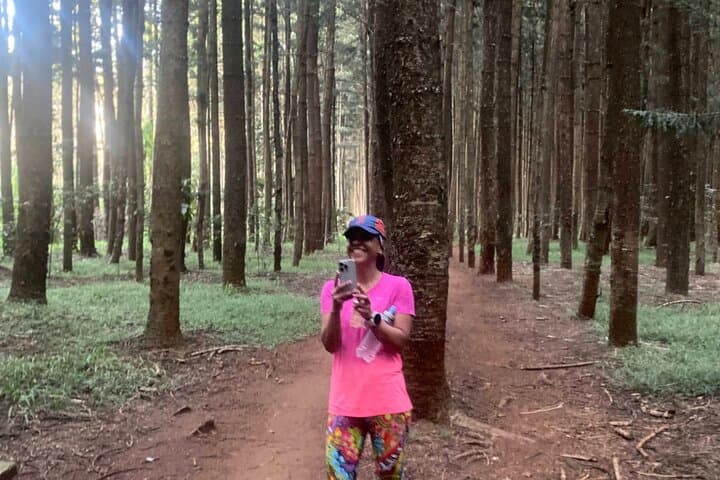
Dawn in Karura Forest arrives soft and active — birds call from the canopy, a thin mist clings to the trail, and the river dares you to follow its course. A guided trail run here threads through tall indigenous trees, skirting streams and a compact waterfall, with short, punchy climbs that wake the legs and caves that punctuate the route.
Dawn in Karura Forest arrives soft and active — birds call from the canopy, a thin mist clings to the trail, and the river dares you to follow its course. A guided trail run here threads through tall indigenous trees, skirting streams and a compact waterfall, with short, punchy climbs that wake the legs and caves that punctuate the route.
Karura is a remnant of Nairobi’s indigenous forest and became a flashpoint in Kenya’s conservation history during the 1990s when public campaigns helped secure it as a protected urban sanctuary. Geologically the area sits on Nairobi’s plateau of volcanic soils and soft rock, producing well-draining earth that becomes slippery after rain. Culturally, runs here pair clean air with a strong local running tradition — Kenya’s daily life and elite sport intersect in the city’s parks.
Expect 5–15 km (3–10 miles) routes on dirt and compacted forest trails, with cumulative elevation gains of roughly 30–90 m (100–300 ft) depending on your line. Early mornings bring the best birdlife and cooler temperatures; mid-day runs can be exposed and hotter.
Practical guidance: wear trail shoes with grip, carry 500–1000 ml water or a light hydration pack, and plan for sticky mud after rains. Stick to marked paths, keep noise low around wildlife, and use a guided run if you’re unfamiliar with trail navigation. Runs are private and typically 90 minutes, offering a practical, athletic way to experience Nairobi’s green heart without leaving the city.