THE ADVENTURE COLLECTIVE® · Independent discovery and booking for outdoor travel

An eight‑hour private day tour from Kandy that pairs the vaulted cave temples of Dambulla, a hands‑on spice garden visit, and the exhilarating climb of Sigiriya (Lion Rock). Practical, paced, and rich in history, it’s an essential circuit for first‑time visitors to central Sri Lanka.
An eight‑hour private day tour from Kandy that pairs the vaulted cave temples of Dambulla, a hands‑on spice garden visit, and the exhilarating climb of Sigiriya (Lion Rock). Practical, paced, and rich in history, it’s an essential circuit for first‑time visitors to central Sri Lanka.
You leave Kandy before the town has finished waking — the city’s red clay roofs shrink in the rear-view mirror as paddy fields and scrub rise toward the central plains. By midmorning the road delivers you to a landscape dominated by a single, startling vertical: Sigiriya, the Lion Rock, pressing skyward like a deliberate interruption in the flat country. The rock doesn’t ask to be admired; it demands attention, and the climb up its iron staircases and carved steps quickly requires it in return.
Verified experiences and guided adventures in the surrounding area.
Operated by Travelling Lanka · Sigiriya, Central Province
You leave Kandy before the town has finished waking — the city’s red clay roofs shrink in the rear-view mirror as paddy fields and scrub rise toward the central plains. By midmorning the road delivers you to a landscape dominated by a single, startling vertical: Sigiriya, the Lion Rock, pressing skyward like a deliberate interruption in the flat country. The rock doesn’t ask to be admired; it demands attention, and the climb up its iron staircases and carved steps quickly requires it in return.
The day tour stitches three distinct chapters of Sri Lanka’s past and present. First, Dambulla’s cave temples — a complex of painted caverns where centuries of devotional layering hide behind cool, dim rock. Statues of the Buddha peer down from niches, their painted robes softened by smoke and age. Then, a short drive brings you to a working spice garden, where cinnamon bark curls like parchment, pepper vines climb trellises, and the guide scratches a piece of turmeric root to prove its heat. Finally, Sigiriya: an engineered palace-summit built by King Kashyapa in the late 5th century CE. Carved lion paws mark the ascent; frescoed panels and the “mirror wall” record an aesthetic of imperial display.
Geologically, Sigiriya is a hardened magma plug — a remnant of a long-eroded volcano — which is why the basalt tower stands so abruptly above the plains. Culturally, it is a stamped memory of royal ambition and urban planning: water gardens, terraced fields and courtyard layouts remain legible even from the summit. On a clear day the top yields a 360-degree panorama that makes the climb feel like a reveal.
Practical guidance: the total tour runs roughly eight hours and includes private, air-conditioned transport from Kandy with hotel pickup. Expect about 1,200 steps and roughly 200 meters of elevation gain on Sigiriya — stone steps and occasional metal platforms make the climb straightforward but steady. Start early in the cool hours, carry at least 1–1.5 liters of water, and wear grippy footwear; some sections are exposed to sun and wind. Tickets for Sigiriya are purchased at the site and are not typically included in the day rate. Allow time for security checks and short waits at viewpoints.
This itinerary balances cultural sites and light exertion, making it well suited to travelers with a moderate fitness level. Guides on these private tours can tailor stops — linger longer at the spice garden or move quickly through the caves — which is ideal if you want to pace the climb. Respect temple etiquette at Dambulla (cover shoulders and remove hats) and be mindful of macaques around car parks: they are curious and opportunistic.
By late afternoon the vehicle eases back onto the road to Kandy, and the Lion Rock recedes into the rear window — the summit’s terraces and ruined walls reduced to a silhouette but lingering in the mind as proof that Sri Lanka’s landscape rewards both attention and effort.
moderate.
8 hours.
Moderate fitness: able to walk stairs and stand for periods; not suitable for those with serious spinal or heart conditions.
No — entrance fees for Sigiriya and Dambulla are typically paid on site; your operator can advise current ticket prices and arrange purchases if requested.
Plan on 45–90 minutes round trip for the ascent and descent depending on fitness, stops, and crowding; many visitors spend additional time exploring the summit ruins.
Yes, but children should be comfortable with stairs and heights; consider carrying younger children at narrow or crowded sections.
Basic facilities and small snack stalls are available near the entrance areas, but bring snacks and water for the climb itself.
Driving distance is roughly 90–110 km depending on route, and travel time is about 2.5–3 hours each way under normal traffic conditions.
No; the Sigiriya climb includes steep stone steps and metal stairways and is not suitable for visitors with significant mobility limitations.
Sigiriya was developed by King Kashyapa in the late 5th century CE as a fortified palace atop a hardened volcanic plug and is one of Sri Lanka’s most intact examples of ancient urban planning.
Visitor pressure and occasional littering threaten fragile frescoes and terraces; use official paths, avoid touching paintings, and minimize single‑use plastics.
Travelling Lanka operates guided outdoor trips and adventures with an emphasis on safety, stewardship, and memorable experiences.
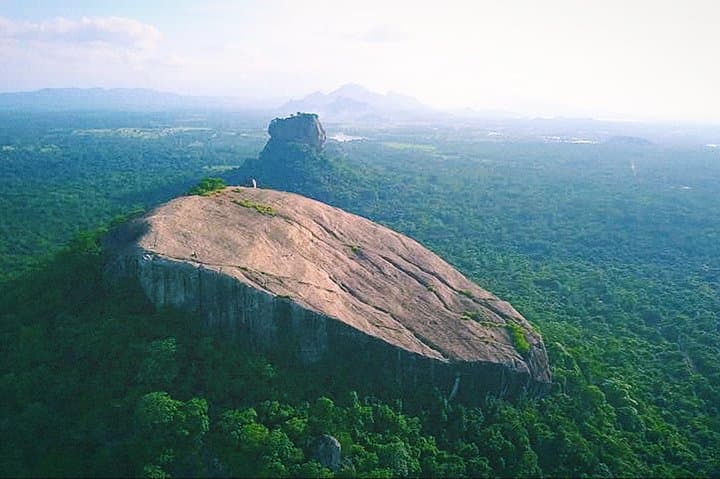
You leave Kandy before the town has finished waking — the city’s red clay roofs shrink in the rear-view mirror as paddy fields and scrub rise toward the central plains. By midmorning the road delivers you to a landscape dominated by a single, startling vertical: Sigiriya, the Lion Rock, pressing skyward like a deliberate interruption in the flat country. The rock doesn’t ask to be admired; it demands attention, and the climb up its iron staircases and carved steps quickly requires it in return.
You leave Kandy before the town has finished waking — the city’s red clay roofs shrink in the rear-view mirror as paddy fields and scrub rise toward the central plains. By midmorning the road delivers you to a landscape dominated by a single, startling vertical: Sigiriya, the Lion Rock, pressing skyward like a deliberate interruption in the flat country. The rock doesn’t ask to be admired; it demands attention, and the climb up its iron staircases and carved steps quickly requires it in return.
The day tour stitches three distinct chapters of Sri Lanka’s past and present. First, Dambulla’s cave temples — a complex of painted caverns where centuries of devotional layering hide behind cool, dim rock. Statues of the Buddha peer down from niches, their painted robes softened by smoke and age. Then, a short drive brings you to a working spice garden, where cinnamon bark curls like parchment, pepper vines climb trellises, and the guide scratches a piece of turmeric root to prove its heat. Finally, Sigiriya: an engineered palace-summit built by King Kashyapa in the late 5th century CE. Carved lion paws mark the ascent; frescoed panels and the “mirror wall” record an aesthetic of imperial display.
Geologically, Sigiriya is a hardened magma plug — a remnant of a long-eroded volcano — which is why the basalt tower stands so abruptly above the plains. Culturally, it is a stamped memory of royal ambition and urban planning: water gardens, terraced fields and courtyard layouts remain legible even from the summit. On a clear day the top yields a 360-degree panorama that makes the climb feel like a reveal.
Practical guidance: the total tour runs roughly eight hours and includes private, air-conditioned transport from Kandy with hotel pickup. Expect about 1,200 steps and roughly 200 meters of elevation gain on Sigiriya — stone steps and occasional metal platforms make the climb straightforward but steady. Start early in the cool hours, carry at least 1–1.5 liters of water, and wear grippy footwear; some sections are exposed to sun and wind. Tickets for Sigiriya are purchased at the site and are not typically included in the day rate. Allow time for security checks and short waits at viewpoints.
This itinerary balances cultural sites and light exertion, making it well suited to travelers with a moderate fitness level. Guides on these private tours can tailor stops — linger longer at the spice garden or move quickly through the caves — which is ideal if you want to pace the climb. Respect temple etiquette at Dambulla (cover shoulders and remove hats) and be mindful of macaques around car parks: they are curious and opportunistic.
By late afternoon the vehicle eases back onto the road to Kandy, and the Lion Rock recedes into the rear window — the summit’s terraces and ruined walls reduced to a silhouette but lingering in the mind as proof that Sri Lanka’s landscape rewards both attention and effort.