THE ADVENTURE COLLECTIVE® · Independent discovery and booking for outdoor travel

Leave Phnom Penh for two days of limestone caves, shimmering salt pans and Kep’s lively crab market. This private, easy-paced tour pairs pepper farms and coastal time with short cultural stops ideal for travelers seeking a compact southern Cambodia experience.
Leave Phnom Penh for two days of limestone caves, shimmering salt pans and Kep’s lively crab market. This private, easy-paced tour pairs pepper farms and coastal time with short cultural stops ideal for travelers seeking a compact southern Cambodia experience.
A sea breeze meets the hum of the road as the van peels out of Phnom Penh and drops you into the rounded hills and salt flats of southern Cambodia.
Verified experiences and guided adventures in the surrounding area.
Operated by Bayon Tabi Tour · Kampot, Kampot Province
A sea breeze meets the hum of the road as the van peels out of Phnom Penh and drops you into the rounded hills and salt flats of southern Cambodia.
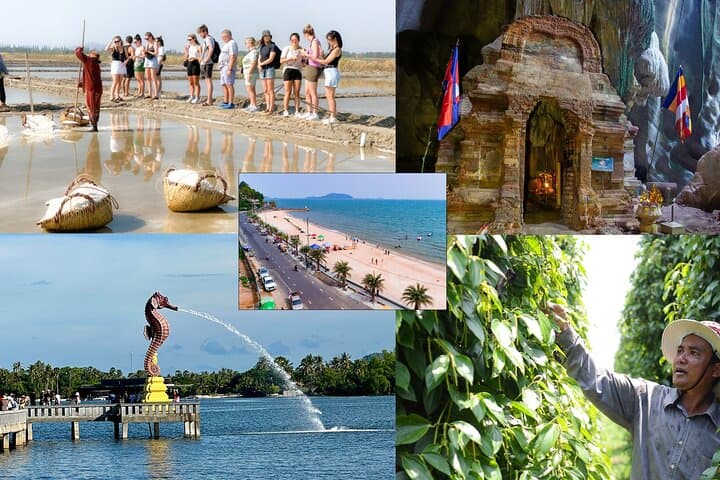
By late afternoon the mirrored pans outside Kampot catch the light and the landscape becomes a bright, geometric gaze—salt fields daring you to time your walk for sunset. Limestone caves puncture the countryside nearby; inside Phnom Chhnork you can feel centuries of rock and brick pressing close, pre-Angkorian carvings half-hidden behind stalagmites. The next day the route dips toward Kep, where the crab market clangs with nets and the smell of charcoal-fired grills; the town’s low-lying beaches invite hammock naps and slow coffee breaks.
This short two-day loop leans on colonial-era Indochine character, agricultural folklore and a coastline shaped by Khmer livelihoods—pepper farms producing Kampot pepper, salt pans timed to the dry season, and a thriving seaside market culture.
Practicalities are straightforward: expect roughly three hours of driving each way from Phnom Penh, short walks to caves and farms, and mostly flat terrain at the salt pans and beaches. Salt-field access is best in the dry season (December–May); pepper harvest runs October–May. Bring sturdy shoes for cave scrambles, sun protection for exposed salt flats and cash for rural markets. If you want the best light, time the salt flats for late afternoon and visit the pepper plantation in the cooler morning.
The tour moves at an easy pace—good for first-time travelers who want a condensed, tactile taste of Cambodia’s south coast.
easy.
2 days.
Suitable for most fitness levels; involves short walks, light scrambling in caves and minimal elevation change
Expect roughly a three-hour drive each way on a private car or van depending on traffic and road conditions.
Salt harvesting is visible during the dry season, typically December through May; outside that window the pans are often flooded or fallow.
Yes—this is an easy-paced, private tour with short walking segments and family-friendly meals, but watch children carefully in caves and near the water.
The tour includes select entrance fees, two lunches, two dinners and breakfast as listed; confirm specifics with your operator before booking.
Kampot and Kep carry a strong colonial-era Indochine imprint—French villas, pepper plantations and trading routes that helped shape the region’s modern economy.
Salt pans and pepper farms are working landscapes; stick to marked paths, avoid disturbing production areas and support local businesses to help maintain sustainable livelihoods.
Bayon Tabi Tour operates guided outdoor trips and adventures with an emphasis on safety, stewardship, and memorable experiences.


A sea breeze meets the hum of the road as the van peels out of Phnom Penh and drops you into the rounded hills and salt flats of southern Cambodia.
A sea breeze meets the hum of the road as the van peels out of Phnom Penh and drops you into the rounded hills and salt flats of southern Cambodia.
By late afternoon the mirrored pans outside Kampot catch the light and the landscape becomes a bright, geometric gaze—salt fields daring you to time your walk for sunset. Limestone caves puncture the countryside nearby; inside Phnom Chhnork you can feel centuries of rock and brick pressing close, pre-Angkorian carvings half-hidden behind stalagmites. The next day the route dips toward Kep, where the crab market clangs with nets and the smell of charcoal-fired grills; the town’s low-lying beaches invite hammock naps and slow coffee breaks.
This short two-day loop leans on colonial-era Indochine character, agricultural folklore and a coastline shaped by Khmer livelihoods—pepper farms producing Kampot pepper, salt pans timed to the dry season, and a thriving seaside market culture.
Practicalities are straightforward: expect roughly three hours of driving each way from Phnom Penh, short walks to caves and farms, and mostly flat terrain at the salt pans and beaches. Salt-field access is best in the dry season (December–May); pepper harvest runs October–May. Bring sturdy shoes for cave scrambles, sun protection for exposed salt flats and cash for rural markets. If you want the best light, time the salt flats for late afternoon and visit the pepper plantation in the cooler morning.
The tour moves at an easy pace—good for first-time travelers who want a condensed, tactile taste of Cambodia’s south coast.