THE ADVENTURE COLLECTIVE® · Independent discovery and booking for outdoor travel

Board a motorboat at dawn and watch Tonle Sap’s houses rise on tall stilts as the lake swells. This half-day tour to Kampong Phluk offers up-close views of stilt architecture, local fishing life, and lakeside markets with practical tips for timing, packing, and etiquette.
Board a motorboat at dawn and watch Tonle Sap’s houses rise on tall stilts as the lake swells. This half-day tour to Kampong Phluk offers up-close views of stilt architecture, local fishing life, and lakeside markets with practical tips for timing, packing, and etiquette.
Early morning light strips the lake to silver as a narrow motorboat parts the glassy surface; stilts rise like wooden pylons from shallow water and children wave from high porches that only months before were dry earth. Kampong Phluk sits on the eastern edge of Tonle Sap, where seasonal floodwaters transform fields into waterways and everyday life adapts to the rise and fall of the lake.
Verified experiences and guided adventures in the surrounding area.
Operated by Cambodia Voluntour - Day Tours · Siem Reap, Siem Reap Province
Early morning light strips the lake to silver as a narrow motorboat parts the glassy surface; stilts rise like wooden pylons from shallow water and children wave from high porches that only months before were dry earth. Kampong Phluk sits on the eastern edge of Tonle Sap, where seasonal floodwaters transform fields into waterways and everyday life adapts to the rise and fall of the lake.
Historically Tonle Sap has been Cambodia’s freshwater breadbasket, its flood pulse driven by the Mekong’s monsoon-fed reversal. Geologically this is a low-gradient floodplain—soft sediments, broad shallow basins—and the architecture here reflects that: houses on 7–10m stilts, boats as primary transport, floating gardens during peak wet months. Culturally the village is both a fishing community and a living archive of adaptive rural practices; you’ll observe nets, seasonally raised rice stores, and the social rhythms that follow water levels.
On a half-day tour you’ll glide through stilted lanes, pause at family compounds to see subsistence fishing gear, and learn how the lake supports local economies and biodiversity. Expect basic boat seating, humidity, and strong sun when the water is low; in the wet season the landscape opens and boats move under house eaves.
Practical guidance: book morning departures to avoid heat and afternoon storms, carry cash for small purchases at the Old Market, wear sun protection and lightweight cover, and bring binoculars for waterbirds. Respect private compounds, ask before photographing residents, and follow your guide’s direction when landing at narrow, raised walkways.
easy.
5 hours.
Suitable for most travelers with basic mobility; involves short boat transfers and stepping on/off narrow docks.
Visit in the cool dry season (November–February) for lower humidity and easier walking; the wet season (June–October) offers dramatic high-water scenes when houses appear to float.
The standard tour is about five hours round-trip from Siem Reap, with 1–2 hours on the lake; seating is on a covered long-tail or motorboat with basic facilities.
Access involves boarding boats and stepping onto narrow, elevated walkways—travelers with serious mobility limitations should notify the operator in advance; the tour is otherwise rated easy.
Yes—there are small local vendors, an Artisan School stop, and the Old Market where you can buy crafts and snacks; bring cash in small riels or US dollars.
Tonle Sap’s seasonal floodplain has supported Khmer agriculture and fisheries for centuries; the floating-stilt dwellings evolved as practical responses to extreme annual water fluctuations.
Tonle Sap is ecologically critical but under pressure from overfishing and upstream damming; support responsible guides and avoid buying endangered wildlife products.
Cambodia Voluntour - Day Tours operates guided outdoor trips and adventures with an emphasis on safety, stewardship, and memorable experiences.
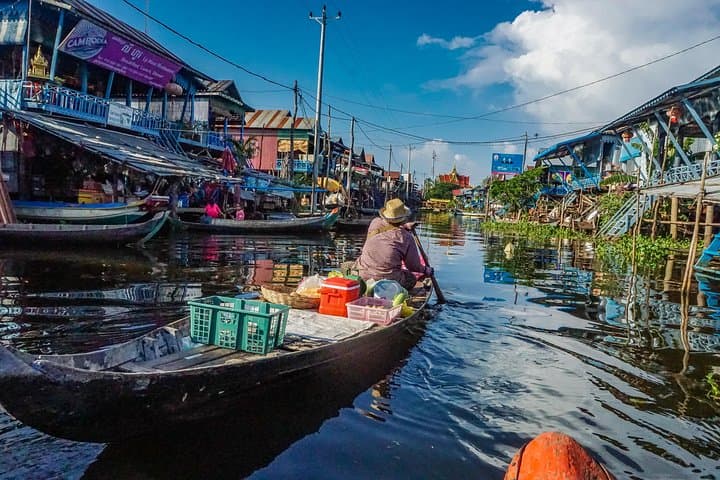


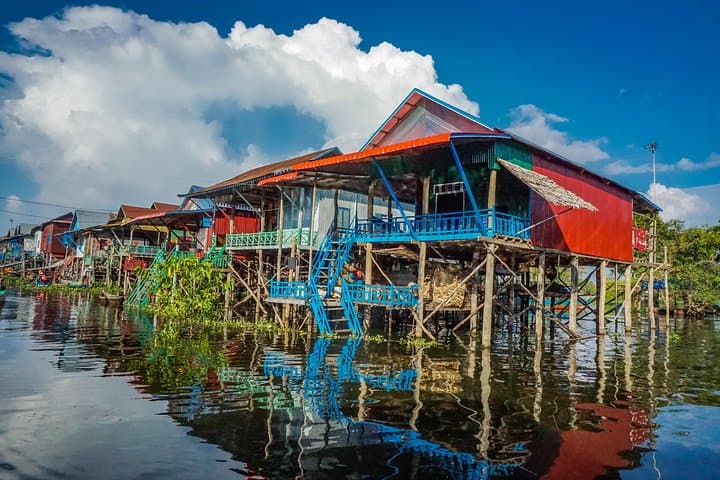
Early morning light strips the lake to silver as a narrow motorboat parts the glassy surface; stilts rise like wooden pylons from shallow water and children wave from high porches that only months before were dry earth. Kampong Phluk sits on the eastern edge of Tonle Sap, where seasonal floodwaters transform fields into waterways and everyday life adapts to the rise and fall of the lake.
Early morning light strips the lake to silver as a narrow motorboat parts the glassy surface; stilts rise like wooden pylons from shallow water and children wave from high porches that only months before were dry earth. Kampong Phluk sits on the eastern edge of Tonle Sap, where seasonal floodwaters transform fields into waterways and everyday life adapts to the rise and fall of the lake.
Historically Tonle Sap has been Cambodia’s freshwater breadbasket, its flood pulse driven by the Mekong’s monsoon-fed reversal. Geologically this is a low-gradient floodplain—soft sediments, broad shallow basins—and the architecture here reflects that: houses on 7–10m stilts, boats as primary transport, floating gardens during peak wet months. Culturally the village is both a fishing community and a living archive of adaptive rural practices; you’ll observe nets, seasonally raised rice stores, and the social rhythms that follow water levels.
On a half-day tour you’ll glide through stilted lanes, pause at family compounds to see subsistence fishing gear, and learn how the lake supports local economies and biodiversity. Expect basic boat seating, humidity, and strong sun when the water is low; in the wet season the landscape opens and boats move under house eaves.
Practical guidance: book morning departures to avoid heat and afternoon storms, carry cash for small purchases at the Old Market, wear sun protection and lightweight cover, and bring binoculars for waterbirds. Respect private compounds, ask before photographing residents, and follow your guide’s direction when landing at narrow, raised walkways.