THE ADVENTURE COLLECTIVE® · Independent discovery and booking for outdoor travel

A compact, two‑hour guided walk through Kampong Glam that pairs mosque history with street art and fixed local snacks. Ideal for travelers who want cultural context and tactile moments in a short, stroller‑friendly route.
A compact, two‑hour guided walk through Kampong Glam that pairs mosque history with street art and fixed local snacks. Ideal for travelers who want cultural context and tactile moments in a short, stroller‑friendly route.
On a humid late-morning in Kampong Glam, narrow streets hum with scooter brakes and the spice-sweet air of curry and kopi. Walkers thread between low, painted shophouses; the gold domes of Sultan Mosque rise and hold the sun like a polished coin.
Verified experiences and guided adventures in the surrounding area.
Operated by Tours by Istoria Collective Singapore · Singapore, Singapore
On a humid late-morning in Kampong Glam, narrow streets hum with scooter brakes and the spice-sweet air of curry and kopi. Walkers thread between low, painted shophouses; the gold domes of Sultan Mosque rise and hold the sun like a polished coin.
The area became the Malay‑Muslim quarter after Stamford Raffles’ early 19th‑century urban plan, when kampongs and royal allotments clustered around the sultan’s residence. Architectural details—wooden jalousies, tiled eaves and shopfront tiles—trace trade links to the Malay Archipelago and Arab merchants who landed on Singapore’s original shoreline. Geologically the precinct sits on low, coastal plains reshaped by land reclamation; today streets replace mangroves and the city’s edge has pushed outward, concentrating history into a compact walkable grid.
On the two‑hour Thread of Faith and Fabric tour, an English‑speaking guide moves through mosque history, mural makers’ stories and the recipes behind a shared dessert. Stops are a mix of curated narrative and tactile moments: feel prayer rug texture, read shopfront dates and pause for a fixed snack that layers coconut and palm sugar.
Practical guidance is straightforward: wear closed-toe shoes for uneven pavements, carry a refillable water bottle (tap water is safe) and dress modestly for mosque views. Bring small cash for boutique purchases, and pack a light rain layer—heavy showers can reroute the walk. Morning and late afternoon offer softer light and a cooler pace. Expect a small-group pace with room for questions, always.
easy.
2–2.5 hours.
Suitable for most fitness levels; short periods of standing and walking on paved, sometimes uneven, streets.
The route is generally stroller accessible on paved paths; some sidewalks have small steps or uneven surfaces—contact the operator in advance for full accessibility details.
Yes—a fixed local snack and a traditional dessert are included; menu items are set and cannot be customized on the day.
Meeting details are provided at booking, typically near Sultan Mosque or a nearby landmark on Bussorah Street; arrive 10 minutes early to check in.
The tour is conducted in English with an English‑speaking guide included in the price.
Kampong Glam was designated as the Malay‑Muslim quarter in the early 19th century during British urban reorganization and grew around the Sultan’s residence and Arab trading community.
Respectful behaviour around religious sites and support for local shopfronts help preserve the precinct; reduce single‑use plastics and stick to marked walkways to protect renovated shophouse facades.
Tours by Istoria Collective Singapore operates guided outdoor trips and adventures with an emphasis on safety, stewardship, and memorable experiences.

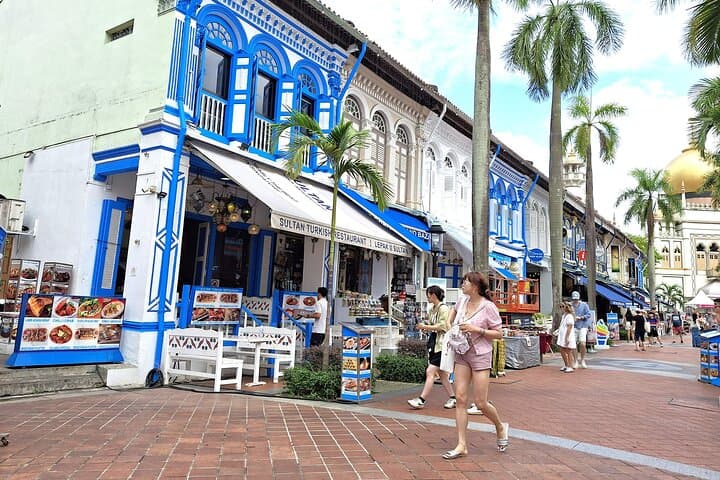


On a humid late-morning in Kampong Glam, narrow streets hum with scooter brakes and the spice-sweet air of curry and kopi. Walkers thread between low, painted shophouses; the gold domes of Sultan Mosque rise and hold the sun like a polished coin.
On a humid late-morning in Kampong Glam, narrow streets hum with scooter brakes and the spice-sweet air of curry and kopi. Walkers thread between low, painted shophouses; the gold domes of Sultan Mosque rise and hold the sun like a polished coin.
The area became the Malay‑Muslim quarter after Stamford Raffles’ early 19th‑century urban plan, when kampongs and royal allotments clustered around the sultan’s residence. Architectural details—wooden jalousies, tiled eaves and shopfront tiles—trace trade links to the Malay Archipelago and Arab merchants who landed on Singapore’s original shoreline. Geologically the precinct sits on low, coastal plains reshaped by land reclamation; today streets replace mangroves and the city’s edge has pushed outward, concentrating history into a compact walkable grid.
On the two‑hour Thread of Faith and Fabric tour, an English‑speaking guide moves through mosque history, mural makers’ stories and the recipes behind a shared dessert. Stops are a mix of curated narrative and tactile moments: feel prayer rug texture, read shopfront dates and pause for a fixed snack that layers coconut and palm sugar.
Practical guidance is straightforward: wear closed-toe shoes for uneven pavements, carry a refillable water bottle (tap water is safe) and dress modestly for mosque views. Bring small cash for boutique purchases, and pack a light rain layer—heavy showers can reroute the walk. Morning and late afternoon offer softer light and a cooler pace. Expect a small-group pace with room for questions, always.