THE ADVENTURE COLLECTIVE® · Independent discovery and booking for outdoor travel

Escape the crowds for a day on Jinshanling’s dramatic ridgelines—where restored Ming walkways meet wild, unrestored stretches. This full-day hike offers steep steps, dozens of watchtowers, and sweeping mountain views best timed for early morning or late afternoon light.
Escape the crowds for a day on Jinshanling’s dramatic ridgelines—where restored Ming walkways meet wild, unrestored stretches. This full-day hike offers steep steps, dozens of watchtowers, and sweeping mountain views best timed for early morning or late afternoon light.
A thin ribbon of stone climbs the spine of the Yan Mountains, and at Jinshanling the wall alternates between neat, restored steps and rough, time-worn battlements that still dare you to explore.
Verified experiences and guided adventures in the surrounding area.
Operated by GlobalTix (Hong Kong) Pte Limited · Chengde, Hebei
A thin ribbon of stone climbs the spine of the Yan Mountains, and at Jinshanling the wall alternates between neat, restored steps and rough, time-worn battlements that still dare you to explore.
Start with the cool of morning as the bus winds from Chengde or Beijing and the ridgelines appear—granite outcrops, scrub pines, and watchtowers stepping down the valley like an old guard. Jinshanling was fortified in the Ming Dynasty; its watchtowers and crenellations were built for visibility and defense, and much of the surviving masonry still reads like military architecture carved into the mountain.
Geology here is honest: hard rock and steep grades force the Wall to cling to ridge crests, producing dramatic sightlines across valleys and distant pine-clad summits. Local villages below speak to a rural Hebei culture that remains quieter than the tourist hubs nearer Beijing.
Practically, expect 3–5 hours on site: climb steep stone steps, traverse restored walkways, and pick your way over tougher, unrestored sections where footing is irregular. The tour includes entrance and a scenic shuttle; departures are early and require a valid passport. Hydrate, wear sturdy shoes with good grip, and time photography for low sun—either dawn or late afternoon when the Wall throws long shadows across the slopes. Respect restricted areas, pack out trash, and move carefully on crumbling sections. Jinshanling rewards curiosity: it's a place where history still leans into the landscape, and the wind along the ridge seems to keep watch as much as the towers do.
moderate.
3–5 hours.
Moderate fitness: you should be comfortable on steep stone steps and uneven terrain for several hours.
The on-site exploration is typically 3–5 hours depending on pace and sections visited; total tour time including travel is longer.
Many sections are family-friendly, but steep steps and uneven unrestored stretches can be challenging—assess mobility and take breaks.
Yes, entrance and scenic shuttle tickets are included with this tour as noted in the inclusions.
Bring sun protection for summer and windproof/warm layers for cool mornings or shoulder seasons; the ridge is exposed to fast-changing conditions.
Jinshanling was reinforced during the Ming Dynasty to control mountain passes; many watchtowers retain original defensive layouts for commanding sightlines.
Visitor impact is managed by limiting large-scale development at the site; practice leave-no-trace and stay on permitted paths to protect fragile masonry and vegetation.
GlobalTix (Hong Kong) Pte Limited operates guided outdoor trips and adventures with an emphasis on safety, stewardship, and memorable experiences.


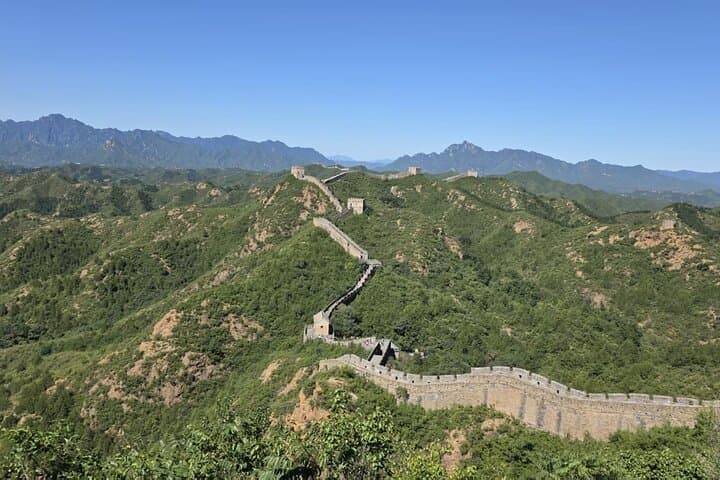

A thin ribbon of stone climbs the spine of the Yan Mountains, and at Jinshanling the wall alternates between neat, restored steps and rough, time-worn battlements that still dare you to explore.
A thin ribbon of stone climbs the spine of the Yan Mountains, and at Jinshanling the wall alternates between neat, restored steps and rough, time-worn battlements that still dare you to explore.
Start with the cool of morning as the bus winds from Chengde or Beijing and the ridgelines appear—granite outcrops, scrub pines, and watchtowers stepping down the valley like an old guard. Jinshanling was fortified in the Ming Dynasty; its watchtowers and crenellations were built for visibility and defense, and much of the surviving masonry still reads like military architecture carved into the mountain.
Geology here is honest: hard rock and steep grades force the Wall to cling to ridge crests, producing dramatic sightlines across valleys and distant pine-clad summits. Local villages below speak to a rural Hebei culture that remains quieter than the tourist hubs nearer Beijing.
Practically, expect 3–5 hours on site: climb steep stone steps, traverse restored walkways, and pick your way over tougher, unrestored sections where footing is irregular. The tour includes entrance and a scenic shuttle; departures are early and require a valid passport. Hydrate, wear sturdy shoes with good grip, and time photography for low sun—either dawn or late afternoon when the Wall throws long shadows across the slopes. Respect restricted areas, pack out trash, and move carefully on crumbling sections. Jinshanling rewards curiosity: it's a place where history still leans into the landscape, and the wind along the ridge seems to keep watch as much as the towers do.