THE ADVENTURE COLLECTIVE® · Independent discovery and booking for outdoor travel

A half-day coach tour from Beijing delivers 10 km of Ming-era wall, more than 100 watchtowers and a mix of restored and wild sections. This guide outlines what to expect on the trail, brief history and practical tips for the hike.
A half-day coach tour from Beijing delivers 10 km of Ming-era wall, more than 100 watchtowers and a mix of restored and wild sections. This guide outlines what to expect on the trail, brief history and practical tips for the hike.
The morning coach pulls away from Beijing; fields thin into rolling hills and the wall appears like a stone spine cutting across ridgelines. At Jinshanling the air is sharp, wind pushing against the towers as if testing their purpose, and the path alternates between restored steps and rough, original masonry that still bears the marks of time.
Verified experiences and guided adventures in the surrounding area.
Operated by Century Holiday · Luanping County, Hebei
The morning coach pulls away from Beijing; fields thin into rolling hills and the wall appears like a stone spine cutting across ridgelines. At Jinshanling the air is sharp, wind pushing against the towers as if testing their purpose, and the path alternates between restored steps and rough, original masonry that still bears the marks of time.
Built and reinforced during the Ming Dynasty, Jinshanling is a 10-kilometer military defense system of passes, beacon towers and watchtowers. Geologically the wall rides a series of granite ridges and weathered sedimentary slopes, which creates steep ascents and exposed traverses. The site sits in Luanping County, Hebei, and historically served as a midpoint between Beijing and the northeastern passes—its towers were designed for signaling and layered defense.
Culturally, nearby villages retain simple mountain cuisine—hearty noodles and braised vegetables—that tour lunches often feature. Expect local vendors near the parking areas and a steady flow of domestic visitors; despite restorations in sections, parts remain rugged and silent.
Practical guidance: the usual itinerary docks around 3–4 hours on the wall—plan for uneven stone, frequent steps and short, steep climbs. Carry at least 2 liters of water, a sun layer and grippy footwear; poles help on the rougher stretches. Follow your guide’s advice about limiting the number of towers you climb to conserve energy for the return drive. Peak daylight hours bring clearer views; early starts reduce crowds. Respect fenced-off areas and leave no trace—the wall’s masonry and surrounding scrub are sensitive to erosion and heavy foot traffic.
moderate.
4–5 hours.
Expect several short steep sections and sustained walking over uneven stone; good aerobic fitness and stable balance help.
The touring section is moderate: uneven stone and steep steps over short pitches, with sections of restored and unrestored wall—expect several hours of active walking.
Hotel pick-up is offered within the 2nd Ring Road between about 6:00–6:30am; specific pickup times are confirmed the evening before.
Public facilities are available at the visitor entrance and some parking areas, but not reliably on the wall itself—use facilities before you start hiking.
Full refunds are available if you cancel at least 24 hours before departure; no refund for no-shows.
Jinshanling was strengthened under the Ming Dynasty as part of a continuous military defense line—its dense cluster of watchtowers enabled fast visual signaling across the frontier.
Heavy foot traffic and informal climbing accelerate masonry wear; visitors should stay on open paths, avoid leaning on fragile brickwork and carry out all trash.
Century Holiday operates guided outdoor trips and adventures with an emphasis on safety, stewardship, and memorable experiences.
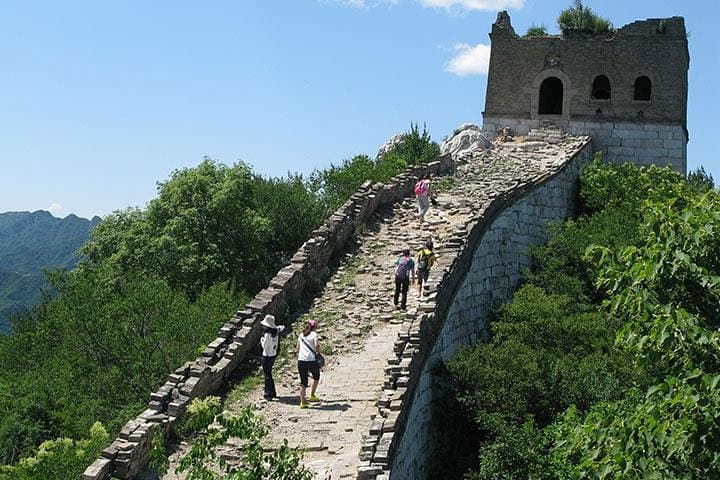


The morning coach pulls away from Beijing; fields thin into rolling hills and the wall appears like a stone spine cutting across ridgelines. At Jinshanling the air is sharp, wind pushing against the towers as if testing their purpose, and the path alternates between restored steps and rough, original masonry that still bears the marks of time.
The morning coach pulls away from Beijing; fields thin into rolling hills and the wall appears like a stone spine cutting across ridgelines. At Jinshanling the air is sharp, wind pushing against the towers as if testing their purpose, and the path alternates between restored steps and rough, original masonry that still bears the marks of time.
Built and reinforced during the Ming Dynasty, Jinshanling is a 10-kilometer military defense system of passes, beacon towers and watchtowers. Geologically the wall rides a series of granite ridges and weathered sedimentary slopes, which creates steep ascents and exposed traverses. The site sits in Luanping County, Hebei, and historically served as a midpoint between Beijing and the northeastern passes—its towers were designed for signaling and layered defense.
Culturally, nearby villages retain simple mountain cuisine—hearty noodles and braised vegetables—that tour lunches often feature. Expect local vendors near the parking areas and a steady flow of domestic visitors; despite restorations in sections, parts remain rugged and silent.
Practical guidance: the usual itinerary docks around 3–4 hours on the wall—plan for uneven stone, frequent steps and short, steep climbs. Carry at least 2 liters of water, a sun layer and grippy footwear; poles help on the rougher stretches. Follow your guide’s advice about limiting the number of towers you climb to conserve energy for the return drive. Peak daylight hours bring clearer views; early starts reduce crowds. Respect fenced-off areas and leave no trace—the wall’s masonry and surrounding scrub are sensitive to erosion and heavy foot traffic.