THE ADVENTURE COLLECTIVE® · Independent discovery and booking for outdoor travel

Take a half-day from Amman to Jerash and walk the broad Oval Plaza, pass under Hadrian’s Arch, and explore one of the best-preserved Roman towns in the Middle East. This practical guide covers what to expect, when to go, and what to pack.
Take a half-day from Amman to Jerash and walk the broad Oval Plaza, pass under Hadrian’s Arch, and explore one of the best-preserved Roman towns in the Middle East. This practical guide covers what to expect, when to go, and what to pack.
A morning drive from Amman opens into a landscape where olive terraces give way to a sweep of stone and colonnades: Jerash. The city arrives gradually — a ribbon of white road, a scatter of modern houses, then the crescent of the Oval Plaza appearing like an amphitheater laid flat. Walkers move through arches and sun-faded marble; wind whispers over columns and the past seems to keep pace.
Verified experiences and guided adventures in the surrounding area.
Operated by Alamal Travel &Tourism · Jerash, Amman Governorate
A morning drive from Amman opens into a landscape where olive terraces give way to a sweep of stone and colonnades: Jerash. The city arrives gradually — a ribbon of white road, a scatter of modern houses, then the crescent of the Oval Plaza appearing like an amphitheater laid flat. Walkers move through arches and sun-faded marble; wind whispers over columns and the past seems to keep pace.
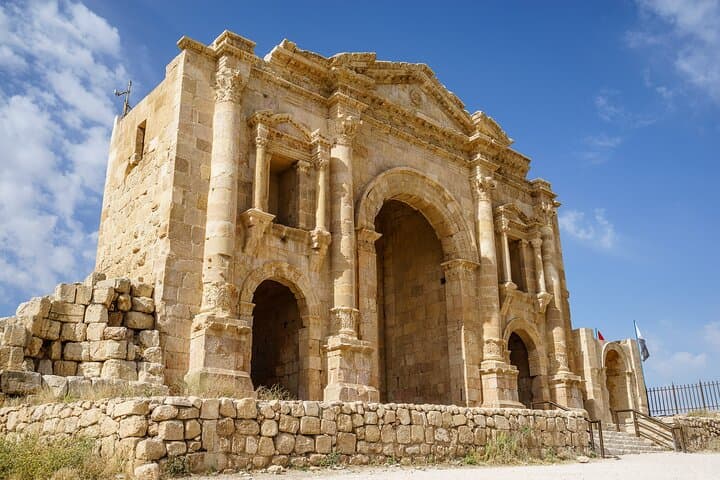
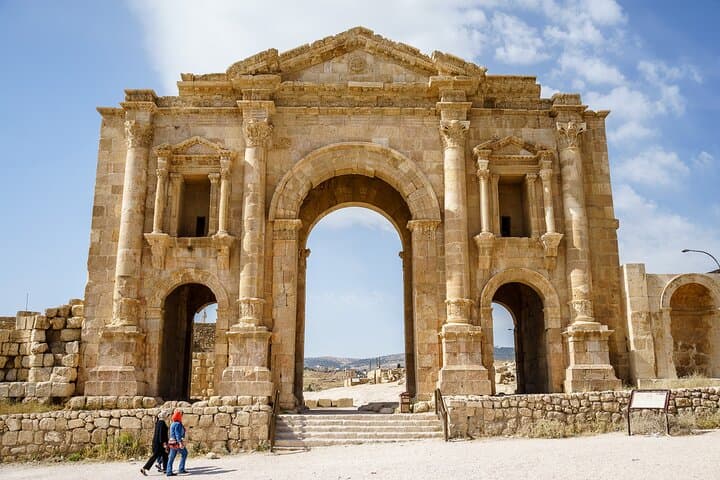
Jerash (ancient Gerasa) is one of the best-preserved Roman provincial towns outside Italy. Founded long before Rome’s arrival, it flourished as part of the Decapolis and expanded under emperors such as Hadrian — whose triumphal arch still marks the main approach. Geologically, the site sits on limestone bedrock that was quarried for local construction; you’ll notice the pale stone and the carved details that have survived millennia.
Culturally the area balances archaeology and everyday Jordanian life: vendors sell coffee and citrus nearby, and English-speaking local guides translate masonry into stories of trade, conquest, and local craft. The drive from Amman is scenic, with low hills and scattered olive trees nudging the roadside.
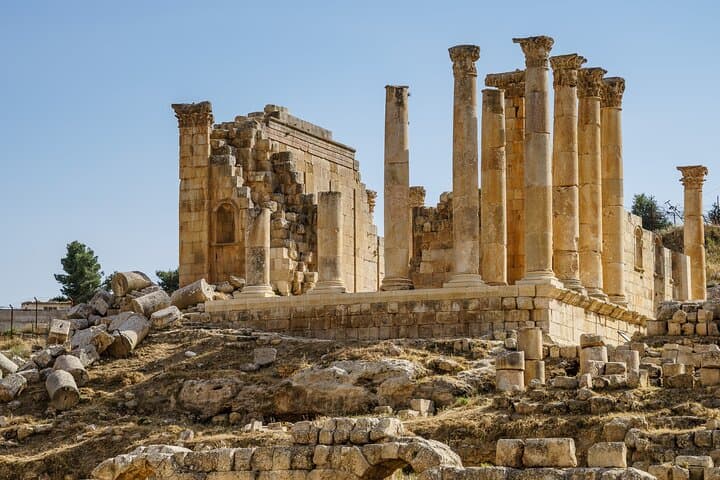
Practical guidance: the half-day tour runs about 5–6 hours including transit, with roughly three hours at the ruins — enough to see Hadrian’s Arch, the Oval Plaza, Temple of Artemis, and the South Theater at a steady pace. Surfaces are uneven and often sun-exposed; comfortable walking shoes, sun protection, and a refillable water bottle are essential. Morning departures reduce heat and crowds; modest dress is advisable when moving through towns. Expect a relaxed, low-intensity outing that rewards curiosity and a steady pair of shoes.
easy.
5–6 hours.
Suitable for most fitness levels; requires walking on uneven ground for up to three hours.
Entry tickets are not automatically included unless selected; check your booking option and bring local currency or a card for onsite purchases.
The drive typically takes about 45–60 minutes each way depending on traffic, making the total tour roughly 5–6 hours including time at the site.
Jerash has uneven surfaces and some steps; while parts near the main gates are more level, full access is limited — discuss specific needs with the operator before booking.
Most private half-day tours include an English-speaking driver and a local guide can often be arranged; confirm guide inclusion when booking.
Jerash (Gerasa) was an important Decapolis city under Roman rule; the layout of cardo, decumanus, and temples reflects Roman urban planning adapted to local topography.
The site manages foot traffic to protect fragile mosaics and columns—stay on marked paths, don’t climb monuments, and support local guides and conservation fees where applicable.
Alamal Travel &Tourism operates guided outdoor trips and adventures with an emphasis on safety, stewardship, and memorable experiences.
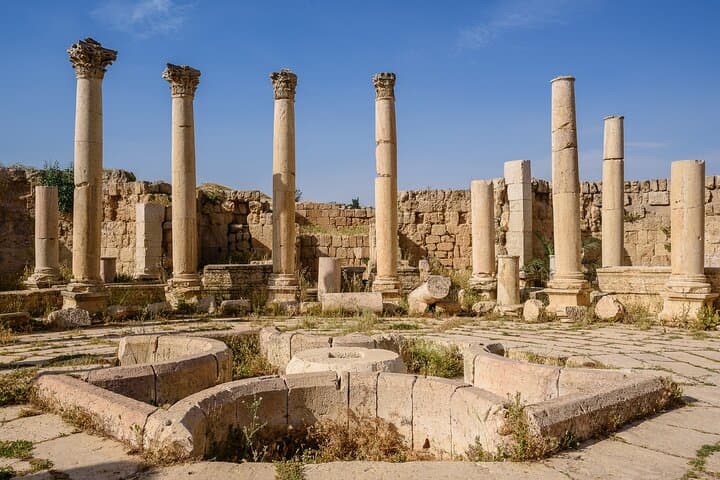
A morning drive from Amman opens into a landscape where olive terraces give way to a sweep of stone and colonnades: Jerash. The city arrives gradually — a ribbon of white road, a scatter of modern houses, then the crescent of the Oval Plaza appearing like an amphitheater laid flat. Walkers move through arches and sun-faded marble; wind whispers over columns and the past seems to keep pace.
A morning drive from Amman opens into a landscape where olive terraces give way to a sweep of stone and colonnades: Jerash. The city arrives gradually — a ribbon of white road, a scatter of modern houses, then the crescent of the Oval Plaza appearing like an amphitheater laid flat. Walkers move through arches and sun-faded marble; wind whispers over columns and the past seems to keep pace.
Jerash (ancient Gerasa) is one of the best-preserved Roman provincial towns outside Italy. Founded long before Rome’s arrival, it flourished as part of the Decapolis and expanded under emperors such as Hadrian — whose triumphal arch still marks the main approach. Geologically, the site sits on limestone bedrock that was quarried for local construction; you’ll notice the pale stone and the carved details that have survived millennia.
Culturally the area balances archaeology and everyday Jordanian life: vendors sell coffee and citrus nearby, and English-speaking local guides translate masonry into stories of trade, conquest, and local craft. The drive from Amman is scenic, with low hills and scattered olive trees nudging the roadside.
Practical guidance: the half-day tour runs about 5–6 hours including transit, with roughly three hours at the ruins — enough to see Hadrian’s Arch, the Oval Plaza, Temple of Artemis, and the South Theater at a steady pace. Surfaces are uneven and often sun-exposed; comfortable walking shoes, sun protection, and a refillable water bottle are essential. Morning departures reduce heat and crowds; modest dress is advisable when moving through towns. Expect a relaxed, low-intensity outing that rewards curiosity and a steady pair of shoes.