THE ADVENTURE COLLECTIVE® · Independent discovery and booking for outdoor travel

Move quickly through Venice’s political and spiritual heart on a 3.5-hour walking tour of St. Mark’s Basilica and the Doge’s Palace. This guided route pairs skip‑the‑line access with historical context to bring the city’s mosaics, courtyards, and canals into sharper focus.
Move quickly through Venice’s political and spiritual heart on a 3.5-hour walking tour of St. Mark’s Basilica and the Doge’s Palace. This guided route pairs skip‑the‑line access with historical context to bring the city’s mosaics, courtyards, and canals into sharper focus.
You step into St. Mark’s Square when the bells have just finished tolling and the light hits the mosaics like polished metal—cool, reflective, decisive. The guide leads the way past flocks of insouciant pigeons and toward the basilica’s bronze doors; inside, the air is cooler and the gold mosaics seem to lean in, eager to be examined. Later, the Doge’s Palace waits across the square: a courtyard of carved marble, shadowed arches, and the narrow corridor that once ferried prisoners past the high windows of the city.
Verified experiences and guided adventures in the surrounding area.
You step into St. Mark’s Square when the bells have just finished tolling and the light hits the mosaics like polished metal—cool, reflective, decisive. The guide leads the way past flocks of insouciant pigeons and toward the basilica’s bronze doors; inside, the air is cooler and the gold mosaics seem to lean in, eager to be examined. Later, the Doge’s Palace waits across the square: a courtyard of carved marble, shadowed arches, and the narrow corridor that once ferried prisoners past the high windows of the city.
This compact 3.5-hour experience stitches together Venice’s civic center: St. Mark’s Basilica, a Byzantine jewel whose layered mosaics and domes narrate centuries of trade, devotion, and political theater; and the Doge’s Palace, the former seat of the republic where justice, administration, and ritual intersected in stone. The basilica grew from a 9th-century reliquary into a lavish 11th-century church, its façade studded with spolia from Constantinople. The palace—built of Istrian stone and pink Verona marble—reflects Venetian wealth earned on Mediterranean routes and sea lanes.
Geologically, Venice is a child of the lagoon: sediment and tidal currents piled silts into islands while the Adriatic’s moods continued to tug the city’s edges. That relationship is alive in every canal—the water lapping at foundation stones, pushing and pulling at stone staircases and campi. Culturally, this part of town is less about residential life and more about performance: civic theater, religious pageantry, and centuries of diplomacy played out against the square’s pavement.
Practically, this tour is a concentrated primer. Expect stairs, historic floors that are uneven, and crowds—especially midday. Skip‑the‑line access smooths entry, but interior rooms can still bottleneck at major highlights. Photography is permitted in many interior spaces, but follow signage and guides; flash can be restricted in mosaic areas. Comfortable shoes are nonnegotiable: you’ll cover cobble and marble, and portions of the walking component are outdoors and exposed.
Good timing multiplies enjoyment: mornings mean softer light and fewer people, late afternoons offer warm facades for photos, and winter brings a quiet, misted quality that reveals the city’s stones rather than its parade. Bring a refillable bottle (water fountains nearby), and foldable rain protection if the forecast hints at acqua alta—Venetian high tides alter routes and add a dramatic note to the day.
For travelers seeking a distilled introduction to Venice’s political and religious heart, this tour delivers concentrated context, tactile history, and a sequence of visual highs—domes, mosaics, carved loggias—that make sense of the city’s long obsession with display and seafaring power.
easy.
3–4 hours.
Suitable for travelers with basic walking fitness; involves standing and climbing stairs over historic uneven flooring.
Most bookings include priority entry to St. Mark’s Basilica and Doge’s Palace, but you may still pass a security screening and experience short waits inside busy rooms.
Accessibility is partial: ramps and lifts exist in some areas, but many rooms and bridges have steps—check with the operator in advance for current accommodations.
Photography is generally allowed in many interior spaces, but flash and tripods are often restricted; obey guides and signage to avoid penalties.
Expect moderate walking on flat and uneven surfaces with several staircases; total tour time is about 3.5 hours including interior visits and outdoor transitions.
Public restrooms are available around Piazza San Marco and at nearby cafe facilities; plan short breaks since interiors have limited facilities.
Guided tours are commonly offered in English and other major languages—confirm language availability when booking, especially for small-group departures.
St. Mark's Basilica became Venice’s cathedral through a mixture of piety and politics after the relics of St. Mark arrived from Alexandria in the 9th century; the Doge’s Palace served as the seat of the Venetian Republic’s government until 1797.
Rising tides and tourist pressure are ongoing challenges; follow local guidance, avoid touching fragile mosaics, and support conservation fees that help maintain historic fabric.
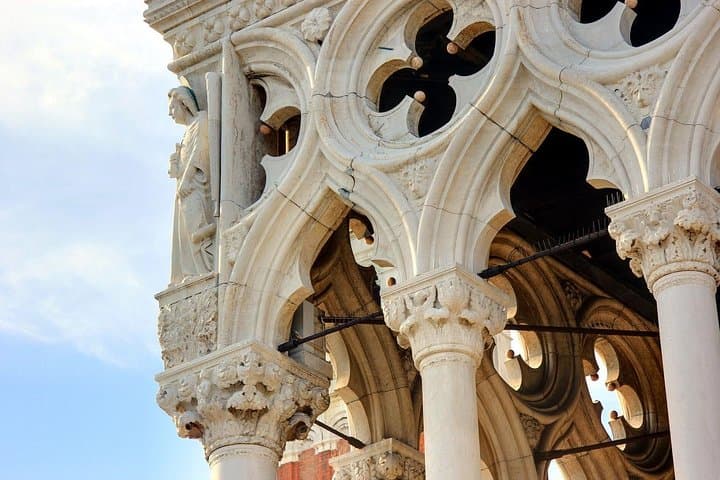
You step into St. Mark’s Square when the bells have just finished tolling and the light hits the mosaics like polished metal—cool, reflective, decisive. The guide leads the way past flocks of insouciant pigeons and toward the basilica’s bronze doors; inside, the air is cooler and the gold mosaics seem to lean in, eager to be examined. Later, the Doge’s Palace waits across the square: a courtyard of carved marble, shadowed arches, and the narrow corridor that once ferried prisoners past the high windows of the city.
You step into St. Mark’s Square when the bells have just finished tolling and the light hits the mosaics like polished metal—cool, reflective, decisive. The guide leads the way past flocks of insouciant pigeons and toward the basilica’s bronze doors; inside, the air is cooler and the gold mosaics seem to lean in, eager to be examined. Later, the Doge’s Palace waits across the square: a courtyard of carved marble, shadowed arches, and the narrow corridor that once ferried prisoners past the high windows of the city.
This compact 3.5-hour experience stitches together Venice’s civic center: St. Mark’s Basilica, a Byzantine jewel whose layered mosaics and domes narrate centuries of trade, devotion, and political theater; and the Doge’s Palace, the former seat of the republic where justice, administration, and ritual intersected in stone. The basilica grew from a 9th-century reliquary into a lavish 11th-century church, its façade studded with spolia from Constantinople. The palace—built of Istrian stone and pink Verona marble—reflects Venetian wealth earned on Mediterranean routes and sea lanes.
Geologically, Venice is a child of the lagoon: sediment and tidal currents piled silts into islands while the Adriatic’s moods continued to tug the city’s edges. That relationship is alive in every canal—the water lapping at foundation stones, pushing and pulling at stone staircases and campi. Culturally, this part of town is less about residential life and more about performance: civic theater, religious pageantry, and centuries of diplomacy played out against the square’s pavement.
Practically, this tour is a concentrated primer. Expect stairs, historic floors that are uneven, and crowds—especially midday. Skip‑the‑line access smooths entry, but interior rooms can still bottleneck at major highlights. Photography is permitted in many interior spaces, but follow signage and guides; flash can be restricted in mosaic areas. Comfortable shoes are nonnegotiable: you’ll cover cobble and marble, and portions of the walking component are outdoors and exposed.
Good timing multiplies enjoyment: mornings mean softer light and fewer people, late afternoons offer warm facades for photos, and winter brings a quiet, misted quality that reveals the city’s stones rather than its parade. Bring a refillable bottle (water fountains nearby), and foldable rain protection if the forecast hints at acqua alta—Venetian high tides alter routes and add a dramatic note to the day.
For travelers seeking a distilled introduction to Venice’s political and religious heart, this tour delivers concentrated context, tactile history, and a sequence of visual highs—domes, mosaics, carved loggias—that make sense of the city’s long obsession with display and seafaring power.