THE ADVENTURE COLLECTIVE® · Independent discovery and booking for outdoor travel

Step behind iron bars for a 30-minute guided exploration of St. Augustine’s Old Jail. Hear the stories of sheriff’s quarters, cell blocks and a justice system that once rented out inmates to local farms.
Step behind iron bars for a 30-minute guided exploration of St. Augustine’s Old Jail. Hear the stories of sheriff’s quarters, cell blocks and a justice system that once rented out inmates to local farms.
A narrow courtyard hush meets the footstep as you push through the iron gate of the Old Jail on San Marco Avenue. Light slits along the cell blocks throw sharp bars of shadow; a guide in period uniform — a modern “jailer” — invites you to step into rooms that kept St. Augustine’s troublemakers and secrets for decades.
Verified experiences and guided adventures in the surrounding area.
Operated by Historic Tours Of America · St. Augustine, Florida
A narrow courtyard hush meets the footstep as you push through the iron gate of the Old Jail on San Marco Avenue. Light slits along the cell blocks throw sharp bars of shadow; a guide in period uniform — a modern “jailer” — invites you to step into rooms that kept St. Augustine’s troublemakers and secrets for decades.
The Old Jail was the county lockup into the mid-20th century and its cells, gallows and sheriff’s quarters map a raw chapter of local justice. Visitors hear stories of Sheriff Perry, a towering figure who ran the facility around the turn of the century and whose policies—like leasing inmates to local farms—left a tangible imprint on the town’s social fabric. Accounts of eight recorded executions, including the 1908 hanging of Sim Jackson, are part of the tour’s sober history.
The jail sits in a city shaped by coquina and coastal winds; the Atlantic pushes cooler air through the narrow streets and the building’s heavy doors hold a weight of civic memory. Culturally, the site spans law enforcement, domestic life (the sheriff’s family lived above the cells) and the evolving ideas about punishment in a small Southern city.
Practicalities are straightforward: tours run about 30 minutes, led by costumed guides; admission is included with the ticket. The museum is wheelchair accessible on the lower floor, children five and under enter free, and reservations aren’t accepted—arrive early in high season. Comfortable shoes, a hat for the short outdoor stretches and water suffice. Photography is permitted in most areas; remain respectful in spaces that recall real human hardship. Expect a tight, atmospheric visit that connects St. Augustine’s civic past to the streets you’ll walk afterward.
easy.
30 minutes.
Suitable for all fitness levels; requires standing and walking on stairs for short periods
Guided tours last about 30 minutes and cover cells, the gallows and the sheriff’s living quarters.
No; tours are first come, first served—arrive early in peak season to secure space.
Yes, the lower floor is wheelchair accessible; upper cell blocks have stairs and limited access.
Children are welcome; children five years and younger enter free per museum policy.
The Old Jail was the county detention center until 1953; exhibits highlight local law enforcement, inmate labor practices and notable cases from the late 19th and early 20th centuries.
The museum operates within historic preservation efforts downtown—respect pathways and signage to protect fragile interiors and original fabric.
Historic Tours Of America operates guided outdoor trips and adventures with an emphasis on safety, stewardship, and memorable experiences.



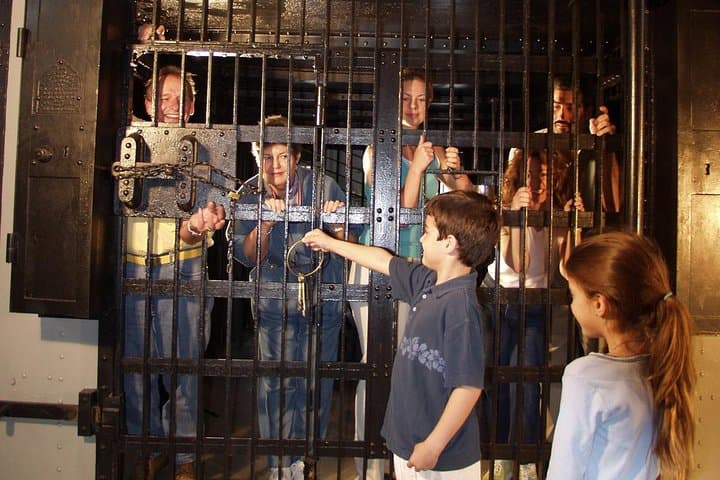
A narrow courtyard hush meets the footstep as you push through the iron gate of the Old Jail on San Marco Avenue. Light slits along the cell blocks throw sharp bars of shadow; a guide in period uniform — a modern “jailer” — invites you to step into rooms that kept St. Augustine’s troublemakers and secrets for decades.
A narrow courtyard hush meets the footstep as you push through the iron gate of the Old Jail on San Marco Avenue. Light slits along the cell blocks throw sharp bars of shadow; a guide in period uniform — a modern “jailer” — invites you to step into rooms that kept St. Augustine’s troublemakers and secrets for decades.
The Old Jail was the county lockup into the mid-20th century and its cells, gallows and sheriff’s quarters map a raw chapter of local justice. Visitors hear stories of Sheriff Perry, a towering figure who ran the facility around the turn of the century and whose policies—like leasing inmates to local farms—left a tangible imprint on the town’s social fabric. Accounts of eight recorded executions, including the 1908 hanging of Sim Jackson, are part of the tour’s sober history.
The jail sits in a city shaped by coquina and coastal winds; the Atlantic pushes cooler air through the narrow streets and the building’s heavy doors hold a weight of civic memory. Culturally, the site spans law enforcement, domestic life (the sheriff’s family lived above the cells) and the evolving ideas about punishment in a small Southern city.
Practicalities are straightforward: tours run about 30 minutes, led by costumed guides; admission is included with the ticket. The museum is wheelchair accessible on the lower floor, children five and under enter free, and reservations aren’t accepted—arrive early in high season. Comfortable shoes, a hat for the short outdoor stretches and water suffice. Photography is permitted in most areas; remain respectful in spaces that recall real human hardship. Expect a tight, atmospheric visit that connects St. Augustine’s civic past to the streets you’ll walk afterward.