THE ADVENTURE COLLECTIVE® · Independent discovery and booking for outdoor travel

Experience Hawaii’s marine life up close at the Maui Ocean Center — from living Pacific corals to a 750,000‑gallon Open Ocean exhibit and an immersive 3D humpback presentation. Plan 2–4 hours and time your visit around daily talks and feedings for the best views.
Experience Hawaii’s marine life up close at the Maui Ocean Center — from living Pacific corals to a 750,000‑gallon Open Ocean exhibit and an immersive 3D humpback presentation. Plan 2–4 hours and time your visit around daily talks and feedings for the best views.
The first view in the Maui Ocean Center is not just tanks and glass but the Pacific pressing close — an aquarium built at the water’s edge where currents and culture meet.
Verified experiences and guided adventures in the surrounding area.
Operated by Maui Ocean Center · Ma'alaea Village, Hawaii
The first view in the Maui Ocean Center is not just tanks and glass but the Pacific pressing close — an aquarium built at the water’s edge where currents and culture meet.
Walk from the Living Reef galleries into the 750,000‑gallon Open Ocean exhibit and the scale of Hawaiian waters becomes physical: coral gardens that host fish found only in these islands, a slow‑moving turtle in a lagoon, and the hush of the Humpbacks of Hawai‘i 3D Sphere that places you beneath seasonal giants. The center pairs natural history with cultural practice — wood carving demonstrations and marine‑naturalist talks frame species within Hawaiian mo‘olelo (stories) and stewardship.
Geologically, Maui’s reefs trace volcanic flows and reef accretion over millennia; the aquarium’s living coral exhibits emphasize Pacific coral diversity and fragility. Expect clear educational signage, scheduled talks (turtle presentations at 10:30 AM & 2:30 PM; shark talks at 11:45 AM & 1:45 PM), and tactile tide‑pool stations for hands‑on learning.
Practically, plan 2–4 hours to move at a relaxed pace, hit the Sphere early to avoid crowding, and time visits around feeding demos for better viewing. The site is wheelchair accessible with on‑site dining and a gift shop if you want local art or sustainable souvenirs. Bring a light layer for air‑conditioned galleries, a refillable bottle, and a camera with a fast lens for low‑light tanks. Whether you’re filling a rainy afternoon or anchoring a family day, the center is both an interpretive hub for Hawaiian marine life and a practical stop for travelers who want to connect with the ocean without getting wet.
easy.
2–4 hours.
Suitable for all fitness levels; mostly flat walking indoors with accessible routes.
All‑day admission allows entry between 9:00 AM and 5:00 PM with last entry at 4:00 PM on the selected date.
Yes — daily marine‑naturalist presentations include Turtle Lagoon at 10:30 AM and 2:30 PM and Shark Nursery Bay talks at 11:45 AM and 1:45 PM; check the daily schedule on arrival.
Yes — facilities, exhibits and restrooms are wheelchair accessible; service animals are allowed.
Outside food is generally not permitted inside exhibit areas, but the on‑site Seascape Restaurant and designated seating areas provide dining options.
The center integrates Hawaiian cultural practices and education alongside marine science, highlighting native species and traditional knowledge about the ocean.
Maui Ocean Center supports reef education and restoration efforts and emphasizes sustainable seafood and visitor stewardship to protect fragile reef ecosystems.
Maui Ocean Center operates guided outdoor trips and adventures with an emphasis on safety, stewardship, and memorable experiences.


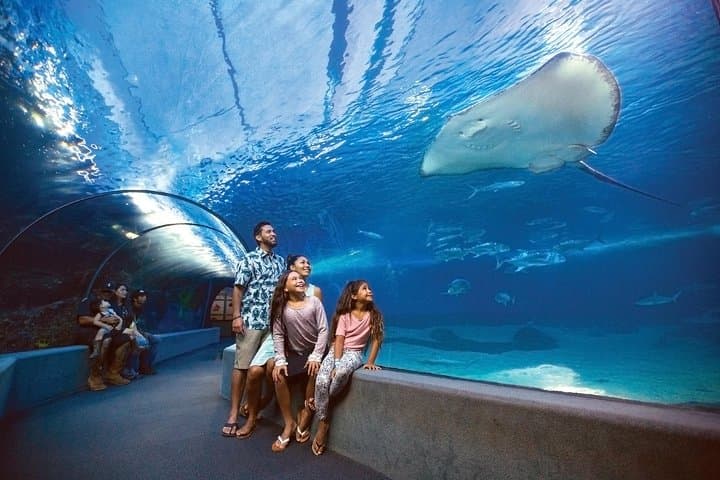

The first view in the Maui Ocean Center is not just tanks and glass but the Pacific pressing close — an aquarium built at the water’s edge where currents and culture meet.
The first view in the Maui Ocean Center is not just tanks and glass but the Pacific pressing close — an aquarium built at the water’s edge where currents and culture meet.
Walk from the Living Reef galleries into the 750,000‑gallon Open Ocean exhibit and the scale of Hawaiian waters becomes physical: coral gardens that host fish found only in these islands, a slow‑moving turtle in a lagoon, and the hush of the Humpbacks of Hawai‘i 3D Sphere that places you beneath seasonal giants. The center pairs natural history with cultural practice — wood carving demonstrations and marine‑naturalist talks frame species within Hawaiian mo‘olelo (stories) and stewardship.
Geologically, Maui’s reefs trace volcanic flows and reef accretion over millennia; the aquarium’s living coral exhibits emphasize Pacific coral diversity and fragility. Expect clear educational signage, scheduled talks (turtle presentations at 10:30 AM & 2:30 PM; shark talks at 11:45 AM & 1:45 PM), and tactile tide‑pool stations for hands‑on learning.
Practically, plan 2–4 hours to move at a relaxed pace, hit the Sphere early to avoid crowding, and time visits around feeding demos for better viewing. The site is wheelchair accessible with on‑site dining and a gift shop if you want local art or sustainable souvenirs. Bring a light layer for air‑conditioned galleries, a refillable bottle, and a camera with a fast lens for low‑light tanks. Whether you’re filling a rainy afternoon or anchoring a family day, the center is both an interpretive hub for Hawaiian marine life and a practical stop for travelers who want to connect with the ocean without getting wet.