THE ADVENTURE COLLECTIVE® · Independent discovery and booking for outdoor travel

Walk into a world of slow-moving giants and precise habitats at Oceanário de Lisboa. This Lisbon institution offers immersive marine displays, educational exhibits, and a practical, accessible layout ideal for families and curious travelers.
Walk into a world of slow-moving giants and precise habitats at Oceanário de Lisboa. This Lisbon institution offers immersive marine displays, educational exhibits, and a practical, accessible layout ideal for families and curious travelers.
Step through the glass doors at Parque das Nações and the air shifts: the hush of filtered light, the slow drift of plankton-like silhouettes and a central tank that seems to hold the pull of the sea itself.
Verified experiences and guided adventures in the surrounding area.
Step through the glass doors at Parque das Nações and the air shifts: the hush of filtered light, the slow drift of plankton-like silhouettes and a central tank that seems to hold the pull of the sea itself.
Opened for Expo '98 and designed as part of a larger riverside renewal, Oceanário de Lisboa arranges marine worlds around a single colossal aquarium that stitches open-ocean life to coastal habitats. Exhibits evoke the Tagus estuary and distant seas alike—rocky Atlantic shores, colder southern waters, and warmer tropical displays—each framed with educational panels and touch-friendly learning spaces.
Beyond the tanks there’s context: Lisbon’s waterfront was refashioned from industrial margin to a public showcase in the late 1990s, making the oceanarium both a cultural landmark and a statement about human relationships with marine systems. Expect an accessible, family-friendly layout with rotating temporary exhibits that highlight conservation, fisheries, and ocean science.
Practical guidance: plan 1–2 hours for a focused visit, longer if you use the educational spaces. Morning entries are quieter; late afternoons can be busier with cruise-day spillover. The site is a short walk from Gare do Oriente (train, metro, bus) and has elevators and ramps for strollers and wheelchairs. Photography is welcome but avoid flash around sensitive animals. Buy skip-the-line tickets on busy days and bring a small refillable bottle—the cafés are convenient but lines can form.
This is an indoor, interpretive marine experience rather than a dive or boat trip: it brings ocean complexity within walking distance of Lisbon’s riverside promenades, pairing spectacle with practical lessons about stewardship.
easy.
1–4 hours.
Light walking and standing; suitable for visitors of most fitness levels
Most visitors spend 1–2 hours; allow up to 3–4 hours if attending temporary exhibits or programs.
Yes—paths, ramps, and elevators provide access throughout the main galleries and educational spaces.
Yes—check the daily schedule on arrival for feedings or short educational presentations, which vary by season.
Outside snacks are generally allowed in public areas, and there are cafés onsite for full meals and drinks.
Built as part of Lisbon’s Expo '98 redevelopment, the Oceanário helped transform a former industrial waterfront into a cultural and science hub.
The facility emphasizes research and public education about marine conservation; visitors can support outreach programs and learn practical actions to reduce plastic and overfishing impacts.
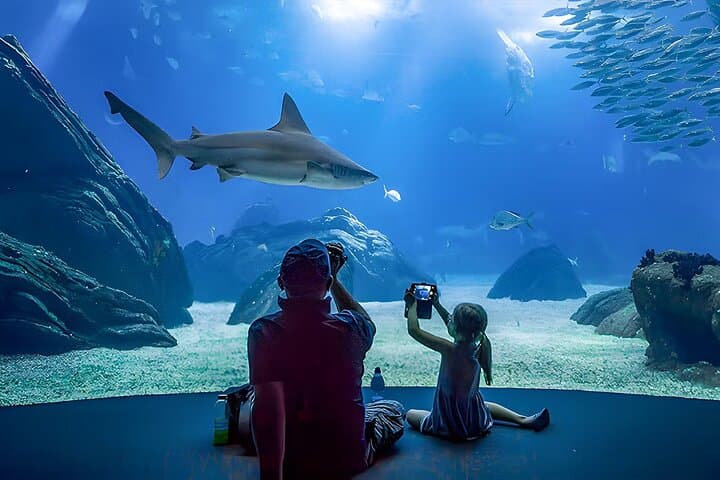
Step through the glass doors at Parque das Nações and the air shifts: the hush of filtered light, the slow drift of plankton-like silhouettes and a central tank that seems to hold the pull of the sea itself.
Step through the glass doors at Parque das Nações and the air shifts: the hush of filtered light, the slow drift of plankton-like silhouettes and a central tank that seems to hold the pull of the sea itself.
Opened for Expo '98 and designed as part of a larger riverside renewal, Oceanário de Lisboa arranges marine worlds around a single colossal aquarium that stitches open-ocean life to coastal habitats. Exhibits evoke the Tagus estuary and distant seas alike—rocky Atlantic shores, colder southern waters, and warmer tropical displays—each framed with educational panels and touch-friendly learning spaces.
Beyond the tanks there’s context: Lisbon’s waterfront was refashioned from industrial margin to a public showcase in the late 1990s, making the oceanarium both a cultural landmark and a statement about human relationships with marine systems. Expect an accessible, family-friendly layout with rotating temporary exhibits that highlight conservation, fisheries, and ocean science.
Practical guidance: plan 1–2 hours for a focused visit, longer if you use the educational spaces. Morning entries are quieter; late afternoons can be busier with cruise-day spillover. The site is a short walk from Gare do Oriente (train, metro, bus) and has elevators and ramps for strollers and wheelchairs. Photography is welcome but avoid flash around sensitive animals. Buy skip-the-line tickets on busy days and bring a small refillable bottle—the cafés are convenient but lines can form.
This is an indoor, interpretive marine experience rather than a dive or boat trip: it brings ocean complexity within walking distance of Lisbon’s riverside promenades, pairing spectacle with practical lessons about stewardship.