THE ADVENTURE COLLECTIVE® · Independent discovery and booking for outdoor travel

A full-day private tour that brings you face-to-face with the Korean Peninsula's dividing line: visit the 3rd Tunnel, Dora Observatory, Imjingak Peace Park and the Gamaksan suspension bridge with an expert guide. Practical, historically focused, and accessible for most visitors.
A full-day private tour that brings you face-to-face with the Korean Peninsula's dividing line: visit the 3rd Tunnel, Dora Observatory, Imjingak Peace Park and the Gamaksan suspension bridge with an expert guide. Practical, historically focused, and accessible for most visitors.
You step off the van into a wind that seems to carry history—metal fences humming with distant traffic, fields that fall away toward another state. The guide points to a rooftop telescope at Dora Observatory; through its lens you can make out patchworks of North Korean farmland and the odd shape of a tractor moving like a toy. The air here feels deliberate, as if the landscape itself is watching.
Verified experiences and guided adventures in the surrounding area.
Operated by Kevin Lee · Paju, Gyeonggi-do
You step off the van into a wind that seems to carry history—metal fences humming with distant traffic, fields that fall away toward another state. The guide points to a rooftop telescope at Dora Observatory; through its lens you can make out patchworks of North Korean farmland and the odd shape of a tractor moving like a toy. The air here feels deliberate, as if the landscape itself is watching.
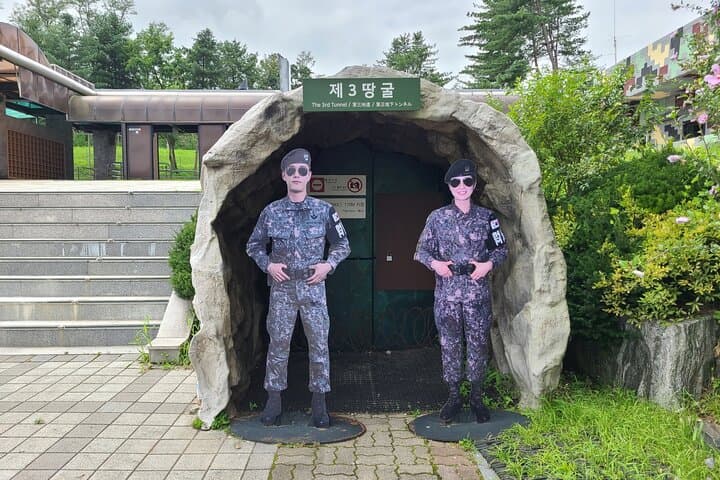
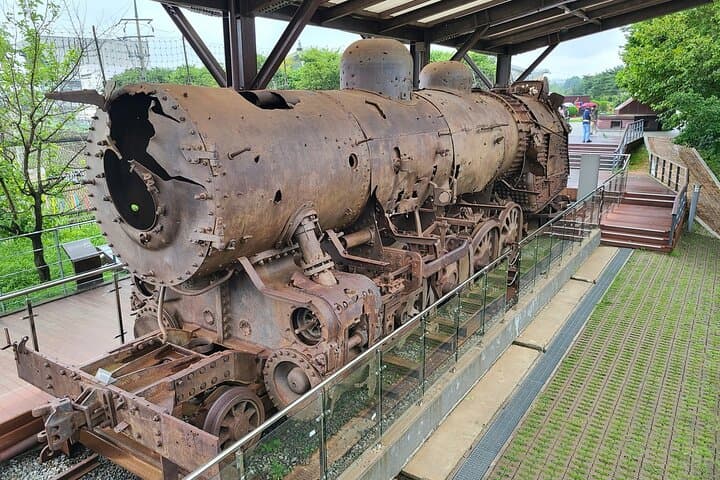
The day follows the spine of Korea's modern history: Imjingak Peace Park's Freedom Bridge and steam locomotive recall prisoner-of-war repatriations; the 3rd Tunnel—discovered in 1978—reveals the subterranean scale of past military plans; Dora Observatory and Tongilchon (Unification Village) put human stories and border logistics in sight. Gamaksan Mountain, at 675 m, offers a contrasting natural coda: a 150 m suspension bridge spanning a steep valley and honoring Gloucestershire Regiment soldiers who fought here.
Expect a full, guided nine-hour circuit with hotel pickup, security checks, and short walks—some underground in the tunnel, some on paved observation decks. Photography rules apply at sensitive sites; passports or ID are required for checkpoint paperwork. Wear sturdy shoes for uneven tunnel floors and the Gamaksan approach, bring water and sun protection, and prepare for brisk winds on the observatory roof.
Practical timing matters: mornings are clearer for distant views; afternoons bring changing light over cultivated fields. This tour balances history, geopolitics, and a compact outdoor experience—an intense day that pairs close-up observation with straightforward logistics.
easy.
9 hours.
Suitable for most adults who can walk short distances and descend stairs; minimal hiking required.
Yes—valid photo ID or passport is usually required for checkpoint procedures and is recommended to have on hand throughout the tour.
No technical demands—the tunnel has a paved descent and level path but can be narrow and low in places; comfortable footwear is advised.
No—photography is restricted in designated military areas and at times the guide will ask visitors to refrain from taking pictures; follow onsite instructions.
Families are permitted, though infants must sit on laps on transport; some stops involve stairs or confined spaces that may be challenging for very young children.
The DMZ is a product of the 1953 armistice that ended active hostilities in the Korean War but left the peninsula divided; the zone has since been a focus of both conflict memory and occasional reconciliation efforts.
Strict military control has created unintended wildlife refuges; visitors should stay on paths, avoid disturbing habitats, and support local vendors who work with border communities.
Kevin Lee operates guided outdoor trips and adventures with an emphasis on safety, stewardship, and memorable experiences.
You step off the van into a wind that seems to carry history—metal fences humming with distant traffic, fields that fall away toward another state. The guide points to a rooftop telescope at Dora Observatory; through its lens you can make out patchworks of North Korean farmland and the odd shape of a tractor moving like a toy. The air here feels deliberate, as if the landscape itself is watching.
You step off the van into a wind that seems to carry history—metal fences humming with distant traffic, fields that fall away toward another state. The guide points to a rooftop telescope at Dora Observatory; through its lens you can make out patchworks of North Korean farmland and the odd shape of a tractor moving like a toy. The air here feels deliberate, as if the landscape itself is watching.
The day follows the spine of Korea's modern history: Imjingak Peace Park's Freedom Bridge and steam locomotive recall prisoner-of-war repatriations; the 3rd Tunnel—discovered in 1978—reveals the subterranean scale of past military plans; Dora Observatory and Tongilchon (Unification Village) put human stories and border logistics in sight. Gamaksan Mountain, at 675 m, offers a contrasting natural coda: a 150 m suspension bridge spanning a steep valley and honoring Gloucestershire Regiment soldiers who fought here.
Expect a full, guided nine-hour circuit with hotel pickup, security checks, and short walks—some underground in the tunnel, some on paved observation decks. Photography rules apply at sensitive sites; passports or ID are required for checkpoint paperwork. Wear sturdy shoes for uneven tunnel floors and the Gamaksan approach, bring water and sun protection, and prepare for brisk winds on the observatory roof.
Practical timing matters: mornings are clearer for distant views; afternoons bring changing light over cultivated fields. This tour balances history, geopolitics, and a compact outdoor experience—an intense day that pairs close-up observation with straightforward logistics.