THE ADVENTURE COLLECTIVE® · Independent discovery and booking for outdoor travel

Explore Grand Central Terminal on a private 90-minute walking tour that blends architecture, gossip and civic history. See the Main Concourse, the whispering corners, and artifacts tied to the Vanderbilts and 20th-century New York.
Explore Grand Central Terminal on a private 90-minute walking tour that blends architecture, gossip and civic history. See the Main Concourse, the whispering corners, and artifacts tied to the Vanderbilts and 20th-century New York.
You step into the Main Concourse and the city reorders itself around the vaulted ceiling: commuters become characters, rush-hour noise becomes rhythm, and a painted firmament watches over it all. Light from the large arched windows slants across the Tennessee marble and brass clock at the information booth, and the guide leans in to point out a scratched signature etched into a railing, a remnant of an earlier New York.
Verified experiences and guided adventures in the surrounding area.
Operated by Cicerone Travel · New York, New York
You step into the Main Concourse and the city reorders itself around the vaulted ceiling: commuters become characters, rush-hour noise becomes rhythm, and a painted firmament watches over it all. Light from the large arched windows slants across the Tennessee marble and brass clock at the information booth, and the guide leans in to point out a scratched signature etched into a railing, a remnant of an earlier New York.
Grand Central opened in 1913 as an ambitious piece of civic engineering — a railroad terminal built on Manhattan’s bedrock of schist and finished with materials meant to endure: Tennessee marble, Guastavino tile vaults and brass fittings. The terminal’s history runs from the Vanderbilt era to Cold War broadcast studios and the mid-century campaigns to save the building from demolition. Cultural threads — Jackie Kennedy’s appearances, scenes from film and literature, and the station’s role in daily commuter life — are part of the story you’ll hear.
On this private 90-minute walk you’ll move through the Main Concourse, into the whispering corners near the Oyster Bar, past hidden amenities like a former private tennis space and into Vanderbilt Hall’s architecture. Expect a walk that’s more about close-up observation than long distances: limited elevation, hard floors, and steady crowds.
Practical tips: arrive 10 minutes early to meet at the information booth clock, bring comfortable shoes and a charged phone for photos, and pick a mid-morning slot to avoid the heaviest commuter crush. The tour is wheelchair accessible and suitable for most ages — it’s an urban history lesson wrapped in moving architecture.
easy.
1–1.5 hours.
Suitable for all fitness levels; involves short periods of standing and slow walking on hard floors.
Meet inside the Main Concourse at the central information booth under the four-faced clock; guides typically wait there 10 minutes before departure.
Yes — Grand Central and this private walking tour route are wheelchair accessible; note surfaces are hard and can be busy during peak hours.
Yes — photography for personal use is allowed, but be mindful of passengers and avoid obstructing walkways or using flash in crowded areas.
Cancel at least 24 hours before the scheduled start to receive a full refund, per the operator’s standard policy.
Grand Central opened in 1913 under the Vanderbilt family’s railroad interests and became a focal point of early-20th-century city growth; later preservation efforts in the 1960s–90s secured its landmark status.
Ongoing preservation balances historic restoration with modern systems upgrades; visitors are encouraged to minimize litter and respect signage to protect finishes and public spaces.
Cicerone Travel operates guided outdoor trips and adventures with an emphasis on safety, stewardship, and memorable experiences.


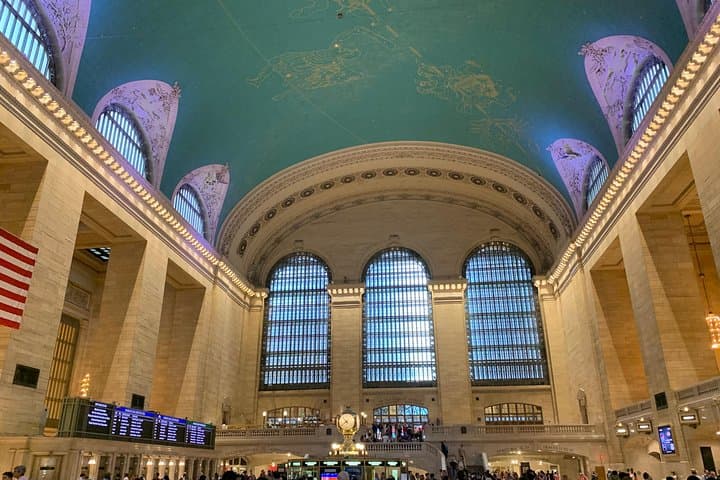

You step into the Main Concourse and the city reorders itself around the vaulted ceiling: commuters become characters, rush-hour noise becomes rhythm, and a painted firmament watches over it all. Light from the large arched windows slants across the Tennessee marble and brass clock at the information booth, and the guide leans in to point out a scratched signature etched into a railing, a remnant of an earlier New York.
You step into the Main Concourse and the city reorders itself around the vaulted ceiling: commuters become characters, rush-hour noise becomes rhythm, and a painted firmament watches over it all. Light from the large arched windows slants across the Tennessee marble and brass clock at the information booth, and the guide leans in to point out a scratched signature etched into a railing, a remnant of an earlier New York.
Grand Central opened in 1913 as an ambitious piece of civic engineering — a railroad terminal built on Manhattan’s bedrock of schist and finished with materials meant to endure: Tennessee marble, Guastavino tile vaults and brass fittings. The terminal’s history runs from the Vanderbilt era to Cold War broadcast studios and the mid-century campaigns to save the building from demolition. Cultural threads — Jackie Kennedy’s appearances, scenes from film and literature, and the station’s role in daily commuter life — are part of the story you’ll hear.
On this private 90-minute walk you’ll move through the Main Concourse, into the whispering corners near the Oyster Bar, past hidden amenities like a former private tennis space and into Vanderbilt Hall’s architecture. Expect a walk that’s more about close-up observation than long distances: limited elevation, hard floors, and steady crowds.
Practical tips: arrive 10 minutes early to meet at the information booth clock, bring comfortable shoes and a charged phone for photos, and pick a mid-morning slot to avoid the heaviest commuter crush. The tour is wheelchair accessible and suitable for most ages — it’s an urban history lesson wrapped in moving architecture.