THE ADVENTURE COLLECTIVE® · Independent discovery and booking for outdoor travel

A two-hour private walk through downtown Honolulu that connects Iolani Palace, historic mission houses, and state government landmarks. Ideal for couples who want a compact, human-scale primer on Hawaiian history and architecture.
A two-hour private walk through downtown Honolulu that connects Iolani Palace, historic mission houses, and state government landmarks. Ideal for couples who want a compact, human-scale primer on Hawaiian history and architecture.
The tour begins in front of Iolani Palace, with the coral-stone façade and flagpole cutting a clean line against the Hawaiian sky. Guides meet their small groups—a pair, a family, a few friends—and the city switches from traffic hum to a paced, pedestrian rhythm. As couples step off the curb, the trade winds push through the streets like a low, approving voice, urging visitors to look up at carved cornices and down at veteran banyans threading roots through sidewalk seams.
Verified experiences and guided adventures in the surrounding area.
Operated by Opatrip.com USA · Honolulu, Hawaii
The tour begins in front of Iolani Palace, with the coral-stone façade and flagpole cutting a clean line against the Hawaiian sky. Guides meet their small groups—a pair, a family, a few friends—and the city switches from traffic hum to a paced, pedestrian rhythm. As couples step off the curb, the trade winds push through the streets like a low, approving voice, urging visitors to look up at carved cornices and down at veteran banyans threading roots through sidewalk seams.
This two-hour walk threads downtown Honolulu’s layers: the royal ambitions of the Hawaiian Kingdom, the missionary era that remade islands’ institutions, and the 20th-century civic planning that created the State Capitol and municipal square. Iolani Palace, the only royal palace on U.S. soil, anchors the route—its rooms once hosted Hawaiian monarchs and now act as a reminder of royal protocol displaced by history. Nearby, the Hawaiian Mission Houses preserve artifacts and letters that reveal how Western visitors introduced new governance, printing presses, and churches that reshaped everyday life.
Geology here is subtle but present—limestone outcrops and coral-derived streetbeds sit atop the ancient volcanic ridge of Oʻahu. Urban Honolulu grew where valleys drained into the harbor; those channels once carried fresh water and now direct tourist traffic toward civic landmarks like the State Capitol and Aliʻiolani Hale, the latter guarded by the bronze figure of Kamehameha I.
Culturally, the walk is conversational: guides balance architecture and policy with local customs. Stops at the Cathedral of St. Andrew and the Kamehameha V Post Office illustrate how imported styles were adapted to island materials and climate—wide eaves, high ceilings, and shuttered windows to catch the trade wind.
Practical guidance is straightforward. The route is flat, mostly paved, and suitable for all fitness levels, but expect two hours of consistent walking and standing. Wear comfortable walking shoes, use reef-safe sunscreen, and bring a refillable bottle—the Hawaiian sun is insistent even on breezy days. Morning departures mean softer light for photos and cooler pavement; midday brings heat and heavier pedestrian traffic.
For couples, the tour compresses Honolulu’s civic story into a compact, human scale—history shown in doorways, law carved in stone, and colonial-era letters that read like private confessions. It ends at Aliʻiolani Hale, where the neoclassical façade and the statue of Kamehameha make for a tidy final scene and a clear moment to plan the next stop: coffee, shave ice, or a harbor-side sunset.
easy.
2 hours.
Light cardio and ability to stand and walk for two hours; suitable for most fitness levels
The tour lasts two hours and covers roughly 1.5–2 miles of mostly flat, paved streets in downtown Honolulu.
Yes—the tour is private and conducted exclusively for your booked group to keep the experience intimate.
Full refunds are available if you cancel at least 24 hours before the scheduled departure time.
Most of the route is flat and paved, but some sidewalks and crossings may be narrow; contact the operator in advance to confirm accommodations.
This walking tour focuses on exterior visits and interpretation; admission to museums or palace interiors is not included unless specified otherwise.
Guides typically conduct the tour in English; check with the operator about multilingual guide options before booking.
Downtown Honolulu grew rapidly in the 19th century as the Hawaiian Kingdom engaged with global trade; many civic buildings reflect a mix of Hawaiian royal patronage and Western architectural influences.
Visitors are encouraged to use reef-safe sunscreen, minimize single-use plastics, and stay on sidewalks to protect fragile historic foundations and coastal ecosystems.
Opatrip.com USA operates guided outdoor trips and adventures with an emphasis on safety, stewardship, and memorable experiences.


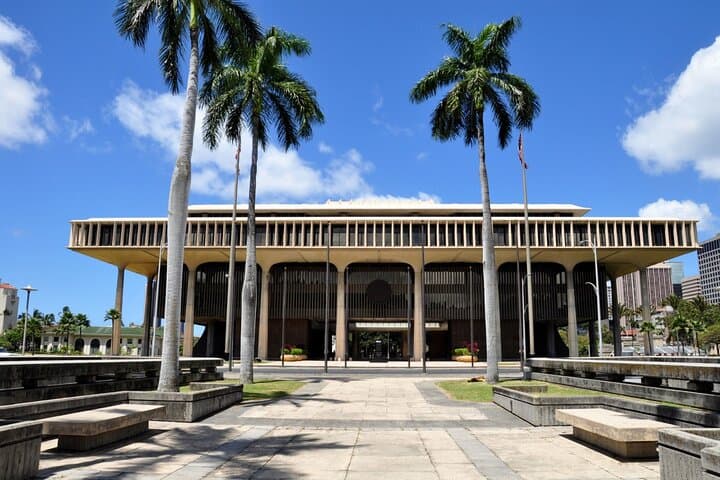

The tour begins in front of Iolani Palace, with the coral-stone façade and flagpole cutting a clean line against the Hawaiian sky. Guides meet their small groups—a pair, a family, a few friends—and the city switches from traffic hum to a paced, pedestrian rhythm. As couples step off the curb, the trade winds push through the streets like a low, approving voice, urging visitors to look up at carved cornices and down at veteran banyans threading roots through sidewalk seams.
The tour begins in front of Iolani Palace, with the coral-stone façade and flagpole cutting a clean line against the Hawaiian sky. Guides meet their small groups—a pair, a family, a few friends—and the city switches from traffic hum to a paced, pedestrian rhythm. As couples step off the curb, the trade winds push through the streets like a low, approving voice, urging visitors to look up at carved cornices and down at veteran banyans threading roots through sidewalk seams.
This two-hour walk threads downtown Honolulu’s layers: the royal ambitions of the Hawaiian Kingdom, the missionary era that remade islands’ institutions, and the 20th-century civic planning that created the State Capitol and municipal square. Iolani Palace, the only royal palace on U.S. soil, anchors the route—its rooms once hosted Hawaiian monarchs and now act as a reminder of royal protocol displaced by history. Nearby, the Hawaiian Mission Houses preserve artifacts and letters that reveal how Western visitors introduced new governance, printing presses, and churches that reshaped everyday life.
Geology here is subtle but present—limestone outcrops and coral-derived streetbeds sit atop the ancient volcanic ridge of Oʻahu. Urban Honolulu grew where valleys drained into the harbor; those channels once carried fresh water and now direct tourist traffic toward civic landmarks like the State Capitol and Aliʻiolani Hale, the latter guarded by the bronze figure of Kamehameha I.
Culturally, the walk is conversational: guides balance architecture and policy with local customs. Stops at the Cathedral of St. Andrew and the Kamehameha V Post Office illustrate how imported styles were adapted to island materials and climate—wide eaves, high ceilings, and shuttered windows to catch the trade wind.
Practical guidance is straightforward. The route is flat, mostly paved, and suitable for all fitness levels, but expect two hours of consistent walking and standing. Wear comfortable walking shoes, use reef-safe sunscreen, and bring a refillable bottle—the Hawaiian sun is insistent even on breezy days. Morning departures mean softer light for photos and cooler pavement; midday brings heat and heavier pedestrian traffic.
For couples, the tour compresses Honolulu’s civic story into a compact, human scale—history shown in doorways, law carved in stone, and colonial-era letters that read like private confessions. It ends at Aliʻiolani Hale, where the neoclassical façade and the statue of Kamehameha make for a tidy final scene and a clear moment to plan the next stop: coffee, shave ice, or a harbor-side sunset.