THE ADVENTURE COLLECTIVE® · Independent discovery and booking for outdoor travel

Walk the downtown blocks where Hawaii’s monarchy, missionaries, and modern statehood intersect. This 70‑minute, locally run tour pairs historical insight with practical urban navigation—perfect for first-time visitors who want context and color beyond the postcard.
Walk the downtown blocks where Hawaii’s monarchy, missionaries, and modern statehood intersect. This 70‑minute, locally run tour pairs historical insight with practical urban navigation—perfect for first-time visitors who want context and color beyond the postcard.
You meet at the base of the King Kamehameha statue—bronze dark against the Honolulu sun—where traffic hums and the trade winds push a faint salt from the harbor through the city streets.
Verified experiences and guided adventures in the surrounding area.
Operated by Hawaii Free Tours · Honolulu, Hawaii
You meet at the base of the King Kamehameha statue—bronze dark against the Honolulu sun—where traffic hums and the trade winds push a faint salt from the harbor through the city streets.
The guide, wearing a white or black Hawaii Free Tour tee, unfurls a map of stories: voyaging Polynesians who read the stars, aliʻi (chiefs) who ruled an island nation, and the plantation-era reshaping that led to annexation and statehood. For seventy minutes the city reconfigures itself into a classroom of stone and shadow—Aliʻiolani Hale’s stoic façade, the modernist sweep of the State Capitol, the quiet stones of King Lunalilo’s burial ground.
Geology here is subtle: volcanic foundations under a grid of asphalt and banyan roots. The shoreline that once dictated settlement is now a harbor horizon glimpsed between government blocks; the land’s volcanic birth underwrites the small ridges and low rises that become narrow viewpoints on a flat downtown route. Culturally, downtown Honolulu is where public power and private memory collide—courthouses and cathedrals next to the shops that grew from plantation capital and immigrant communities.
The tour balances narrative and navigation. Guides layer oral histories—how kahuna and navigators passed knowledge by voice—alongside documented episodes: the monarchy’s chiefs, the arrival of missionaries, and the contested turn toward U.S. governance. Expect stops at Kawaiahaʻo Church, Aliʻiolani Hale, the State Capitol grounds, and King Lunalilo’s Garden, each framed with local anecdotes and practical context.
Practicalities: the route is an easy 1–1.5 mile loop on mostly flat pavement with a few steps at historical buildings; total elevation gain is negligible. Wear breathable walking shoes and bring a refillable water bottle—the Hawaiian sun is direct, even in city shade. The tour runs about 70 minutes; aim for morning or late afternoon to avoid the mid-day heat and capture better light for photos.
Accessibility is thoughtful: strollers are welcome and the pace is gentle, though some stops have steps. Tickets are mobile-friendly and the tour is free, run by local guides who appreciate tips for time and insight. If weather turns—brief tropical showers are common—confirm with the operator; tours may be canceled for heavy rain.
This is more than a sightseeing loop: it’s an orientation to Oʻahu’s contested past and living culture. Walk away with directions to quieter pockets—nearby Chinatown markets and the palace grounds—and a clearer sense of aloha that’s rooted in story, stewardship, and the city’s ongoing conversations about place and identity.
easy.
70 minutes (1–1.5 hours).
Suitable for all fitness levels; mostly flat walking with occasional steps
Yes—walks are free to join; guides welcome voluntary tips for their time and local expertise.
In front of the King Kamehameha statue at 447 S. King St. Guides wear white or black Hawaii Free Tour shirts.
The route is stroller-friendly; wheelchair accessibility is generally good but some stops have steps—contact the operator if you need specific accommodations.
The guide speaks English; the tour description specifies an English-speaking guide.
Tours may be canceled in heavy rain; brief showers often pass—check confirmation and local weather before heading out.
About 70 minutes covering roughly 1–1.5 miles on flat pavement with short pauses at historic sites.
Downtown Honolulu is where Hawaii’s monarchy, missionary influence, and plantation-era economies intersected—sites on this route reflect the islands’ transition from an independent kingdom to U.S. statehood.
Respect historic sites and cultural spaces: stay on paths, don’t remove or disturb native plants or artifacts, and support local guides to keep storytelling grounded in community.
Hawaii Free Tours operates guided outdoor trips and adventures with an emphasis on safety, stewardship, and memorable experiences.


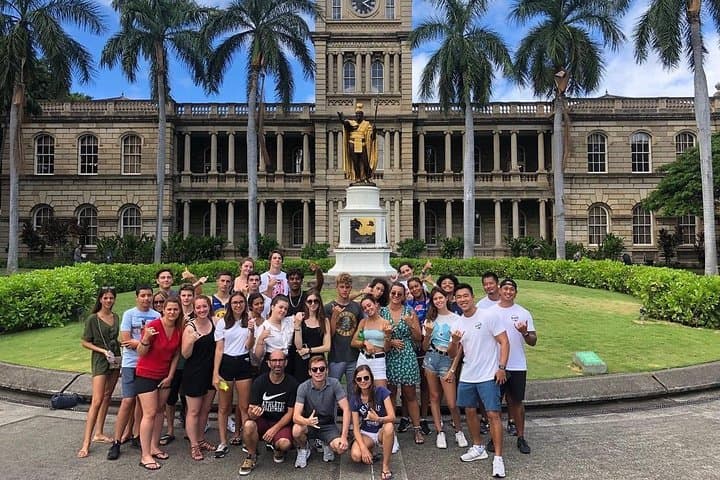

You meet at the base of the King Kamehameha statue—bronze dark against the Honolulu sun—where traffic hums and the trade winds push a faint salt from the harbor through the city streets.
You meet at the base of the King Kamehameha statue—bronze dark against the Honolulu sun—where traffic hums and the trade winds push a faint salt from the harbor through the city streets.
The guide, wearing a white or black Hawaii Free Tour tee, unfurls a map of stories: voyaging Polynesians who read the stars, aliʻi (chiefs) who ruled an island nation, and the plantation-era reshaping that led to annexation and statehood. For seventy minutes the city reconfigures itself into a classroom of stone and shadow—Aliʻiolani Hale’s stoic façade, the modernist sweep of the State Capitol, the quiet stones of King Lunalilo’s burial ground.
Geology here is subtle: volcanic foundations under a grid of asphalt and banyan roots. The shoreline that once dictated settlement is now a harbor horizon glimpsed between government blocks; the land’s volcanic birth underwrites the small ridges and low rises that become narrow viewpoints on a flat downtown route. Culturally, downtown Honolulu is where public power and private memory collide—courthouses and cathedrals next to the shops that grew from plantation capital and immigrant communities.
The tour balances narrative and navigation. Guides layer oral histories—how kahuna and navigators passed knowledge by voice—alongside documented episodes: the monarchy’s chiefs, the arrival of missionaries, and the contested turn toward U.S. governance. Expect stops at Kawaiahaʻo Church, Aliʻiolani Hale, the State Capitol grounds, and King Lunalilo’s Garden, each framed with local anecdotes and practical context.
Practicalities: the route is an easy 1–1.5 mile loop on mostly flat pavement with a few steps at historical buildings; total elevation gain is negligible. Wear breathable walking shoes and bring a refillable water bottle—the Hawaiian sun is direct, even in city shade. The tour runs about 70 minutes; aim for morning or late afternoon to avoid the mid-day heat and capture better light for photos.
Accessibility is thoughtful: strollers are welcome and the pace is gentle, though some stops have steps. Tickets are mobile-friendly and the tour is free, run by local guides who appreciate tips for time and insight. If weather turns—brief tropical showers are common—confirm with the operator; tours may be canceled for heavy rain.
This is more than a sightseeing loop: it’s an orientation to Oʻahu’s contested past and living culture. Walk away with directions to quieter pockets—nearby Chinatown markets and the palace grounds—and a clearer sense of aloha that’s rooted in story, stewardship, and the city’s ongoing conversations about place and identity.