THE ADVENTURE COLLECTIVE® · Independent discovery and booking for outdoor travel

Float the slow channels of Honey Island Swamp on a pontoon, then step onto a raised boardwalk for a guided eco-walk among ancient cypress and active wildlife. Perfect for families and first-time swamp explorers, this tour pairs easy boating with close-up nature interpretation.
Float the slow channels of Honey Island Swamp on a pontoon, then step onto a raised boardwalk for a guided eco-walk among ancient cypress and active wildlife. Perfect for families and first-time swamp explorers, this tour pairs easy boating with close-up nature interpretation.
A low-slung pontoon eases away from a narrow dock and the Pearl River opens like a ribbon of tannin, daring you into the maze of Honey Island Swamp. Cypress knees puncture the water; Spanish moss drapes branches that shade the boat’s path. The ride is slow and close to the waterline—ideal for spotting wading birds and alligators sunning themselves on muddy banks—then the group steps onto a raised boardwalk for a guided walk amid ancient cypress and wetland shrubs.
Verified experiences and guided adventures in the surrounding area.
A low-slung pontoon eases away from a narrow dock and the Pearl River opens like a ribbon of tannin, daring you into the maze of Honey Island Swamp. Cypress knees puncture the water; Spanish moss drapes branches that shade the boat’s path. The ride is slow and close to the waterline—ideal for spotting wading birds and alligators sunning themselves on muddy banks—then the group steps onto a raised boardwalk for a guided walk amid ancient cypress and wetland shrubs.
Geologically the swamp is a backwater of the Pearl River system, formed by sediment and slow-moving currents that created a mosaic of channels and oxbows. Culturally, this stretch of southeastern Louisiana blends Cajun and Choctaw influences—river work, fishing, and swamp knowledge passed down through generations shape local storytelling and place names. Historical remnants near the launch point hint at 19th-century river commerce and small riverine settlements.
On the boardwalk the guide points out how the swamp breathes: knees filtering water, marsh grasses stabilizing banks, birds using the canopy like a highway. Children with Eco-Tinker packs learn species ID and see a live demonstration of a small creature, making the landscape tactile.
Practical guidance: tours typically run 2–3 hours total; expect uneven boardwalk sections and insect activity. Bring binoculars, layered clothing for sun and humidity, and a reusable water bottle. Morning departures give cooler air and more wildlife activity; afternoons can be quiet and luminous. The experience is accessible to most ages but requires steady footing for the walk portion.
easy.
2–3 hours.
Suitable for people with basic mobility who can stand and walk on an uneven boardwalk for up to 60–90 minutes.
The combined experience runs about 2–3 hours: roughly an hour on the boat and 60–90 minutes on the boardwalk, though exact timing can vary by operator.
Yes—this tour is family-friendly; however, the boardwalk includes uneven sections, so stable footwear and moderate mobility are recommended.
Alligators are common in Honey Island Swamp, but sightings depend on season, time of day, and weather—guides position the boat in likely areas to increase chances of viewing.
Operators monitor weather and may reschedule in severe conditions; bring sun protection and water for hot, humid days, and a light rain jacket for passing showers.
The Honey Island Swamp sits within the lower Pearl River basin; historically the region supported small fishing and logging communities and retains strong river-based cultural traditions.
The swamp is ecologically sensitive—stay on boardwalks, avoid feeding wildlife, and follow guide instructions to limit disturbance and protect wetland habitat.
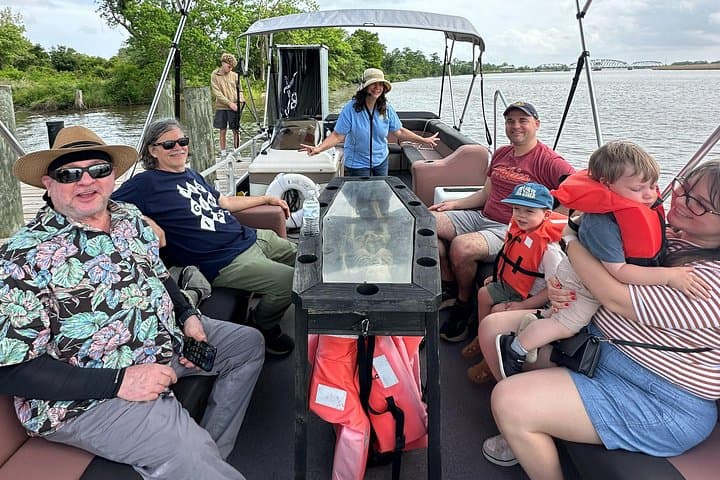
A low-slung pontoon eases away from a narrow dock and the Pearl River opens like a ribbon of tannin, daring you into the maze of Honey Island Swamp. Cypress knees puncture the water; Spanish moss drapes branches that shade the boat’s path. The ride is slow and close to the waterline—ideal for spotting wading birds and alligators sunning themselves on muddy banks—then the group steps onto a raised boardwalk for a guided walk amid ancient cypress and wetland shrubs.
A low-slung pontoon eases away from a narrow dock and the Pearl River opens like a ribbon of tannin, daring you into the maze of Honey Island Swamp. Cypress knees puncture the water; Spanish moss drapes branches that shade the boat’s path. The ride is slow and close to the waterline—ideal for spotting wading birds and alligators sunning themselves on muddy banks—then the group steps onto a raised boardwalk for a guided walk amid ancient cypress and wetland shrubs.
Geologically the swamp is a backwater of the Pearl River system, formed by sediment and slow-moving currents that created a mosaic of channels and oxbows. Culturally, this stretch of southeastern Louisiana blends Cajun and Choctaw influences—river work, fishing, and swamp knowledge passed down through generations shape local storytelling and place names. Historical remnants near the launch point hint at 19th-century river commerce and small riverine settlements.
On the boardwalk the guide points out how the swamp breathes: knees filtering water, marsh grasses stabilizing banks, birds using the canopy like a highway. Children with Eco-Tinker packs learn species ID and see a live demonstration of a small creature, making the landscape tactile.
Practical guidance: tours typically run 2–3 hours total; expect uneven boardwalk sections and insect activity. Bring binoculars, layered clothing for sun and humidity, and a reusable water bottle. Morning departures give cooler air and more wildlife activity; afternoons can be quiet and luminous. The experience is accessible to most ages but requires steady footing for the walk portion.