THE ADVENTURE COLLECTIVE® · Independent discovery and booking for outdoor travel

Cycle from Hoi An’s old town into Tra Que Village to learn traditional herb farming, make white rose dumplings with a local family, and savor Cao Lau at a neighborhood restaurant. A compact, sensory half‑day that pairs easy riding with true foodcraft.
Cycle from Hoi An’s old town into Tra Que Village to learn traditional herb farming, make white rose dumplings with a local family, and savor Cao Lau at a neighborhood restaurant. A compact, sensory half‑day that pairs easy riding with true foodcraft.
Pedaling out of Hoi An’s old quarter, the road opens into a checkerboard of irrigated fields and low, crumbling brick houses. The air tastes of river mud and crushed herbs; farmers at work wave you past rows of neon-green lettuce in Tra Que Village. Bicycles hum beneath you as scents of lemongrass and grilled pork ride the breeze toward the market.
Verified experiences and guided adventures in the surrounding area.
Operated by Hoi An Express Travel · Hoi An, Quang Nam
Pedaling out of Hoi An’s old quarter, the road opens into a checkerboard of irrigated fields and low, crumbling brick houses. The air tastes of river mud and crushed herbs; farmers at work wave you past rows of neon-green lettuce in Tra Que Village. Bicycles hum beneath you as scents of lemongrass and grilled pork ride the breeze toward the market.
This short route threads together Hoi An’s layered history: a 16th‑century trading port shaped by Chinese and Japanese merchants, local Cham influence and the freshwater channels that supply Ba Le Well — the well whose water is still credited with giving Cao Lau its unique texture. Geologically the region is flat coastal plain, its alluvial soils fed by the Thu Bon River, which made rice paddies and vegetable gardens possible for generations.
Culturally, the day balances hands‑on craft and convivial eating. In Tra Que you’ll see traditional organic soil treatments and herbs tended by family plots; back in town, a local household shows how to shape delicate white rose dumplings and explains why rice paper, pork, and rare Ba Le water matter to Cao Lau.
Practical guidance: expect 3–4 hours of mostly flat cycling on quiet lanes and short paved stretches; bring sun protection, rehydration, and closed-toe shoes for the kitchen portion. Morning departures avoid heat and offer sharper light for photos. Respect working farms by staying on paths and asking before entering gardens. The trip is approachable for anyone comfortable on a standard city bike and hungry to learn — both the pedals and your appetite will be rewarded.
easy.
3–4 hours.
Suitable for most fitness levels; you should be comfortable riding a standard city bike for short bursts and standing during a cooking workshop.
No — the route is mostly flat on quiet lanes; basic bike handling and balance are sufficient.
Yes — guides and host families can adapt the cooking and tasting to common dietary needs if notified in advance.
Yes — standard bicycles are provided and bottled water is included; helmet availability varies so request one when booking.
Transfers are listed as included per itinerary; confirm pickup point at booking and provide full names for logistics.
Hoi An prospered as a regional trading port from the 15th to 19th centuries; many local recipes reflect Chinese, Japanese and Southeast Asian influences, with Ba Le Well often cited in Cao Lau lore.
Tra Que Village promotes small-scale organic practices; travelers should avoid stepping on beds, minimize plastic use, and support local families directly.
Hoi An Express Travel operates guided outdoor trips and adventures with an emphasis on safety, stewardship, and memorable experiences.
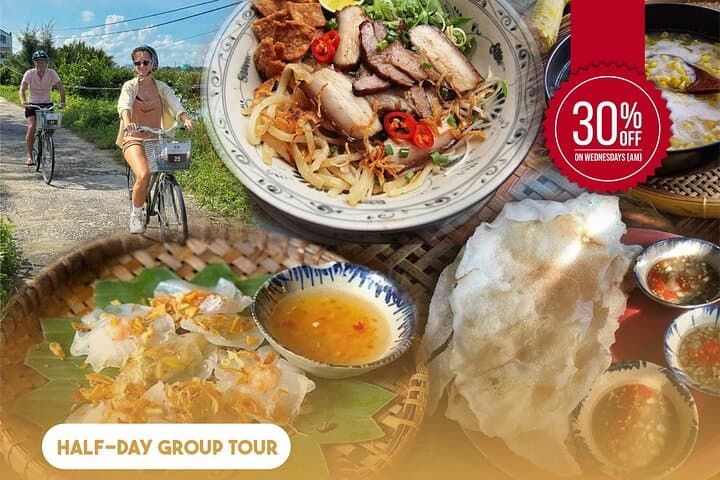


Pedaling out of Hoi An’s old quarter, the road opens into a checkerboard of irrigated fields and low, crumbling brick houses. The air tastes of river mud and crushed herbs; farmers at work wave you past rows of neon-green lettuce in Tra Que Village. Bicycles hum beneath you as scents of lemongrass and grilled pork ride the breeze toward the market.
Pedaling out of Hoi An’s old quarter, the road opens into a checkerboard of irrigated fields and low, crumbling brick houses. The air tastes of river mud and crushed herbs; farmers at work wave you past rows of neon-green lettuce in Tra Que Village. Bicycles hum beneath you as scents of lemongrass and grilled pork ride the breeze toward the market.
This short route threads together Hoi An’s layered history: a 16th‑century trading port shaped by Chinese and Japanese merchants, local Cham influence and the freshwater channels that supply Ba Le Well — the well whose water is still credited with giving Cao Lau its unique texture. Geologically the region is flat coastal plain, its alluvial soils fed by the Thu Bon River, which made rice paddies and vegetable gardens possible for generations.
Culturally, the day balances hands‑on craft and convivial eating. In Tra Que you’ll see traditional organic soil treatments and herbs tended by family plots; back in town, a local household shows how to shape delicate white rose dumplings and explains why rice paper, pork, and rare Ba Le water matter to Cao Lau.
Practical guidance: expect 3–4 hours of mostly flat cycling on quiet lanes and short paved stretches; bring sun protection, rehydration, and closed-toe shoes for the kitchen portion. Morning departures avoid heat and offer sharper light for photos. Respect working farms by staying on paths and asking before entering gardens. The trip is approachable for anyone comfortable on a standard city bike and hungry to learn — both the pedals and your appetite will be rewarded.