THE ADVENTURE COLLECTIVE® · Independent discovery and booking for outdoor travel

Combine a walking tour of Ho Chi Minh City’s colonial landmarks with an up-close exploration of the Cu Chi Tunnels. Expect museums, markets, and an engineered underground network that speaks to wartime resilience.
Combine a walking tour of Ho Chi Minh City’s colonial landmarks with an up-close exploration of the Cu Chi Tunnels. Expect museums, markets, and an engineered underground network that speaks to wartime resilience.
You set out from a hotel lobby in District 1 as motorbikes stream past, the humid air carrying incense smoke from a nearby pagoda and the clack of a vendor’s cart. The morning moves through broad colonial boulevards—Notre-Dame’s twin towers puncture the skyline while the Central Post Office’s vaulted ceiling hums with history—and then the landscape tightens, the city’s concrete grid giving way to rubber plantations and the low, green rim of the Cu Chi countryside.
Verified experiences and guided adventures in the surrounding area.
Operated by Authentic Travel in Vietnam · Ho Chi Minh City, Ho Chi Minh
You set out from a hotel lobby in District 1 as motorbikes stream past, the humid air carrying incense smoke from a nearby pagoda and the clack of a vendor’s cart. The morning moves through broad colonial boulevards—Notre-Dame’s twin towers puncture the skyline while the Central Post Office’s vaulted ceiling hums with history—and then the landscape tightens, the city’s concrete grid giving way to rubber plantations and the low, green rim of the Cu Chi countryside.
Ho Chi Minh City’s center is a layered record: 19th-century French civic design, the chaotic commerce of Ben Thanh Market, and post‑war modern Vietnam. Geologically the region sits on alluvial plains of the Mekong Delta; those soft, stamped soils made the underground tunnels of Cu Chi possible. Built and expanded during the Vietnam War by local fighters, the tunnels are an engineered response to terrain and conflict—narrow galleries, hidden chambers, and camouflaged traps that reveal both tactical ingenuity and the human cost of prolonged warfare.
Practical guidance: plan for a long day—expect 9–10 hours with hotel pickup, museum time, and a 2–3 hour Cu Chi visit. Wear closed-toe shoes and breathable layers, bring a refillable water bottle, and carry a small amount of cash for market snacks. If you’re claustrophobic, note that only some sections require crawling; many exhibits are above ground. Photographs are allowed in public spaces but avoid touching artifacts. Midday heat and sudden tropical showers are common—time museum visits for morning or late afternoon to avoid the hottest stretch.
This is a city-and-country pairing: cultural architecture and street life in the morning, then an intimate, sobering look underground that brings history into sharp, physical focus.
moderate.
9–10 hours.
Suitable for travelers in average shape who can handle several hours of walking and some stairs; limited crawling at Cu Chi is optional.
Many sections are modified for visitors; some are widened and reinforced while original narrow passages are shown nearby—ask your guide which sections are open to crawl through.
Entrance fees for listed sites are included with this tour, as noted in the itinerary and inclusions.
Yes—the operator can accommodate vegetarians if requested in advance when booking.
Yes—an air-conditioned vehicle will pick you up from your hotel lobby and return you at the end of the day.
Ho Chi Minh City blends French colonial architecture with modern Vietnamese urban life; the Cu Chi Tunnels were an extensive guerrilla network used during the Vietnam War.
Sites like Cu Chi are managed to balance tourism with preservation—stay on marked paths, don’t remove artifacts, and follow guide instructions to limit wear on fragile areas.
Authentic Travel in Vietnam operates guided outdoor trips and adventures with an emphasis on safety, stewardship, and memorable experiences.

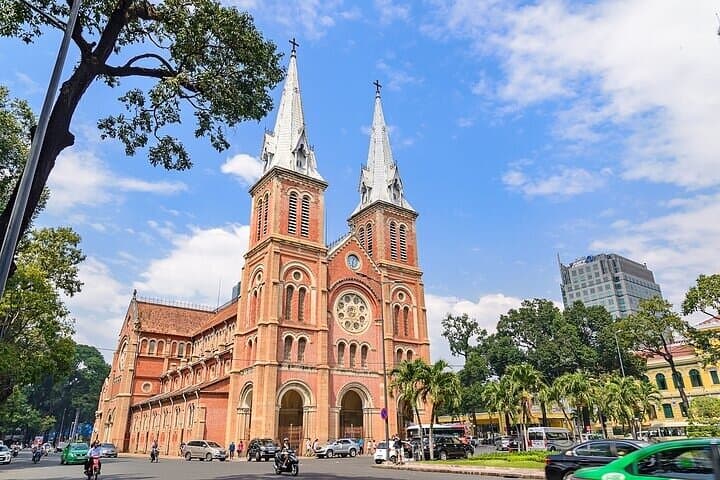
You set out from a hotel lobby in District 1 as motorbikes stream past, the humid air carrying incense smoke from a nearby pagoda and the clack of a vendor’s cart. The morning moves through broad colonial boulevards—Notre-Dame’s twin towers puncture the skyline while the Central Post Office’s vaulted ceiling hums with history—and then the landscape tightens, the city’s concrete grid giving way to rubber plantations and the low, green rim of the Cu Chi countryside.
You set out from a hotel lobby in District 1 as motorbikes stream past, the humid air carrying incense smoke from a nearby pagoda and the clack of a vendor’s cart. The morning moves through broad colonial boulevards—Notre-Dame’s twin towers puncture the skyline while the Central Post Office’s vaulted ceiling hums with history—and then the landscape tightens, the city’s concrete grid giving way to rubber plantations and the low, green rim of the Cu Chi countryside.
Ho Chi Minh City’s center is a layered record: 19th-century French civic design, the chaotic commerce of Ben Thanh Market, and post‑war modern Vietnam. Geologically the region sits on alluvial plains of the Mekong Delta; those soft, stamped soils made the underground tunnels of Cu Chi possible. Built and expanded during the Vietnam War by local fighters, the tunnels are an engineered response to terrain and conflict—narrow galleries, hidden chambers, and camouflaged traps that reveal both tactical ingenuity and the human cost of prolonged warfare.
Practical guidance: plan for a long day—expect 9–10 hours with hotel pickup, museum time, and a 2–3 hour Cu Chi visit. Wear closed-toe shoes and breathable layers, bring a refillable water bottle, and carry a small amount of cash for market snacks. If you’re claustrophobic, note that only some sections require crawling; many exhibits are above ground. Photographs are allowed in public spaces but avoid touching artifacts. Midday heat and sudden tropical showers are common—time museum visits for morning or late afternoon to avoid the hottest stretch.
This is a city-and-country pairing: cultural architecture and street life in the morning, then an intimate, sobering look underground that brings history into sharp, physical focus.