THE ADVENTURE COLLECTIVE® · Independent discovery and booking for outdoor travel

Walk the trails of Meteora with a certified guide, visiting one or two cliff-top monasteries and soaking in sweeping valley views. This 4-hour tour mixes geology, monastic history, and rugged hiking suitable for moderately fit travelers.
Walk the trails of Meteora with a certified guide, visiting one or two cliff-top monasteries and soaking in sweeping valley views. This 4-hour tour mixes geology, monastic history, and rugged hiking suitable for moderately fit travelers.
You step out of the minivan onto a plateau where sandstone pillars rise like sculpted towers, the valley wind nudging you toward narrow trails. The path threads between cliff faces and pines; monasteries perch on domes of rock above, their red roofs and stone steps carving human stories into an ancient landscape.
Verified experiences and guided adventures in the surrounding area.
Operated by Meteora Thrones -Travel Center · Kalambaka, Thessaly
You step out of the minivan onto a plateau where sandstone pillars rise like sculpted towers, the valley wind nudging you toward narrow trails. The path threads between cliff faces and pines; monasteries perch on domes of rock above, their red roofs and stone steps carving human stories into an ancient landscape.
Meteora’s rocks are Miocene conglomerate—layers of river-borne stones cemented and eroded over millions of years—shaped into steep columns that early Orthodox monks scaled in the 14th century to seek solitude. Kalambaka below grew as a service town for these ascetics; today visitors still climb the original mule tracks to reach Great Meteoron, Varlaam, or St. Nicholas when open.
The guided hike covers roughly 5–8 km of mixed dirt and paved switchbacks with cumulative elevation gain of about 200–350 m, depending on the route. Terrain is uneven: rocky steps, loose scree on some descents, and narrow ridgelines that demand steady footing. The guide will point out geology, monastic history, and the best panoramic viewpoints over the Meteora plain.
Practicalities matter: start mid-morning for optimal light and cooler temperatures, carry 1–2 liters of water, and wear shoes with good tread. Expect photo stops, a short monastery interior visit (entry when open), and transport back to Kalambaka within four hours. For anyone curious about landscape and living history, this is a compact, heady introduction to one of Greece’s most singular outdoor-cultural sites.
moderate.
4 hours.
Moderate—comfortable pace, ability to handle uneven terrain and short steep sections
The tour lasts about 4 hours and covers 5–8 km with roughly 200–350 m of cumulative elevation gain—suitable for moderately fit hikers.
The itinerary includes at least one interior visit (often Great Meteoron or Varlaam) depending on opening days; guides will note alternatives if closed.
Yes—hotel pickup and drop-off in Kalambaka are included and the tour operates by air-conditioned minivan to trailheads.
Children must be accompanied by an adult; the trip requires steady walking and is not recommended for those with serious back, heart, or pregnancy-related restrictions.
Monastic life at Meteora began in the Byzantine era when monks sought isolation on the pillars; many monasteries date to the 14th–16th centuries and preserve religious art.
Meteora is protected for its geological and cultural value; visitors are asked to stay on trails, avoid littering, and respect restricted monastic areas to limit erosion and preserve frescoes.
Meteora Thrones -Travel Center operates guided outdoor trips and adventures with an emphasis on safety, stewardship, and memorable experiences.



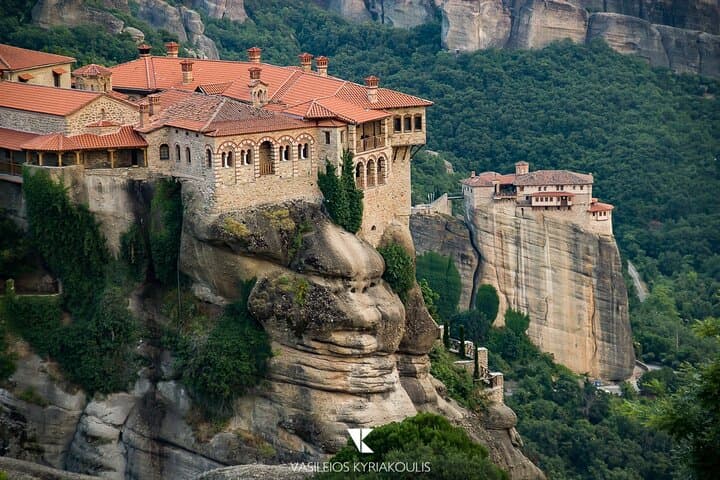
You step out of the minivan onto a plateau where sandstone pillars rise like sculpted towers, the valley wind nudging you toward narrow trails. The path threads between cliff faces and pines; monasteries perch on domes of rock above, their red roofs and stone steps carving human stories into an ancient landscape.
You step out of the minivan onto a plateau where sandstone pillars rise like sculpted towers, the valley wind nudging you toward narrow trails. The path threads between cliff faces and pines; monasteries perch on domes of rock above, their red roofs and stone steps carving human stories into an ancient landscape.
Meteora’s rocks are Miocene conglomerate—layers of river-borne stones cemented and eroded over millions of years—shaped into steep columns that early Orthodox monks scaled in the 14th century to seek solitude. Kalambaka below grew as a service town for these ascetics; today visitors still climb the original mule tracks to reach Great Meteoron, Varlaam, or St. Nicholas when open.
The guided hike covers roughly 5–8 km of mixed dirt and paved switchbacks with cumulative elevation gain of about 200–350 m, depending on the route. Terrain is uneven: rocky steps, loose scree on some descents, and narrow ridgelines that demand steady footing. The guide will point out geology, monastic history, and the best panoramic viewpoints over the Meteora plain.
Practicalities matter: start mid-morning for optimal light and cooler temperatures, carry 1–2 liters of water, and wear shoes with good tread. Expect photo stops, a short monastery interior visit (entry when open), and transport back to Kalambaka within four hours. For anyone curious about landscape and living history, this is a compact, heady introduction to one of Greece’s most singular outdoor-cultural sites.