THE ADVENTURE COLLECTIVE® · Independent discovery and booking for outdoor travel

Walk a well-preserved stretch of Ming-era fortification at Jinshanling, where restored steps meet rugged, unrestored towers. This guide outlines route options, local context, and practical logistics for a day hike from Beijing.
Walk a well-preserved stretch of Ming-era fortification at Jinshanling, where restored steps meet rugged, unrestored towers. This guide outlines route options, local context, and practical logistics for a day hike from Beijing.
Morning light slants across crumbling bricks as you step onto Jinshanling’s ramparts; the wall rises and falls like a long, watchful spine, watchtowers punching the skyline. Wind moves through the crenellations, daring you forward as the valley below narrows into terraces and scrub.
Verified experiences and guided adventures in the surrounding area.
Operated by Great Wall Expert · Luanping, Hebei
Morning light slants across crumbling bricks as you step onto Jinshanling’s ramparts; the wall rises and falls like a long, watchful spine, watchtowers punching the skyline. Wind moves through the crenellations, daring you forward as the valley below narrows into terraces and scrub.
This section of the Ming-era Great Wall preserves staggered watchtowers and the so-called Barrier Wall—features shaped by centuries of military engineering. Geologically, the wall sits where rugged, low-relief ridges of metamorphic rock give way to cultivated foothills; the stones you walk on were quarried nearby and set to resist freeze-thaw and the lean of time. Local villages in Luanping County still carry an agrarian rhythm; vendors and teahouses near the entrance reflect northern Chinese rural life and hospitality.
Expect varied terrain: restored staircases switch to steep, uneven stone and short scree crossings on unrestored stretches. Three common routes run about 5 km, 9 km, and 11 km—choose the shorter route for a gentle, cultural stroll, the longer for sustained exposure and scrambling between towers. Weather shifts fast—sun, wind, and sudden rain are all part of the day.
Practical guidance: arrive early to avoid buses and heat, pack 1–2 liters of water, layered clothing, sturdy boots with grip, and a compact rain shell. Use poles on the steeper, loose sections and allow 3–5 hours on the wall itself depending on route choice. Guided pickups from Beijing are common; confirm vehicle pickup point and cancellation policy when booking.
Jinshanling rewards steady pacing: move deliberately, read the masonry, and let the wall set the tempo.
moderate.
5–6 hours (including transport from Beijing).
Suitable for hikers with moderate fitness who can manage stairs, uneven stone, and short steep sections.
The common wall routes are roughly 5 km, 9 km, or 11 km; expect 2–4 hours on the wall depending on pace and stops.
Yes—choose the 5 km route for a lower-impact option, but be prepared for stone steps and uneven footing.
Many day tours include round-trip pickup in an air-conditioned vehicle; confirm pickup location and group size when booking.
Basic teahouses and restrooms exist near main access points; services are limited on longer, unrestored stretches so carry essentials.
Jinshanling preserves Ming-dynasty military architecture, including densely placed watchtowers used to relay signals and defend approaches.
Increased visitation stresses paths and local water supplies—stick to trails, pack out trash, and support local businesses that practice low-impact tourism.
Great Wall Expert operates guided outdoor trips and adventures with an emphasis on safety, stewardship, and memorable experiences.


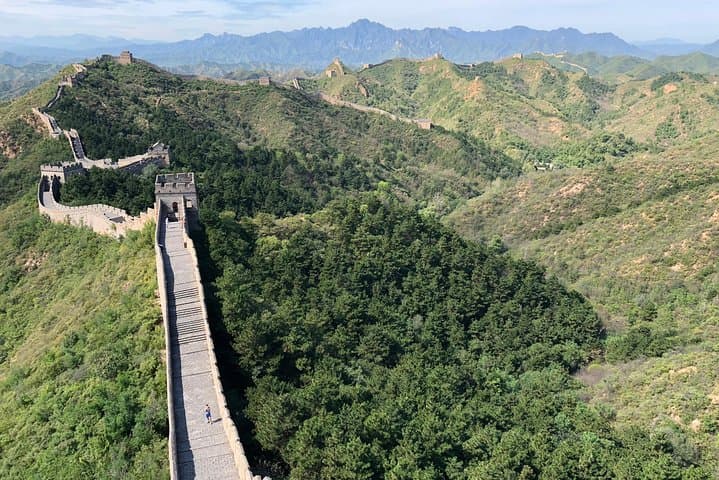
Morning light slants across crumbling bricks as you step onto Jinshanling’s ramparts; the wall rises and falls like a long, watchful spine, watchtowers punching the skyline. Wind moves through the crenellations, daring you forward as the valley below narrows into terraces and scrub.
Morning light slants across crumbling bricks as you step onto Jinshanling’s ramparts; the wall rises and falls like a long, watchful spine, watchtowers punching the skyline. Wind moves through the crenellations, daring you forward as the valley below narrows into terraces and scrub.
This section of the Ming-era Great Wall preserves staggered watchtowers and the so-called Barrier Wall—features shaped by centuries of military engineering. Geologically, the wall sits where rugged, low-relief ridges of metamorphic rock give way to cultivated foothills; the stones you walk on were quarried nearby and set to resist freeze-thaw and the lean of time. Local villages in Luanping County still carry an agrarian rhythm; vendors and teahouses near the entrance reflect northern Chinese rural life and hospitality.
Expect varied terrain: restored staircases switch to steep, uneven stone and short scree crossings on unrestored stretches. Three common routes run about 5 km, 9 km, and 11 km—choose the shorter route for a gentle, cultural stroll, the longer for sustained exposure and scrambling between towers. Weather shifts fast—sun, wind, and sudden rain are all part of the day.
Practical guidance: arrive early to avoid buses and heat, pack 1–2 liters of water, layered clothing, sturdy boots with grip, and a compact rain shell. Use poles on the steeper, loose sections and allow 3–5 hours on the wall itself depending on route choice. Guided pickups from Beijing are common; confirm vehicle pickup point and cancellation policy when booking.
Jinshanling rewards steady pacing: move deliberately, read the masonry, and let the wall set the tempo.