THE ADVENTURE COLLECTIVE® · Independent discovery and booking for outdoor travel

A brisk, accessible hike up to Syambhunath Stupa offers sweeping views over Kathmandu, close-up encounters with resident monkeys, and a compact dose of Buddhist heritage. This easy urban trek is ideal for travelers who want a short climb with cultural payoff.
A brisk, accessible hike up to Syambhunath Stupa offers sweeping views over Kathmandu, close-up encounters with resident monkeys, and a compact dose of Buddhist heritage. This easy urban trek is ideal for travelers who want a short climb with cultural payoff.
A short climb out of Kathmandu's grid of streets delivers a different city: the air thins, prayer wheels click like a slow metronome and the hill seems to breathe around the dome of the stupa. Walkers enter through a fringe of scrub and stone steps, passing fluttering prayer flags and omnipresent rhesus macaques that regard passersby with practiced indifference.
Verified experiences and guided adventures in the surrounding area.
Operated by Arpan Nepal · Kathmandu, Bagmati Province
A short climb out of Kathmandu's grid of streets delivers a different city: the air thins, prayer wheels click like a slow metronome and the hill seems to breathe around the dome of the stupa. Walkers enter through a fringe of scrub and stone steps, passing fluttering prayer flags and omnipresent rhesus macaques that regard passersby with practiced indifference.
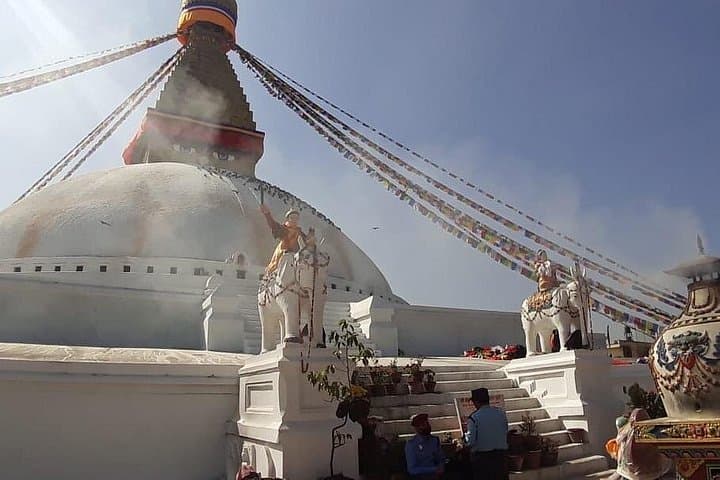
Syambhunath—often called the Monkey Temple—is one of Kathmandu Valley's oldest religious sites, a hemispherical stupa crowned with painted eyes that watch the valley below. Geologically the site sits on a modest knoll formed by old river deposits uplifted during Himalayan tectonic activity; trails are short but steep in places, built from stone steps and compacted earth. Culturally, the hill is shared space: monks chant in corners, pilgrims make clockwise circuit of the stupa, and vendors sell butter lamps and malas at the base.
Practical guidance: expect roughly 300 stone steps and 150–200 m of elevation gain from the nearest pedestrian approach, with a round-trip distance of about 1.5–2.5 km depending on your start point. Wear sturdy shoes—steps can be uneven—and carry water; shade is limited on the upper sections. Morning light offers the clearest views across Kathmandu and thinner crowds. Respect prayer practices: walk clockwise, avoid touching offerings, and keep a safe distance from monkeys—do not feed them.
The route is short, accessible for most fitness levels, and rewarding for a half-day outing that combines history, city views, and a brisk climb.
easy.
2–3 hours.
Suitable for most fitness levels; comfortable walking ability and basic stair-climbing fitness recommended
From central approach points it's usually a 30–60 minute climb one way; allow 2–3 hours total including time to explore the stupa and return.
There is no general entry fee for visiting the stupa, though small charges may apply for specific facilities or donations are customary for offerings.
Yes—many visitors of varied ages make the climb; take breaks on the steps and consider a taxi to the base to reduce overall ascent.
Yes, but be respectful: observe quietly, avoid disrupting rituals, and follow local dress and conduct expectations near altars.
Syambhunath is one of Kathmandu Valley's oldest religious complexes, with a stupa whose origins date back over a millennium and which serves both Buddhist and Hindu devotees.
Visitors are encouraged to minimize litter, avoid feeding wildlife, and support local preservation efforts that maintain the hill's trails and cultural sites.
Arpan Nepal operates guided outdoor trips and adventures with an emphasis on safety, stewardship, and memorable experiences.
A short climb out of Kathmandu's grid of streets delivers a different city: the air thins, prayer wheels click like a slow metronome and the hill seems to breathe around the dome of the stupa. Walkers enter through a fringe of scrub and stone steps, passing fluttering prayer flags and omnipresent rhesus macaques that regard passersby with practiced indifference.
A short climb out of Kathmandu's grid of streets delivers a different city: the air thins, prayer wheels click like a slow metronome and the hill seems to breathe around the dome of the stupa. Walkers enter through a fringe of scrub and stone steps, passing fluttering prayer flags and omnipresent rhesus macaques that regard passersby with practiced indifference.
Syambhunath—often called the Monkey Temple—is one of Kathmandu Valley's oldest religious sites, a hemispherical stupa crowned with painted eyes that watch the valley below. Geologically the site sits on a modest knoll formed by old river deposits uplifted during Himalayan tectonic activity; trails are short but steep in places, built from stone steps and compacted earth. Culturally, the hill is shared space: monks chant in corners, pilgrims make clockwise circuit of the stupa, and vendors sell butter lamps and malas at the base.
Practical guidance: expect roughly 300 stone steps and 150–200 m of elevation gain from the nearest pedestrian approach, with a round-trip distance of about 1.5–2.5 km depending on your start point. Wear sturdy shoes—steps can be uneven—and carry water; shade is limited on the upper sections. Morning light offers the clearest views across Kathmandu and thinner crowds. Respect prayer practices: walk clockwise, avoid touching offerings, and keep a safe distance from monkeys—do not feed them.
The route is short, accessible for most fitness levels, and rewarding for a half-day outing that combines history, city views, and a brisk climb.