THE ADVENTURE COLLECTIVE® · Independent discovery and booking for outdoor travel

Board a purpose-built catamaran at Hermanus New Harbour and spend six hours searching Walker Bay for southern right, Bryde’s and occasional humpback whales. A whale specialist interprets sightings while crew manage comfort and safety.
Board a purpose-built catamaran at Hermanus New Harbour and spend six hours searching Walker Bay for southern right, Bryde’s and occasional humpback whales. A whale specialist interprets sightings while crew manage comfort and safety.
Morning mist lifts from Walker Bay as a purpose-built catamaran slips from Hermanus New Harbour, crew voices low and binoculars raised. The sea reads like a map—spouts, tail flukes and rolling backs become punctuation marks in a six‑hour search. Onboard a whale specialist interprets behavior while a videographer captures passes, and seals and dolphins often stage their own side shows between sightings.
Verified experiences and guided adventures in the surrounding area.
Operated by Okapi Safari Tours cape town · Hermanus, Western Cape
Morning mist lifts from Walker Bay as a purpose-built catamaran slips from Hermanus New Harbour, crew voices low and binoculars raised. The sea reads like a map—spouts, tail flukes and rolling backs become punctuation marks in a six‑hour search. Onboard a whale specialist interprets behavior while a videographer captures passes, and seals and dolphins often stage their own side shows between sightings.
Hermanus's relationship with whales shifted from 19th‑century shore whaling to modern conservation and tourism; the town's steep sandstone cliffs and the glacially shaped seabed focus nutrients that attract anchovy, which in turn lure large whales. Southern right whales are the most iconic visitors here, with Bryde’s and occasional humpbacks or transient humpback pods depending on the season.
Culturally, the town celebrates sightings with land-based lookouts and an ethical watching code that limits disturbance; guides translate surface behavior into readable patterns so you understand what a breach or prolonged blow means.
Practically: arrive early for the on‑land briefing and expect crew instructions on life jackets and safe movement on deck. Dress in layered windproof clothing—the ocean can be significantly colder than shore—and bring binoculars and a telephoto lens if you want detailed photos. Seas can be choppy; sit mid‑boat to reduce motion and take preventative medication if you’re prone to nausea. Weather and whale behavior dictate proximity, so patience is part of the outing. Respect guide directions to safeguard the animals and improve everyone’s chance of a memorable encounter.
easy.
6 hours.
Suitable for most fitness levels — requires basic mobility to board and move on deck
Southern right whales are most commonly seen from June–November with a peak around August–October; Bryde’s whales may be present year‑round.
Yes — the tour is rated easy and suitable for most ages, but young children require close supervision and infant seats may be available on request.
The crew provides safety briefings; sit mid‑boat to reduce motion, use anti‑nausea measures if needed, and follow all staff instructions for a safe trip.
This operator advises the tour is not recommended for pregnant travelers or people with serious cardiovascular conditions due to movement and potential rough seas.
Hermanus moved from a 19th‑century shore‑based whaling economy to a conservation and ecotourism focus; the town’s whale‑watching culture grew as whales returned to Walker Bay.
Operators follow local guidelines to minimize disturbance; staying at designated distances and keeping noise low helps protect breeding and resting behaviors.
Okapi Safari Tours cape town operates guided outdoor trips and adventures with an emphasis on safety, stewardship, and memorable experiences.

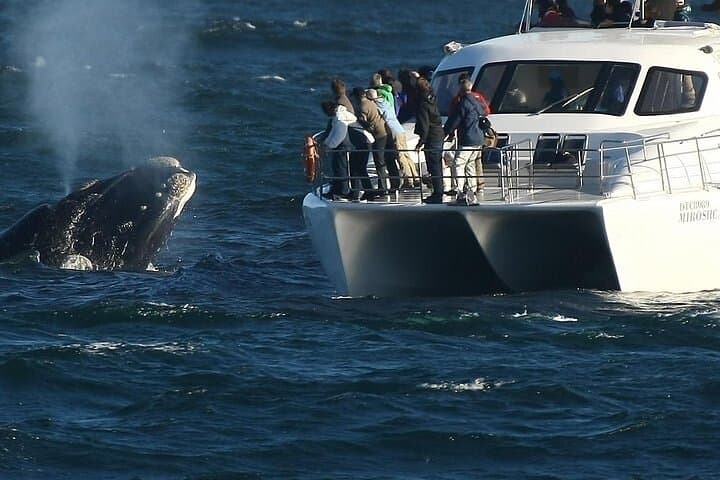


Morning mist lifts from Walker Bay as a purpose-built catamaran slips from Hermanus New Harbour, crew voices low and binoculars raised. The sea reads like a map—spouts, tail flukes and rolling backs become punctuation marks in a six‑hour search. Onboard a whale specialist interprets behavior while a videographer captures passes, and seals and dolphins often stage their own side shows between sightings.
Morning mist lifts from Walker Bay as a purpose-built catamaran slips from Hermanus New Harbour, crew voices low and binoculars raised. The sea reads like a map—spouts, tail flukes and rolling backs become punctuation marks in a six‑hour search. Onboard a whale specialist interprets behavior while a videographer captures passes, and seals and dolphins often stage their own side shows between sightings.
Hermanus's relationship with whales shifted from 19th‑century shore whaling to modern conservation and tourism; the town's steep sandstone cliffs and the glacially shaped seabed focus nutrients that attract anchovy, which in turn lure large whales. Southern right whales are the most iconic visitors here, with Bryde’s and occasional humpbacks or transient humpback pods depending on the season.
Culturally, the town celebrates sightings with land-based lookouts and an ethical watching code that limits disturbance; guides translate surface behavior into readable patterns so you understand what a breach or prolonged blow means.
Practically: arrive early for the on‑land briefing and expect crew instructions on life jackets and safe movement on deck. Dress in layered windproof clothing—the ocean can be significantly colder than shore—and bring binoculars and a telephoto lens if you want detailed photos. Seas can be choppy; sit mid‑boat to reduce motion and take preventative medication if you’re prone to nausea. Weather and whale behavior dictate proximity, so patience is part of the outing. Respect guide directions to safeguard the animals and improve everyone’s chance of a memorable encounter.