THE ADVENTURE COLLECTIVE® · Independent discovery and booking for outdoor travel

Reach Everest’s doorstep in hours rather than days: a high-altitude helicopter flight over Everest Base Camp and Kala Patthar with a landing at the Everest View Hotel. Expect guaranteed window seats, glacier-sculpted panoramas, and a brisk hotel stop at Syangboche for photography and refreshments.
Reach Everest’s doorstep in hours rather than days: a high-altitude helicopter flight over Everest Base Camp and Kala Patthar with a landing at the Everest View Hotel. Expect guaranteed window seats, glacier-sculpted panoramas, and a brisk hotel stop at Syangboche for photography and refreshments.
The morning opens in Kathmandu with the city’s dusty hum still clinging to your boots as the helicopter lifts and the valley peels away beneath you. Within an hour the plains give way to cragged ridges and a necklace of glaciers; Lhotse and Ama Dablam rise like deliberate, patient mountains, and the Khumbu Glacier threads the valley, daring you to follow its crevasses from above.
Verified experiences and guided adventures in the surrounding area.
Operated by Luxury Holidays Nepal Pvt. Ltd. · Kathmandu, Bagmati Province
The morning opens in Kathmandu with the city’s dusty hum still clinging to your boots as the helicopter lifts and the valley peels away beneath you. Within an hour the plains give way to cragged ridges and a necklace of glaciers; Lhotse and Ama Dablam rise like deliberate, patient mountains, and the Khumbu Glacier threads the valley, daring you to follow its crevasses from above.
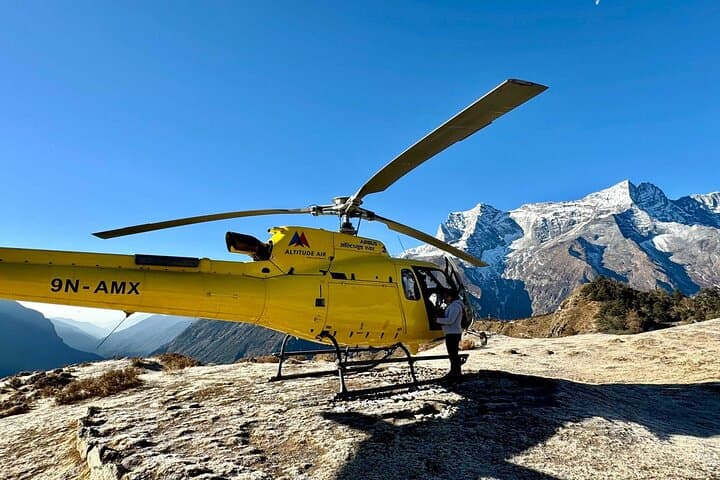
The flight skirts Everest Base Camp (5,364 m) and provides a close, airborne look at Kala Patthar (5,545 m), one of the region’s best natural viewpoints. The helicopter then touches down at Syangboche, home to the Everest View Hotel (≈3,780 m), where guests step out into thin air and broad panoramas—breakfast with Everest on the horizon is as literal as it sounds.
This landscape is the result of the Indian and Eurasian tectonic plates colliding over millions of years; human history here is recent but intense—Sherpa villages, centuries-old trade routes, and the high-stakes history of Himalayan mountaineering that culminated in the 1953 ascent of Everest.
Practical matters shape the day: pilots experienced in high-altitude rotorcraft, guaranteed window seats, and a roughly 5–6 hour round trip from Kathmandu. Weather dictates the schedule; flights can be canceled for safety. Travelers should expect light walking at the hotel stop, brisk temperatures, and rapid changes in sun and wind.
Bring warm, layered clothing, protect your camera gear from cold and glare, and allow time in Kathmandu to adjust before flying—this is an efficient, high-reward way to meet Everest without the weeks-long trek.
easy.
5–6 hours.
Suitable for travelers of average fitness; minimal walking during the hotel stop but expect thinner air and brief periods of standing.
The full experience is roughly 5–6 hours from hotel pickup in Kathmandu to return, including the landing at Everest View Hotel.
No—there’s a flyover at Everest Base Camp and Kala Patthar; the landing is at Syangboche (Everest View Hotel) where passengers disembark.
The tour is suitable for most travelers and described as physically easy, but it’s not recommended for pregnant travelers and is subject to cancellation in bad weather for safety.
Bring warm layers, sunglasses, sunscreen, and your camera; footwear should be stable for short walks on uneven ground.
The Khumbu region is Sherpa country and the modern climbing history of Everest accelerated after the 1953 summit; Lukla and Namche developed as hubs for expeditions and trade.
High-altitude tourism has prompted waste-management initiatives and permit systems—travelers should minimize single-use plastics and follow local guidelines to protect fragile alpine ecosystems.
Luxury Holidays Nepal Pvt. Ltd. operates guided outdoor trips and adventures with an emphasis on safety, stewardship, and memorable experiences.

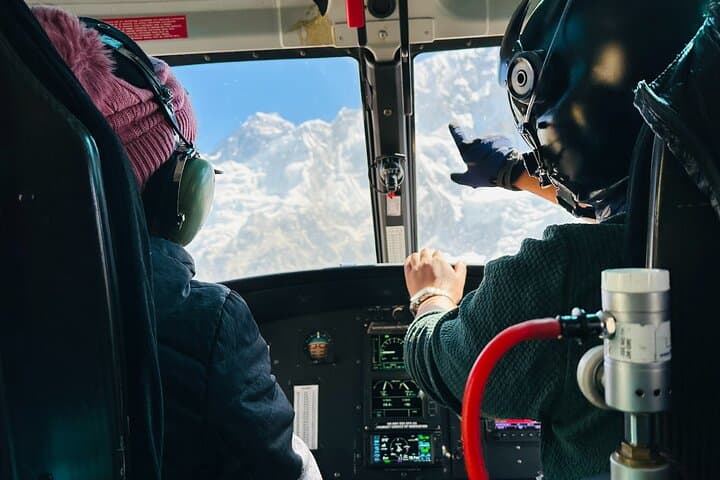

The morning opens in Kathmandu with the city’s dusty hum still clinging to your boots as the helicopter lifts and the valley peels away beneath you. Within an hour the plains give way to cragged ridges and a necklace of glaciers; Lhotse and Ama Dablam rise like deliberate, patient mountains, and the Khumbu Glacier threads the valley, daring you to follow its crevasses from above.
The morning opens in Kathmandu with the city’s dusty hum still clinging to your boots as the helicopter lifts and the valley peels away beneath you. Within an hour the plains give way to cragged ridges and a necklace of glaciers; Lhotse and Ama Dablam rise like deliberate, patient mountains, and the Khumbu Glacier threads the valley, daring you to follow its crevasses from above.
The flight skirts Everest Base Camp (5,364 m) and provides a close, airborne look at Kala Patthar (5,545 m), one of the region’s best natural viewpoints. The helicopter then touches down at Syangboche, home to the Everest View Hotel (≈3,780 m), where guests step out into thin air and broad panoramas—breakfast with Everest on the horizon is as literal as it sounds.
This landscape is the result of the Indian and Eurasian tectonic plates colliding over millions of years; human history here is recent but intense—Sherpa villages, centuries-old trade routes, and the high-stakes history of Himalayan mountaineering that culminated in the 1953 ascent of Everest.
Practical matters shape the day: pilots experienced in high-altitude rotorcraft, guaranteed window seats, and a roughly 5–6 hour round trip from Kathmandu. Weather dictates the schedule; flights can be canceled for safety. Travelers should expect light walking at the hotel stop, brisk temperatures, and rapid changes in sun and wind.
Bring warm, layered clothing, protect your camera gear from cold and glare, and allow time in Kathmandu to adjust before flying—this is an efficient, high-reward way to meet Everest without the weeks-long trek.