THE ADVENTURE COLLECTIVE® · Independent discovery and booking for outdoor travel

Walk after dark through Oxford’s oldest streets with historian-guides who read hauntings as social history. This 75-minute tour moves from graveyards to the Radcliffe Camera, pairing eerie tales with archival context.
Walk after dark through Oxford’s oldest streets with historian-guides who read hauntings as social history. This 75-minute tour moves from graveyards to the Radcliffe Camera, pairing eerie tales with archival context.
A chill from the stones meets you first — the pavement still holds the cold of centuries as the guide gathers the group beneath an iron gate.
Verified experiences and guided adventures in the surrounding area.
Operated by Uncomfortable Oxford · Oxford, Oxfordshire
A chill from the stones meets you first — the pavement still holds the cold of centuries as the guide gathers the group beneath an iron gate.
This 75-minute walking tour threads through Oxford’s oldest blocks: an atmospheric graveyard, the margins of the city centre where public executions once occurred, the shadowed approaches to the university libraries and the Radcliffe Camera, and the alleys trod by soldiers in the English Civil War. The route finishes outside one of Oxford’s most storied pubs, the kind of doorway that feels watched.
Oxford’s architecture is a record: limestone facades from the medieval period, Victorian additions and the compact street plan that sheltered communities across social and religious divides. The tour is curated by historians who interpret hauntings as echoes of gendered violence, social fracture and contested memory — the ghosts are entry points into real, sometimes uncomfortable pasts rather than jump-scares.
Expect low-light sections and narrow lanes; the guide mixes archival detail with on-site interpretation. Practicalities matter: tours run in all weather, last about 1.25 hours, and are wheelchair-accessible with gentle pacing, but some spots have uneven cobbles and low lighting.
Bring weatherproof layers, sturdy shoes, and a small torch if you rely on clearer footing. Arrive 10 minutes early to check in, respect memorial sites, and be ready for stories that fold history into place. Small groups (up to 15) make this a personal, immediate way to see how the city’s past still moves through its streets.
easy.
1–1.5 hours.
Suitable for most fitness levels; involves standing and short walks on uneven surfaces.
Yes — dogs are welcome, but they should be well-behaved and on a short lead to navigate narrow streets.
The operator lists the tour as wheelchair accessible, but some cobbled or low-lit areas may be more challenging — contact the provider if you require assistance.
Tours run in all weather; cancellations for severe conditions are rare, but you can cancel up to 24 hours in advance for a full refund.
Shared tours are capped at about 15 participants, creating an intimate setting for questions and discussion.
Oxford’s streets record medieval university growth, Civil War troop movements and long-standing community histories, including notable Jewish and academic communities.
Stick to marked paths and avoid touching stonework or memorials; support local businesses such as the finishing pub rather than leaving litter at sensitive sites.
Uncomfortable Oxford operates guided outdoor trips and adventures with an emphasis on safety, stewardship, and memorable experiences.
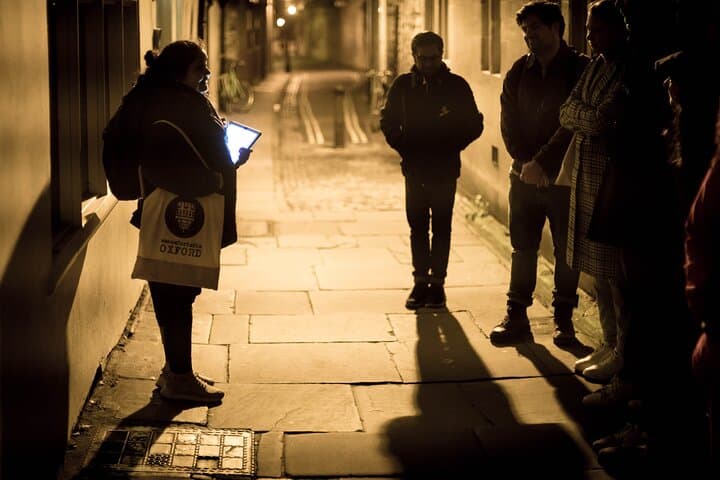

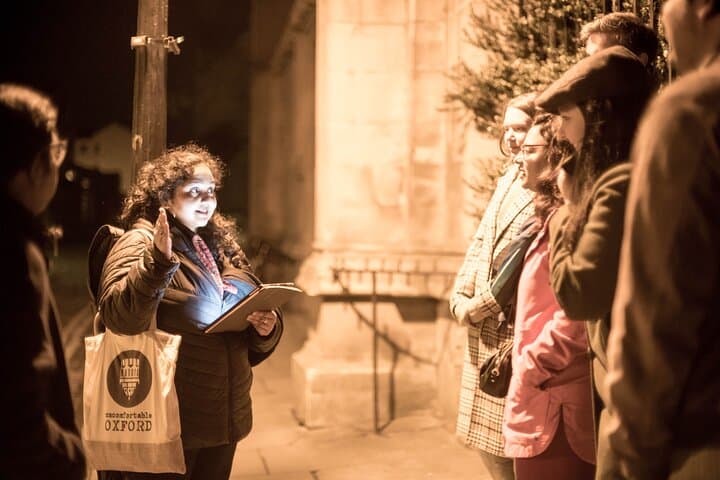

A chill from the stones meets you first — the pavement still holds the cold of centuries as the guide gathers the group beneath an iron gate.
A chill from the stones meets you first — the pavement still holds the cold of centuries as the guide gathers the group beneath an iron gate.
This 75-minute walking tour threads through Oxford’s oldest blocks: an atmospheric graveyard, the margins of the city centre where public executions once occurred, the shadowed approaches to the university libraries and the Radcliffe Camera, and the alleys trod by soldiers in the English Civil War. The route finishes outside one of Oxford’s most storied pubs, the kind of doorway that feels watched.
Oxford’s architecture is a record: limestone facades from the medieval period, Victorian additions and the compact street plan that sheltered communities across social and religious divides. The tour is curated by historians who interpret hauntings as echoes of gendered violence, social fracture and contested memory — the ghosts are entry points into real, sometimes uncomfortable pasts rather than jump-scares.
Expect low-light sections and narrow lanes; the guide mixes archival detail with on-site interpretation. Practicalities matter: tours run in all weather, last about 1.25 hours, and are wheelchair-accessible with gentle pacing, but some spots have uneven cobbles and low lighting.
Bring weatherproof layers, sturdy shoes, and a small torch if you rely on clearer footing. Arrive 10 minutes early to check in, respect memorial sites, and be ready for stories that fold history into place. Small groups (up to 15) make this a personal, immediate way to see how the city’s past still moves through its streets.