THE ADVENTURE COLLECTIVE® · Independent discovery and booking for outdoor travel

Explore Gettysburg College by lantern light on a 75-minute guided walk that mixes Civil War history with local ghost stories. Accessible and paced for most visitors, the tour highlights campus sites converted into hospitals and burial grounds after the 1863 battle.
Explore Gettysburg College by lantern light on a 75-minute guided walk that mixes Civil War history with local ghost stories. Accessible and paced for most visitors, the tour highlights campus sites converted into hospitals and burial grounds after the 1863 battle.
A late-afternoon wind moves across Gettysburg College green, tugging at fallen leaves while lantern light pools under sandstone arches. On a guided 75-minute walk, the campus sheds its daytime shape and becomes a corridor of stories: dormitory windows that later generations long remembered as witness points, a courtyard that once held temporary graves, and a hospital wing where voices from 1863 are said to linger.
Verified experiences and guided adventures in the surrounding area.
Operated by Ghosts of Gettysburg · Gettysburg, Pennsylvania
A late-afternoon wind moves across Gettysburg College green, tugging at fallen leaves while lantern light pools under sandstone arches. On a guided 75-minute walk, the campus sheds its daytime shape and becomes a corridor of stories: dormitory windows that later generations long remembered as witness points, a courtyard that once held temporary graves, and a hospital wing where voices from 1863 are said to linger.
Gettysburg’s geology — gently rolling limestone ridges carved by creeks — set the stage for the town’s decisive Civil War encounter. The college buildings bore the practical weight of that history, converted into field hospitals and burial sites in the days after the battle. Local culture treats those events with a mixture of reverence and curiosity; guides combine archival facts with oral lore to frame each apparition report.
The tour moves at a steady, accessible pace across paved paths and campus greens. Visitors hear how particular windows and stairwells became focal points for eyewitness accounts, and how memory and architecture intersect on a small college campus that doubled as a wartime landscape.
Practical tips: arrive 10–15 minutes early to the parking garage pay station where the guide meets guests in period attire with a lantern. The route is wheelchair accessible and suitable for all fitness levels, but dress for cool evenings and bring a light source for darker pathways. Photography is allowed in public spaces, but respect resident students and private areas. For anyone curious about Civil War history with a taste for evening atmosphere, this tour blends grounded history with the performative thrill of a ghost walk.
easy.
1–1.5 hours.
Suitable for most fitness levels; requires standing and walking at an easy pace for about 75 minutes.
Yes — the route is planned on paved, accessible paths and the experience is suitable for wheelchair users.
Yes — the tour is family-friendly, but content references wartime hospitals and burial sites; use discretion for young children.
Meet at the ground-floor pay station of the campus parking garage; arrive 10–15 minutes early so the guide can check in guests and begin promptly.
Tours may be canceled for severe weather; check cancellation policy and the provider’s notifications for last-minute changes.
After the July 1863 Battle of Gettysburg, many college buildings were converted to field hospitals and some campus grounds were used for temporary graves, leaving a tangible wartime imprint that informs local stories.
Visitors are asked to stay on marked paths, respect private property and student life, and avoid touching or disturbing historical markers to preserve them for future study.
Ghosts of Gettysburg operates guided outdoor trips and adventures with an emphasis on safety, stewardship, and memorable experiences.
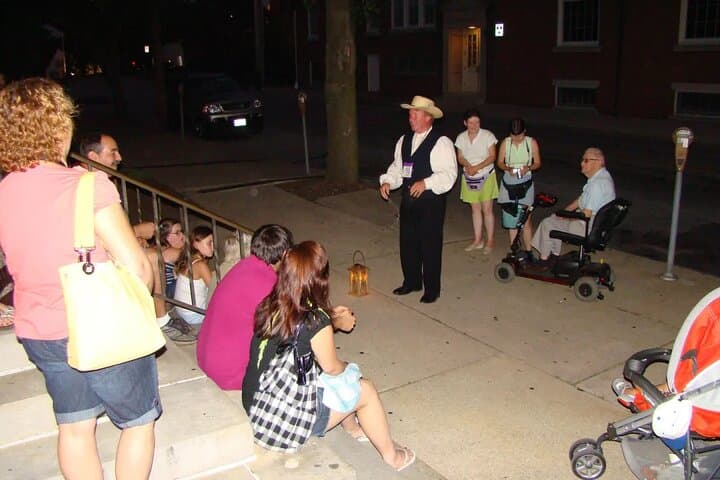



A late-afternoon wind moves across Gettysburg College green, tugging at fallen leaves while lantern light pools under sandstone arches. On a guided 75-minute walk, the campus sheds its daytime shape and becomes a corridor of stories: dormitory windows that later generations long remembered as witness points, a courtyard that once held temporary graves, and a hospital wing where voices from 1863 are said to linger.
A late-afternoon wind moves across Gettysburg College green, tugging at fallen leaves while lantern light pools under sandstone arches. On a guided 75-minute walk, the campus sheds its daytime shape and becomes a corridor of stories: dormitory windows that later generations long remembered as witness points, a courtyard that once held temporary graves, and a hospital wing where voices from 1863 are said to linger.
Gettysburg’s geology — gently rolling limestone ridges carved by creeks — set the stage for the town’s decisive Civil War encounter. The college buildings bore the practical weight of that history, converted into field hospitals and burial sites in the days after the battle. Local culture treats those events with a mixture of reverence and curiosity; guides combine archival facts with oral lore to frame each apparition report.
The tour moves at a steady, accessible pace across paved paths and campus greens. Visitors hear how particular windows and stairwells became focal points for eyewitness accounts, and how memory and architecture intersect on a small college campus that doubled as a wartime landscape.
Practical tips: arrive 10–15 minutes early to the parking garage pay station where the guide meets guests in period attire with a lantern. The route is wheelchair accessible and suitable for all fitness levels, but dress for cool evenings and bring a light source for darker pathways. Photography is allowed in public spaces, but respect resident students and private areas. For anyone curious about Civil War history with a taste for evening atmosphere, this tour blends grounded history with the performative thrill of a ghost walk.