THE ADVENTURE COLLECTIVE® · Independent discovery and booking for outdoor travel

Walk Hanover’s layered history on a guided two-hour tour from the Rathaus to Leineschloss, passing medieval alleys, classicist architecture, and the Aegidienkirche memorial. Practical tips cover timing, footwear, accessibility, and transit.
Walk Hanover’s layered history on a guided two-hour tour from the Rathaus to Leineschloss, passing medieval alleys, classicist architecture, and the Aegidienkirche memorial. Practical tips cover timing, footwear, accessibility, and transit.
A soft morning light filters down a narrow alley off Marktplatz as your guide points toward a squat dome rising over green copper—Hanover’s Neues Rathaus. The walk threads through medieval lanes, crosses the river Leine, and pauses beneath carved beams of centuries-old half-timbered houses, each facade keeping its own story.
Verified experiences and guided adventures in the surrounding area.
Operated by Hannover Tourismus · Hanover, Lower Saxony
A soft morning light filters down a narrow alley off Marktplatz as your guide points toward a squat dome rising over green copper—Hanover’s Neues Rathaus. The walk threads through medieval lanes, crosses the river Leine, and pauses beneath carved beams of centuries-old half-timbered houses, each facade keeping its own story.
This two-hour ramble moves through layers of history: a medieval merchant quarter rebuilt in the 19th century, classical façades by architect Georg Friedrich Laves, and the wartime scars visible at the Aegidienkirche ruin that now stands as a memorial. Geology is subtle here—the Leine’s low terraces shaped settlement patterns and supplied mills, while the city’s clay-rich soils influenced building materials and the distinctive timber framing.
Culture and civic life converge around Leineschloss, long the seat of regional power and now part of Lower Saxony’s institutional landscape. Along the route you’ll hear stories of trade, reconstruction after WWII, and Hanover’s steady reinvention as a university and trade fair city.
Practical guidance: wear supportive walking shoes for cobbles and occasional uneven pavement, plan morning or late-afternoon slots to avoid peak crowds, and bring a compact umbrella—weather shifts fast in northern Germany. The route is stroller- and wheelchair-accessible in main sections, but expect tighter passages in the oldest alleys. Public transit connects directly to the old town, and bilingual guides typically offer context in German and English. Stay attentive at crossings along the riverfront and leave space to photograph the city hall dome—its miniature city models reward a close look.
easy.
2 hours.
Suitable for most fitness levels; you'll be on your feet and walking at a steady urban pace for two hours.
Main sections of the tour are wheelchair- and stroller-accessible, but some older alleys have tighter passages; inform the operator of accessibility needs when booking.
Guides commonly conduct tours in German and English; check the booking for language options and request your preference.
This walking tour focuses on outdoor sights and civic landmarks; admission to museums or paid sites is typically not included.
Plan to arrive 10–15 minutes before departure to meet your guide and allow time for ticketing or transit delays.
Hanover grew from a medieval trading center into the seat of the Hanoverian court; Leineschloss has housed regional rulers and now functions within Lower Saxony’s government.
Local initiatives focus on preserving historic façades and improving riverbank ecology; visitors are asked to stick to paths and respect signage in protected spots.
Hannover Tourismus operates guided outdoor trips and adventures with an emphasis on safety, stewardship, and memorable experiences.


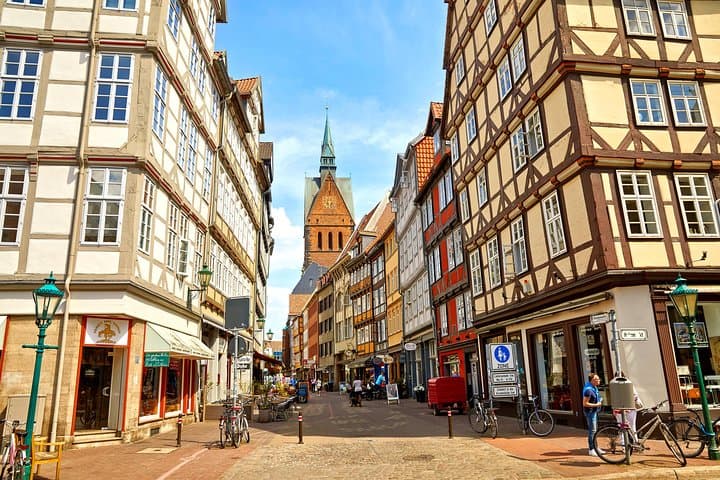
A soft morning light filters down a narrow alley off Marktplatz as your guide points toward a squat dome rising over green copper—Hanover’s Neues Rathaus. The walk threads through medieval lanes, crosses the river Leine, and pauses beneath carved beams of centuries-old half-timbered houses, each facade keeping its own story.
A soft morning light filters down a narrow alley off Marktplatz as your guide points toward a squat dome rising over green copper—Hanover’s Neues Rathaus. The walk threads through medieval lanes, crosses the river Leine, and pauses beneath carved beams of centuries-old half-timbered houses, each facade keeping its own story.
This two-hour ramble moves through layers of history: a medieval merchant quarter rebuilt in the 19th century, classical façades by architect Georg Friedrich Laves, and the wartime scars visible at the Aegidienkirche ruin that now stands as a memorial. Geology is subtle here—the Leine’s low terraces shaped settlement patterns and supplied mills, while the city’s clay-rich soils influenced building materials and the distinctive timber framing.
Culture and civic life converge around Leineschloss, long the seat of regional power and now part of Lower Saxony’s institutional landscape. Along the route you’ll hear stories of trade, reconstruction after WWII, and Hanover’s steady reinvention as a university and trade fair city.
Practical guidance: wear supportive walking shoes for cobbles and occasional uneven pavement, plan morning or late-afternoon slots to avoid peak crowds, and bring a compact umbrella—weather shifts fast in northern Germany. The route is stroller- and wheelchair-accessible in main sections, but expect tighter passages in the oldest alleys. Public transit connects directly to the old town, and bilingual guides typically offer context in German and English. Stay attentive at crossings along the riverfront and leave space to photograph the city hall dome—its miniature city models reward a close look.