THE ADVENTURE COLLECTIVE® · Independent discovery and booking for outdoor travel

Step off Hanoi’s busy streets for a five‑hour visit to Chuong and Quang Phu Cau—villages where conical hats and incense are still made by hand. Watch artisans, paint your own hat, and learn the rural techniques that supply Vietnam’s markets.
Step off Hanoi’s busy streets for a five‑hour visit to Chuong and Quang Phu Cau—villages where conical hats and incense are still made by hand. Watch artisans, paint your own hat, and learn the rural techniques that supply Vietnam’s markets.
You leave the Old Quarter’s racket behind and, within 30–40 minutes, find yourself on a narrow village lane where bamboo racks lean like scaffolds and the air is threaded with drying straw and spice-sweet smoke.
Verified experiences and guided adventures in the surrounding area.
Operated by Vinadu · Hanoi, Hanoi
You leave the Old Quarter’s racket behind and, within 30–40 minutes, find yourself on a narrow village lane where bamboo racks lean like scaffolds and the air is threaded with drying straw and spice-sweet smoke.
Chuong Village has practiced conical hat (non la) making for about 300 years; Quang Phu Cau’s incense craft evolved alongside the Red River Delta’s rice economy, turning agricultural byproducts into fragrant sticks. Geologically the area sits on alluvial plain—flat fields that feed villages and give artisans easy access to bamboo, palm, and natural dyes.
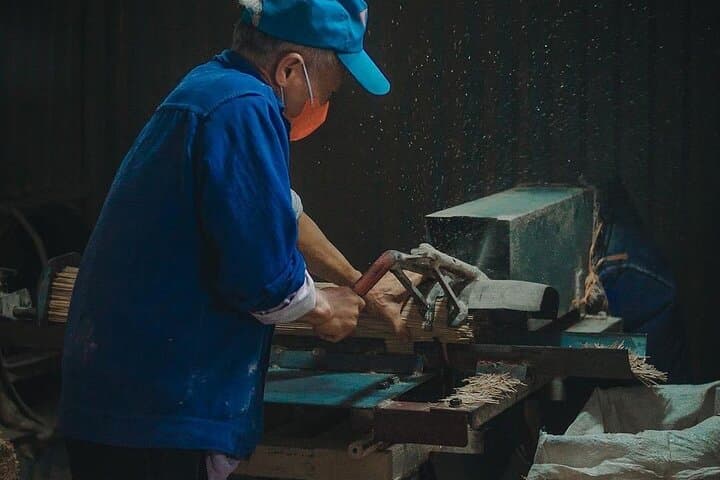
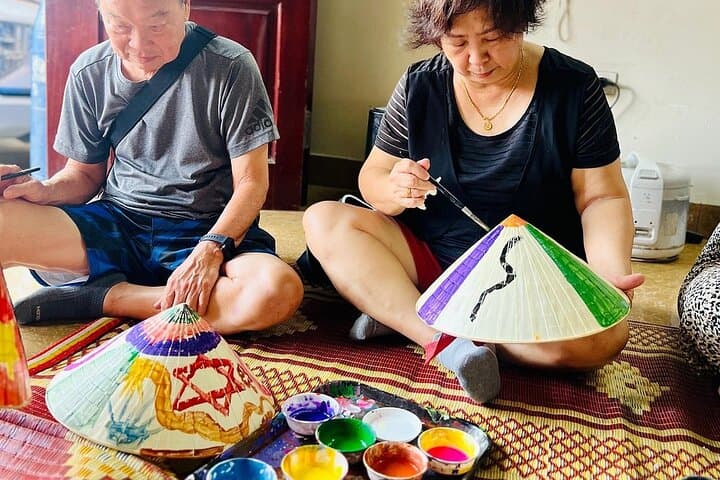
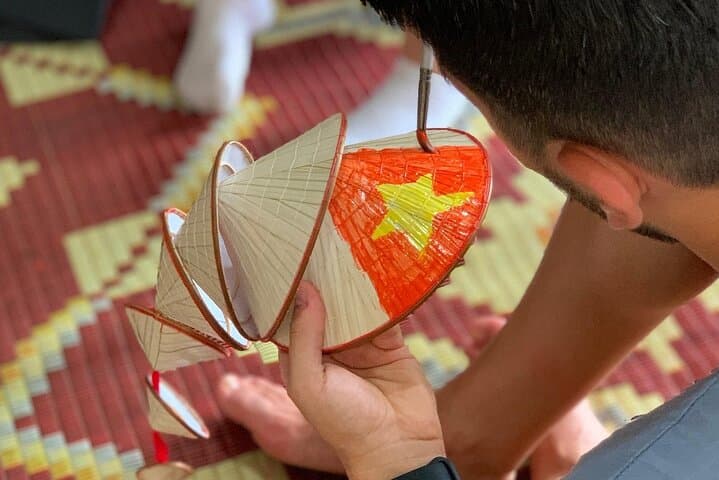
In both places production is domestic and artisanal: family workshops, low benches, and tools tuned by generations. Expect lively demonstrations—splitting bamboo ribs, stitching palm leaves, dipping and dyeing incense bundles—and time to paint your own hat with local pigments. Photography is excellent: saturated dye houses, drying racks, and rhythmic hands moving through repetitive craft.
Practical guidance: this is a half-day outing (≈5 hours total) with pick-up in Hanoi Old Quarter. Wear closed-toe shoes for compacted dirt lanes and bring cash for small purchases; the tour includes a bottle of water and one conical hat per person. Morning departures are cooler and better for photos; afternoons can be humid during summer. The walking is gentle but uneven—good for most fitness levels. Respect working families by asking before photographing close-up and buy directly from artisans to support livelihoods. With modest preparation you’ll return to the city with a painted hat, new craft skills, and a clearer sense of how everyday Vietnamese objects are still made by hand.
easy.
5 hours.
Light walking on flat but uneven village lanes; suitable for most fitness levels
The tour is approximately 5 hours with morning (around 7:30–8:00) and afternoon (around 12:00–12:30) pick-ups from the Hanoi Old Quarter.
Yes—hotel or private address pickup and drop-off in Hanoi Old Quarter are included in the tour price.
Yes—part of the itinerary includes painting and assembling a conical hat under artisan guidance; one hat is provided per person to take home.
The tour is listed as suitable for all fitness levels; however, village lanes are uneven—travelers with limited mobility should contact the operator to discuss accessibility and pickup logistics.
Conical hats and incense have deep local roots: hat-making in Chuong Village spans centuries, while Quang Phu Cau developed as a specialized incense center supplying temples and households across northern Vietnam.
Support local craftsmanship by buying directly from families and avoid single-use plastics; the villages are small and tourism impact is managed best through respectful, small-group visits.
Vinadu operates guided outdoor trips and adventures with an emphasis on safety, stewardship, and memorable experiences.

You leave the Old Quarter’s racket behind and, within 30–40 minutes, find yourself on a narrow village lane where bamboo racks lean like scaffolds and the air is threaded with drying straw and spice-sweet smoke.
You leave the Old Quarter’s racket behind and, within 30–40 minutes, find yourself on a narrow village lane where bamboo racks lean like scaffolds and the air is threaded with drying straw and spice-sweet smoke.
Chuong Village has practiced conical hat (non la) making for about 300 years; Quang Phu Cau’s incense craft evolved alongside the Red River Delta’s rice economy, turning agricultural byproducts into fragrant sticks. Geologically the area sits on alluvial plain—flat fields that feed villages and give artisans easy access to bamboo, palm, and natural dyes.
In both places production is domestic and artisanal: family workshops, low benches, and tools tuned by generations. Expect lively demonstrations—splitting bamboo ribs, stitching palm leaves, dipping and dyeing incense bundles—and time to paint your own hat with local pigments. Photography is excellent: saturated dye houses, drying racks, and rhythmic hands moving through repetitive craft.
Practical guidance: this is a half-day outing (≈5 hours total) with pick-up in Hanoi Old Quarter. Wear closed-toe shoes for compacted dirt lanes and bring cash for small purchases; the tour includes a bottle of water and one conical hat per person. Morning departures are cooler and better for photos; afternoons can be humid during summer. The walking is gentle but uneven—good for most fitness levels. Respect working families by asking before photographing close-up and buy directly from artisans to support livelihoods. With modest preparation you’ll return to the city with a painted hat, new craft skills, and a clearer sense of how everyday Vietnamese objects are still made by hand.