THE ADVENTURE COLLECTIVE® · Independent discovery and booking for outdoor travel

Spend a focused half‑day exploring Villa d'Este's famed Renaissance fountains and terraces, reached by private transfer from Rome. This compact tour combines transport, local insights and admission to one of Tivoli's UNESCO masterpieces.
Spend a focused half‑day exploring Villa d'Este's famed Renaissance fountains and terraces, reached by private transfer from Rome. This compact tour combines transport, local insights and admission to one of Tivoli's UNESCO masterpieces.
You step out of the air‑conditioned van and the sound of water arrives first — fountains and channels trading whispers across terraces — guiding you toward Villa d'Este's main parterre.
Verified experiences and guided adventures in the surrounding area.
Operated by Fast Travel Services · Tivoli, Lazio
You step out of the air‑conditioned van and the sound of water arrives first — fountains and channels trading whispers across terraces — guiding you toward Villa d'Este's main parterre.
The sixteenth‑century villa is a practical marvel as much as a garden: cascades, nymphaea and hydraulic music plumbing engineered from local springs and ancient Roman aqueducts. Before the Renaissance gardens, the wider Tivoli landscape tells an older story — Hadrian’s Villa (Villa Adriana) lies nearby, a sprawling archaeological complex that marks Rome’s imperial reach across stone and hill.
Tivoli sits where the Apennines give way to limestone ravines carved by the Aniene river; those ravines shape the dramatic drops and grottoes that make the gardens perform. Culturally, Tivoli was a stop on the Grand Tour, attracting poets, painters and architects who took the place as a practical classroom of ancient engineering and Renaissance taste. Villa d'Este and Villa Adriana are both UNESCO sites, preserved through tourism and careful local stewardship.
Practical guidance: the half‑day tour typically includes private roundtrip pickup from Rome and Villa d'Este admission; expect 4–5 hours total. Wear sturdy walking shoes — paths are paved but uneven — and carry water and sun protection in summer. Mornings are cooler and less crowded; check museum hours (Villa d'Este closes Monday mornings). Accessibility is good in many areas, but some terraces involve steps. Bring a small camera and allow time to sit by a fountain: the water does more than decorate — it measures the place and sets the pace.
easy.
4–5 hours.
Suitable for travelers in normal physical condition; involves moderate walking and some steps.
Yes — the tour offers private roundtrip transport from your Rome accommodation as listed at booking.
Admission to Villa d'Este is included on this half‑day tour; confirm whether other sites (like Villa Adriana) are part of your specific booking.
Many main areas and pathways at Villa d'Este are wheelchair accessible, and the operator lists wheelchair‑friendly transport — contact them for specific access details.
This half‑day product focuses on Villa d'Este; visiting Villa Adriana usually requires more time or a separate excursion—check multi‑site options if you want both.
Tivoli has ancient roots predating Rome; Villa Adriana (Hadrian’s Villa) reflects 2nd‑century imperial architecture while Villa d'Este showcases 16th‑century Renaissance garden engineering.
Both villas are UNESCO protected and local conservation focuses on water management, visitor flow control and preservation of original stonework and hydraulic systems.
Fast Travel Services operates guided outdoor trips and adventures with an emphasis on safety, stewardship, and memorable experiences.
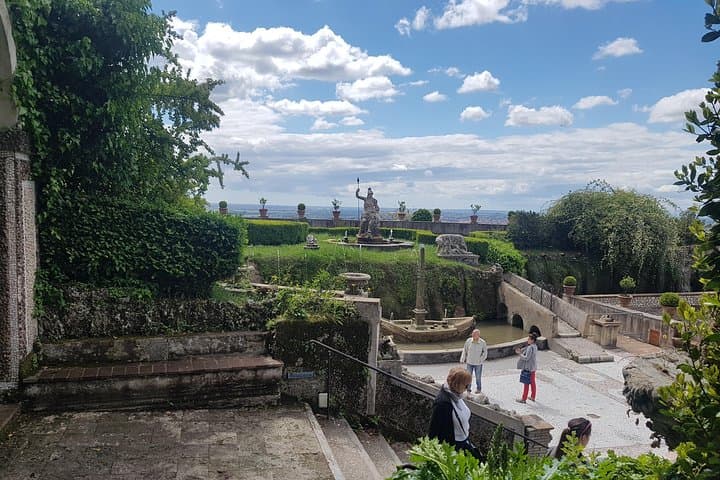


You step out of the air‑conditioned van and the sound of water arrives first — fountains and channels trading whispers across terraces — guiding you toward Villa d'Este's main parterre.
You step out of the air‑conditioned van and the sound of water arrives first — fountains and channels trading whispers across terraces — guiding you toward Villa d'Este's main parterre.
The sixteenth‑century villa is a practical marvel as much as a garden: cascades, nymphaea and hydraulic music plumbing engineered from local springs and ancient Roman aqueducts. Before the Renaissance gardens, the wider Tivoli landscape tells an older story — Hadrian’s Villa (Villa Adriana) lies nearby, a sprawling archaeological complex that marks Rome’s imperial reach across stone and hill.
Tivoli sits where the Apennines give way to limestone ravines carved by the Aniene river; those ravines shape the dramatic drops and grottoes that make the gardens perform. Culturally, Tivoli was a stop on the Grand Tour, attracting poets, painters and architects who took the place as a practical classroom of ancient engineering and Renaissance taste. Villa d'Este and Villa Adriana are both UNESCO sites, preserved through tourism and careful local stewardship.
Practical guidance: the half‑day tour typically includes private roundtrip pickup from Rome and Villa d'Este admission; expect 4–5 hours total. Wear sturdy walking shoes — paths are paved but uneven — and carry water and sun protection in summer. Mornings are cooler and less crowded; check museum hours (Villa d'Este closes Monday mornings). Accessibility is good in many areas, but some terraces involve steps. Bring a small camera and allow time to sit by a fountain: the water does more than decorate — it measures the place and sets the pace.