THE ADVENTURE COLLECTIVE® · Independent discovery and booking for outdoor travel

Step out from historic Kennecott onto the Root Glacier for a guided half‑day hike across white ice, moulins and blue pools. Expect interpretive history, glacier science, and close-up views of the Stairway Icefall on this five‑hour outing.
Step out from historic Kennecott onto the Root Glacier for a guided half‑day hike across white ice, moulins and blue pools. Expect interpretive history, glacier science, and close-up views of the Stairway Icefall on this five‑hour outing.
The trail opens with the rattle of gravel underboots and a breath of cold air that smells faintly of metal and ice. Walk past rusting corrugated roofs of historic Kennecott and the guide pauses, pointing to the stair-step of the Stairway Icefall where the glacier peels and shifts like a living thing. Blue pools wink from crevasses; moulins spin water into vertical wells. The Root Glacier demands attention — its white ice pushes forward, cracking and reforming underfoot.
Verified experiences and guided adventures in the surrounding area.
Operated by McCarthy River Tours · McCarthy, Alaska
The trail opens with the rattle of gravel underboots and a breath of cold air that smells faintly of metal and ice. Walk past rusting corrugated roofs of historic Kennecott and the guide pauses, pointing to the stair-step of the Stairway Icefall where the glacier peels and shifts like a living thing. Blue pools wink from crevasses; moulins spin water into vertical wells. The Root Glacier demands attention — its white ice pushes forward, cracking and reforming underfoot.
This route threads together human and geological stories. Kennecott’s early 20th‑century copper mines left a compact industrial village that sits against the vast Wrangell Mountains. Geologically, the glacier is a river of ice carved from alpine snowfields, exposing moraines, seracs and melt channels that reveal how the landscape has evolved through repeated advances and retreats.
Locals favor a slow rhythm: learn the mining history near the mill buildings, taste wild Alaska berries along the trail, and look for ptarmigan and Dall sheep on the ridges. Guides bring crampons and glaciology knowledge; their interpretation turns the hike into a short field course on moving ice.
Practical guidance: the full excursion runs about five hours, including a two‑mile approach from Kennecott to the ice. Expect uneven terrain, cold wind, and bright glare — layers, gloves and sturdy boots are essential. Bring water, sunscreen and a camera with extra batteries. The trip operates in variable weather; book with a certified guide, follow their safety briefings, and be prepared to move deliberately across crevassed ice.
moderate.
5 hours.
Participants should have a moderate level of fitness—able to hike 2 miles on uneven terrain and stand on ice with crampons for extended periods.
Minimum age is 8 years; children must be accompanied by an adult and assessed for comfort on icy terrain.
No prior glacier experience is required—guides provide crampon instruction and route management, but participants should be steady on their feet.
Operators run in varied weather; guides evaluate conditions and will alter plans for safety, but all sales are final so confirm details before booking.
Most guests stay in McCarthy; the operator’s office on the west side of the Kennicott River is the meeting point and there’s private transportation from McCarthy to Kennecott.
Kennecott was a booming early 20th‑century copper mining camp built to process some of the richest copper ore discovered, leaving an intact industrial village against the glacier.
Glacier retreat is visible year to year—practice Leave No Trace, avoid disturbing meltwater channels, and support local operators who follow minimal‑impact procedures.
McCarthy River Tours operates guided outdoor trips and adventures with an emphasis on safety, stewardship, and memorable experiences.

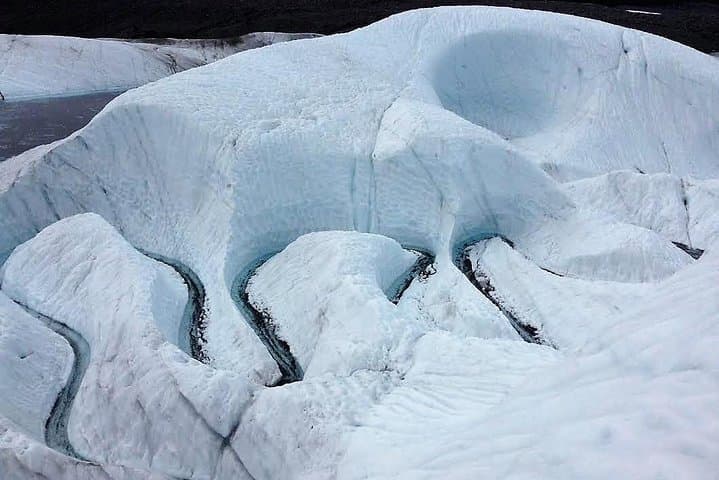


The trail opens with the rattle of gravel underboots and a breath of cold air that smells faintly of metal and ice. Walk past rusting corrugated roofs of historic Kennecott and the guide pauses, pointing to the stair-step of the Stairway Icefall where the glacier peels and shifts like a living thing. Blue pools wink from crevasses; moulins spin water into vertical wells. The Root Glacier demands attention — its white ice pushes forward, cracking and reforming underfoot.
The trail opens with the rattle of gravel underboots and a breath of cold air that smells faintly of metal and ice. Walk past rusting corrugated roofs of historic Kennecott and the guide pauses, pointing to the stair-step of the Stairway Icefall where the glacier peels and shifts like a living thing. Blue pools wink from crevasses; moulins spin water into vertical wells. The Root Glacier demands attention — its white ice pushes forward, cracking and reforming underfoot.
This route threads together human and geological stories. Kennecott’s early 20th‑century copper mines left a compact industrial village that sits against the vast Wrangell Mountains. Geologically, the glacier is a river of ice carved from alpine snowfields, exposing moraines, seracs and melt channels that reveal how the landscape has evolved through repeated advances and retreats.
Locals favor a slow rhythm: learn the mining history near the mill buildings, taste wild Alaska berries along the trail, and look for ptarmigan and Dall sheep on the ridges. Guides bring crampons and glaciology knowledge; their interpretation turns the hike into a short field course on moving ice.
Practical guidance: the full excursion runs about five hours, including a two‑mile approach from Kennecott to the ice. Expect uneven terrain, cold wind, and bright glare — layers, gloves and sturdy boots are essential. Bring water, sunscreen and a camera with extra batteries. The trip operates in variable weather; book with a certified guide, follow their safety briefings, and be prepared to move deliberately across crevassed ice.